A humanoid robot autonomously moving 60 totes per hour across a live factory floor-for more than eight uninterrupted hours-would have been dismissed as speculative just three years ago. As of January 2026, it is a documented proof of concept. The Siemens and Humanoid trial at the Electronics Factory in Erlangen, Germany, marks a pivotal transition: humanoid robotics in industrial logistics has moved from controlled demonstration to measurable operational performance.
For plant managers and operations directors weighing their next automation investment cycle, the Erlangen results demand attention-not as grounds for immediate capital commitment, but as a calibration point for what is now technically achievable and what stands between current pilot results and production-scale deployment.
The Erlangen Proof of Concept: What Actually Happened
Humanoid, a UK-based AI and robotics company, and Siemens completed a proof of concept (POC) demonstrating humanoid robots in industrial logistics. Humanoid's HMND 01 wheeled Alpha robot was deployed in real operations at a Siemens facility, marking a significant step toward broader industrial adoption.
The project proceeded in two distinct phases. The initial phase focused on in-house development and testing, during which the Humanoid team created a physical twin of the work environment. This enabled rapid iteration, system optimization, and validation of core capabilities before live deployment. The second phase involved a two-week on-site trial at the Siemens Electronics Factory, where the robot operated within an active production environment.
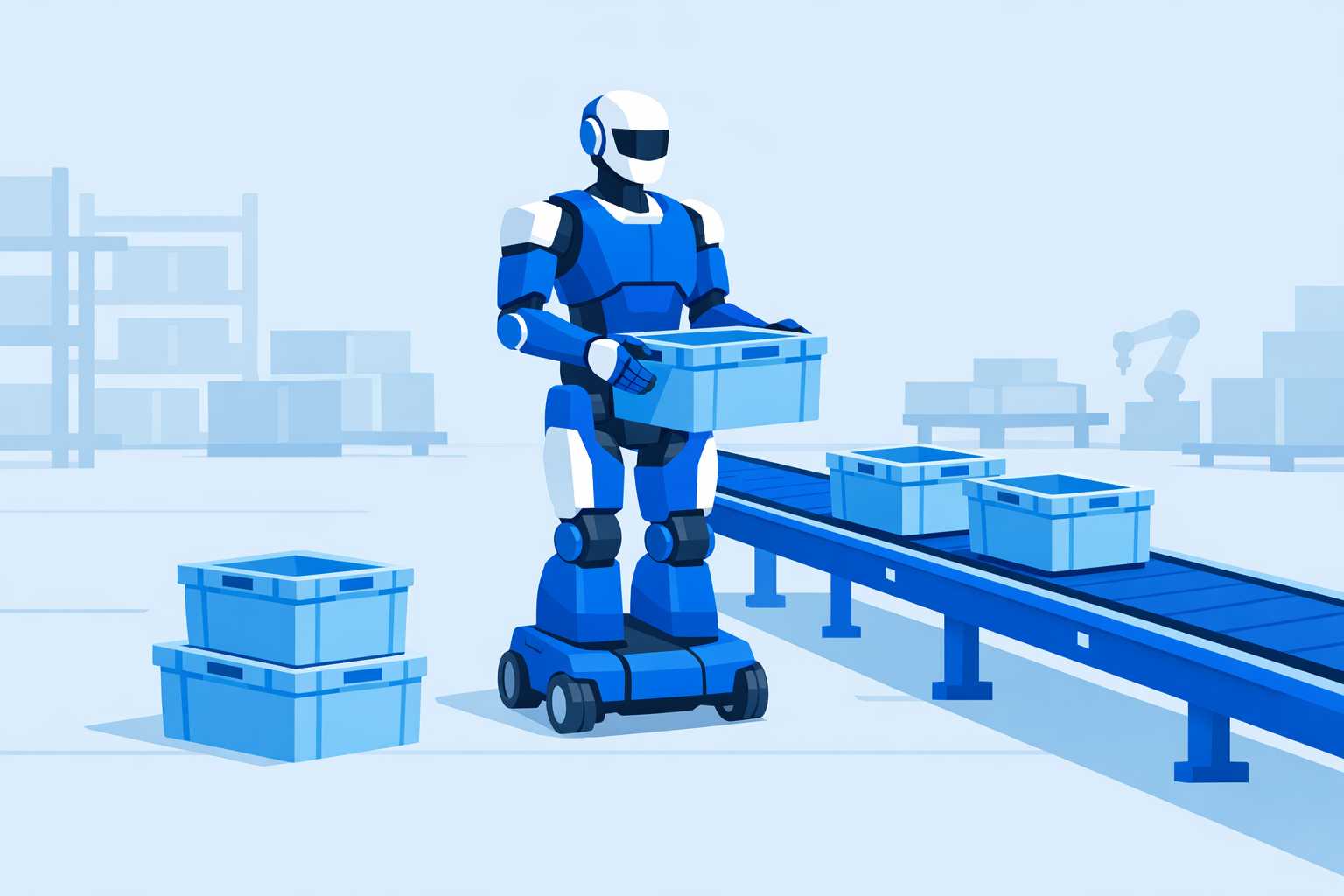
The POC targeted a tote-to-conveyor destacking task within Siemens' logistics process. The robot autonomously picked totes from a storage stack, transported them to a conveyor, and placed them at the designated pickup point for human operators.
Performance Metrics
All six target performance metrics were met in full during the two-week live trial. Targets included throughput of 60 tote moves per hour, operation with two different tote sizes, continuous autonomous task execution exceeding 30 minutes, uptime beyond 8 hours, and both overall and autonomous pick-and-place success rates above 90%.
| Performance Metric | Target | Result |
|---|---|---|
| Throughput | 60 tote moves/hour | ✅ Met |
| Autonomous pick-and-place success rate | >90% | ✅ Met |
| Overall pick-and-place success rate | >90% | ✅ Met |
| Continuous autonomous task execution | >30 minutes | ✅ Met |
| Uptime (continuous operation) | >8 hours | ✅ Met |
| Tote size variants handled | 2 sizes | ✅ Met |
The Technology Stack: Physical AI Meets Industrial Infrastructure
The Erlangen deployment was not a single-vendor effort. Its architecture reflects the multi-layer integration that any realistic industrial humanoid deployment will require.
The Robot Hardware
Humanoid developed the HMND 01 Alpha specifically for industrial applications, combining an omnidirectional wheeled base with advanced manipulation capability and a proprietary AI decision-making system. The robot stands 220 cm tall, achieves wheeled speeds up to 7.2 km/h, carries a 15 kg payload to 2 m high, and features 29 active degrees of freedom. It includes interchangeable hands-five-finger hands or parallel grippers-alongside 360° RGB and dual depth sensors.
By employing simulation-driven design using NVIDIA's toolchain, the development team reduced the typical robotics hardware development period from 18-24 months to seven months. Engineers designed and tested the robot using NVIDIA's AI stack, including Jetson Thor for edge computing, Isaac Sim for simulation, and Isaac Lab for reinforcement learning-based action training.
The Industrial Integration Backbone
The robot's raw performance is only half the story. Siemens incorporated the robot into its production processes through the Xcelerator platform, which provides a digital twin, integrated AI perception, and real-time control interfaces for factory systems. This allows the robot to coordinate logistics tasks alongside human staff and other automation while maintaining synchronized workflows and data exchange across the facility.
The Xcelerator portfolio enables real-time data exchange with production systems and autonomous guided vehicles (AGVs), synchronized workflows with machinery and human operators, and adaptive behavior responding dynamically to changing conditions. The portfolio spans a comprehensive digital twin, AI-enabled perception, integrated control and PLC-robot interfaces, fleet management, industrial communication networks, and high-performance drives.
This is a critical architectural insight for operations decision-makers: the robot is not the integration challenge-the OT/IT bridge is. Organizations that have invested in mature digital infrastructure and flexible automation platforms will hold a structural head start in humanoid deployment readiness.
Beyond Erlangen: The Broader Deployment Landscape
The Siemens trial is one data point in a rapidly expanding set. Humanoid robots in logistics are gaining traction across multiple industries simultaneously.
- Agility Robotics announced that its bipedal humanoid robot Digit had moved more than 100,000 totes in a commercial environment-at a GXO Logistics facility in Flowery Branch, Georgia-before confirming plans to deploy Digit robots in San Antonio, Texas, to handle fulfillment operations for e-commerce platform Mercado Libre.
- Humanoid's HMND 01 Alpha Wheeled model has also completed a proof of concept with Schaeffler to pick metallic bearing rings in a near-production environment, demonstrating adaptability across different form factors.
- At CES 2025, Hyundai Motor Group announced plans to develop a scalable system capable of deploying up to 30,000 humanoid robots per year by 2028, targeting automation of repetitive tasks across its factories.
Automakers are equally active. As covered in Renault's plans to deploy 350 humanoid robots by 2027, the automotive sector is moving toward phased commitments at scale-a pattern logistics operators are now beginning to replicate.
By 2030, warehousing and logistics deployments are projected to represent 25% of total humanoid robotics installations globally, driven by advances in embodied AI and manipulation. Their value lies specifically in addressing the "flexible picking" gap-a major bottleneck in modern logistics caused by small-batch, multi-SKU operations requiring frequent changeovers and exception handling that traditional automation cannot manage.
Deployment Economics: Where the Numbers Stand
Honest ROI analysis is essential for capital planning. The economics of humanoid deployment in logistics remain at an early, high-uncertainty stage.
Growth rates across multiple forecasts range from 38-49% annually, and IDTechEx projects the humanoid robot market to reach approximately US$30 billion by 2035. However, current per-unit costs present a significant hurdle. Chinese manufacturers offer robots at $5,900-$13,560, versus Western platforms at $20,000 and above, creating a competitive cost dynamic that will shape procurement decisions.
The RaaS Model as a Near-Term On-Ramp
Humanoid is pursuing a robots-as-a-service (RaaS) model, which fits warehouse automation realities by converting upfront capital expenditure into operational expenditure-a structure familiar to operators who have adopted AMR-as-a-service arrangements. For facilities unable to absorb long payback windows, RaaS structures merit serious evaluation.
Depending on deployment scale, ROI for logistics robotics typically falls between 12 and 36 months. High-volume warehouses running multiple shifts regularly recover costs on the shorter end, but smaller operations may take longer.
Battery Endurance: The Operational Constraint
Battery performance is improving, but slowly. Most humanoids today operate for only about two hours under full bipedal load, and achieving a full eight-hour shift without recharging could take up to 10 years as energy density improves. Until then, operators will need to rely on innovations such as swappable batteries and fast charging, or limit operations to environments where robots can remain continuously plugged in. The HMND 01 Alpha's wheeled platform-which avoids the energy demands of bipedal locomotion-achieved 8-hour uptime specifically because it sidesteps this constraint.
Scalability Challenges: From One Robot to a Fleet
Passing a two-week proof of concept and deploying a fleet of 20+ robots across a distribution center are separated by operational gaps that trial conditions rarely expose.
OT/IT Ecosystem Interoperability
Humanoid robots must communicate with warehouse management systems (WMS), manufacturing execution systems (MES), and existing automated fleets-all of which operate on different communication protocols. Real-time data exchange with production systems and other AGVs, synchronized workflows, and adaptive behavior responding dynamically to changing conditions cannot be assumed; they must be engineered into each site-specific integration.
For operations teams managing AI cobots and broader automation stacks, the message is consistent: the bottleneck is rarely the robot-it is the data plumbing.
Task Diversity and the "Autonomy Gap"
Most humanoid robots today remain in pilot phases, heavily dependent on human input for navigation, dexterity, or task switching. This "autonomy gap" is real: current demonstrations often mask technical constraints through staged environments or remote supervision.
Over the next three years, the first commercial applications will emerge from semi-structured tasks such as tote picking, palletizing, or line feeding inside durable goods factories, warehouses, and transportation settings-where humanoids can leverage existing automation infrastructure and workflows. Operations managers should be skeptical of vendor claims about general-purpose deployment outside this narrow task profile.
Greenfield vs. Brownfield
A key differentiator for humanoid robots over conventional fixed automation is their compatibility with existing facility layouts. Past automation solutions required rethinking how factories and warehouses are built (greenfield); a legged humanoid can be operational in minimal time with minimal changes to the existing landscape (brownfield). This matters enormously for established distribution centers where capital infrastructure cannot easily be altered.
Safety, Ergonomics, and the Regulatory Gap
Safety compliance for humanoid robots in shared workspaces is an evolving and incomplete framework-a fact that operations and EHS managers must understand before signing any deployment agreement.
Humanoid robot safety in 2026 centers on established and emerging frameworks: ISO 10218:2025 certifies collaborative applications (not just hardware), while ANSI/A3 R15.06-2025 provides the U.S. national standard for industrial robot safety.
The gap specific to mobile humanoids is significant. ISO 25785-1, currently under development, will establish safety requirements for dynamically stable robots-machines that require active balance control to remain upright. Traditional robot arms bolt to the floor; humanoid robots walk, introducing fall risk. As of January 2026, ISO 25785-1 remains a Working Draft.
The regulatory shift is from hardware to application: purchasing a safe robot is step one, but certifying a safe deployment is step two. Most violations occur in step two.
Practical Safety Considerations for Plant Operators:
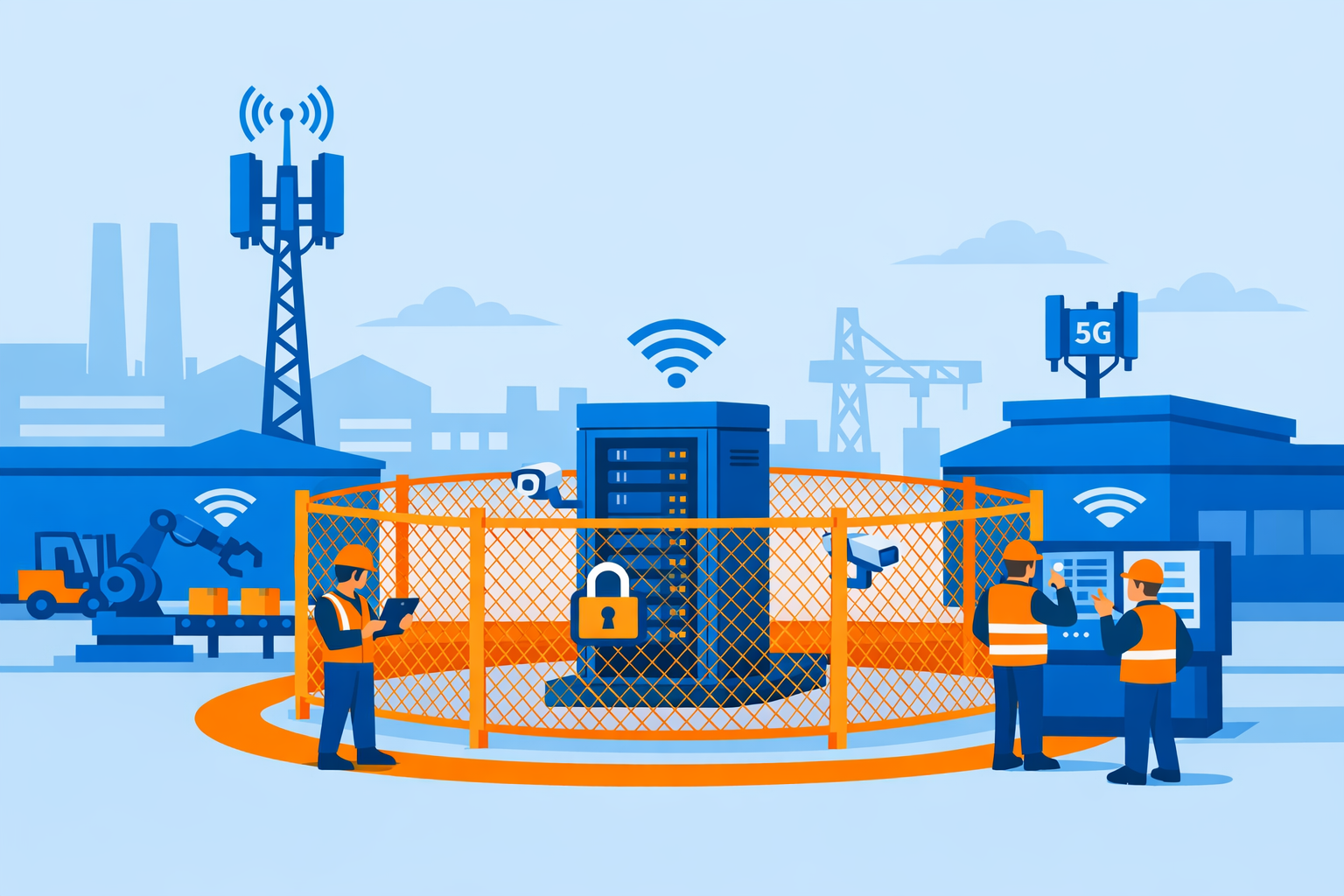
- Initial deployments typically start in segregated zones before expanding to fully shared spaces.
- Speed and Separation Monitoring (SSM) is the most common mitigation; the robot slows or stops when a human enters a defined zone. ISO 10218-2:2025 requires SSM systems to account for both robot and human speed.
- Compliance extends beyond selecting a "safe" robot-it requires application-specific risk assessments, validated safety functions, and ongoing reviews as processes change.
- Workers facing ergonomic injury risk from repetitive handling tasks-the very use case humanoids target-represent both a workforce protection opportunity and a compliance milestone.
What Operations Teams Should Do Now
The Siemens Erlangen trial confirms that humanoid robots are no longer speculative technology for industrial logistics. They are pre-commercial technology with demonstrated performance on narrow, well-defined tasks. The question is not whether to engage-it is how to engage at the right scope and sequence.
Near-Term Actions (0-12 months):
- Identify 2-3 candidate tasks characterized by repetitiveness, ergonomic strain, and defined pick-and-place geometry. Tote destacking, line feeding, and container movement are the most validated starting points.
- Audit OT/IT infrastructure readiness: WMS/MES interoperability, PLC-robot communication protocols, and digital twin maturity are preconditions, not afterthoughts.
- Engage vendors on RaaS commercial structures to limit capital exposure during the pilot phase.
- Begin application-level safety planning under ISO 10218-2:2025 now, rather than at deployment time.
Medium-Term Positioning (12-36 months):
- Structure pilots with explicit performance benchmarks-throughput, uptime, pick success rate-mirroring the Siemens POC model.
- Plan for fleet management infrastructure from the outset; single-robot trials rarely surface the coordination complexity of 10+ unit deployments.
- Monitor ISO 25785-1 development closely; facility safety protocols may need revision as the standard finalizes.
Commercial success will hinge on ecosystem readiness. Companies that pilot early, invest in infrastructure, and build workforce trust will be well positioned when the technology matures. The Erlangen trial has moved that readiness horizon meaningfully closer.
FAQ: Humanoid Robots in Logistics and Warehousing
What tasks are humanoid robots best suited for in warehouses today? The strongest current use cases are semi-structured material handling tasks: tote destacking, tote-to-conveyor transfer, line feeding, and bin handling. Tasks such as warehouse sorting or tray delivery can be executed with current levels of mechanical reach and grip. Fine assembly and sub-centimeter pick operations remain beyond the capability of current platforms.
How does a humanoid robot integrate with existing WMS and automation infrastructure? A humanoid robot's value lies in becoming a fully integrated, collaborative asset on the shop floor-requiring real-time data exchange with production systems and other AGVs, synchronized workflows with machinery and human operators, and adaptive behavior responding dynamically to changing conditions. Integration complexity scales with the maturity of the existing OT/IT stack.
What are the primary safety standards governing humanoid robot deployment? The current framework centers on ISO 10218:2025 for collaborative applications and ANSI/A3 R15.06-2025 for U.S. industrial robot safety. ISO 25785-1-which will govern dynamically stable (walking) robots-remains a Working Draft as of January 2026.
How long does a typical humanoid robot pilot take? A typical pilot takes 8-16 weeks from site survey to production use, including facility mapping (1-2 weeks), WMS integration (2-4 weeks), safety validation (2-3 weeks), and operator training (1 week). Full-scale rollout after a successful pilot usually requires an additional 3-6 months depending on fleet size and facility count.
Will humanoid robots replace warehouse workers? The design intent, as stated by Humanoid's development team, centers on augmenting capabilities and freeing individuals for more fulfilling work rather than replacing human workers. In practice, most initial deployments frame humanoid robots as labor-shortage solutions for dull, dirty, or dangerous jobs-including unloading containers, moving heavy bins, night-shift logistics, and high-heat or cramped zones.