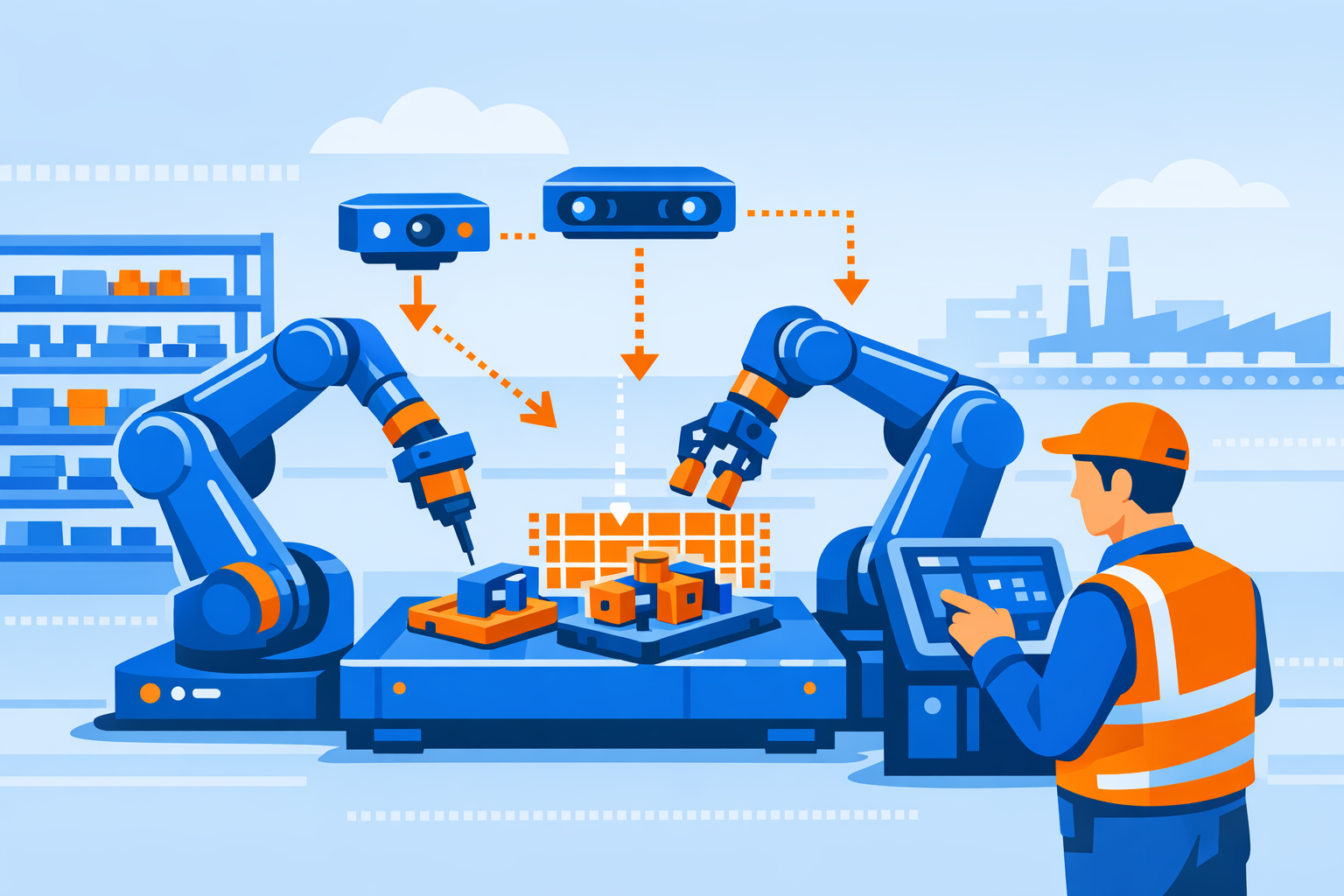
Manufacturers are increasingly implementing AI-driven perception systems, adaptive control, and flexible tooling to automate high-variability production environments. Advances in 3D vision and physical AI enable robotic systems to adjust dynamically to diverse parts and assembly conditions, supporting greater customization and productivity. Research frameworks and pilot deployments in various industries demonstrate practical integration with human-robot collaboration, indicating a shift from fixed automation to agile, intelligent assembly.
Background
High-mix, low-volume manufacturing poses challenges for traditional automation due to frequent changeovers and product variation. AI systems featuring machine vision, force detection, and modular tooling now provide real-time adaptation strategies. Industry reports indicate that over 20% of manufacturers plan to adopt "physical AI"-robots capable of autonomously sorting, transporting, or installing parts-within two years, signaling increased adoption of flexible automation[1]. In parallel, 3D vision pipelines have become central to agile manufacturing, allowing robots to perceive spatial geometry and manage variability without custom fixtures[2].
Details
Recent academic research highlights advances in adaptive assembly. The CoViLLM framework integrates depth-camera localization, operator categorization, and large language models (LLMs) to generate task plans for previously unseen or customized products, expanding the scope of human-robot collaboration[3]. The RoCo Challenge, introduced at AAAI 2026, benchmarks robotic assembly of precision planetary gearboxes, demonstrating embodied AI systems with continuous perception-action loops in industrial settings[4]. Applied deployments include SAIC-GM-Wuling's automotive factories in China, where flexible, AI-driven "island" manufacturing systems reportedly boosted efficiency by approximately 30%, reduced unit costs by 31%, supported full product traceability, and shortened development cycles by 43%[5]. Additionally, modular cell deployments at Mercedes-Benz's Digital Factory Campus in Berlin combine humanoid robots, generative AI planning, and real-time sequencing to produce multiple model variants from a single line[6].
Outlook
Manufacturers adopting AI-enabled perception, flexible tooling, and adaptive control are positioned to support mass customization while maintaining efficiency. Next steps include scaling these systems through federated data ecosystems, zero-shot learning, and agentic autonomy to enable broader deployment across supply chains and diverse production settings[7].