Drag chain cable demand is rising steadily as manufacturers increase automation investments through 2035. In 2026, Asia-Pacific generated about 40% of market revenue, while North America and Europe accounted for roughly 25% and 20%, respectively. Regional growth is attributable to expanding robotics, CNC machine use, and logistics automation.Asia-Pacific held ~40%, North America ~25%, Europe ~20% in 2026 (source)
Background
Automated equipment depends on drag chain cable systems for reliable, high-cycle motion and safety. This trend aligns with Industry 4.0 initiatives and automation upgrades in automotive, electronics, and smart factory sectors.Automation in machine tool industries contributes around 30% of drag chain market expansion; nearly 20% of new installations incorporate smart monitoring sensors (source). Supply chain volatility and rising raw material costs, however, are restraining market growth by approximately 15%.High input-material costs and inconsistent supply-chain logistics restrict ~15% of demand (source).
Details
Technology advances are transforming drag chain cable offerings. About 25% of new products now feature Internet of Things (IoT) capabilities with lightweight composite materials. More than 22% of buyers require predictive maintenance features.~25% of new launches focus on IoT-enabled chains; over 22% buyers specify predictive-maintenance (source). Plastic drag chains make up 50% of the market, steel accounts for 35%, and hybrid designs are emerging.Plastic drag chains hold 50%, steel 35%, others 15% (source). Regionally, North America comprised about 30% of installations in 2025 and should reach USD 201.95 million by 2035. Europe held 28%, forecast to achieve USD 190.31 million, and Asia about 32%, projected at USD 233.75 million by that year.North America ~30% share, USD 150.47M in 2025 to USD 201.95M by 2035; Europe ~28% share, USD 140.44M to USD 190.31M; Asia ~32% share, USD 160.50M to USD 233.75M (source).
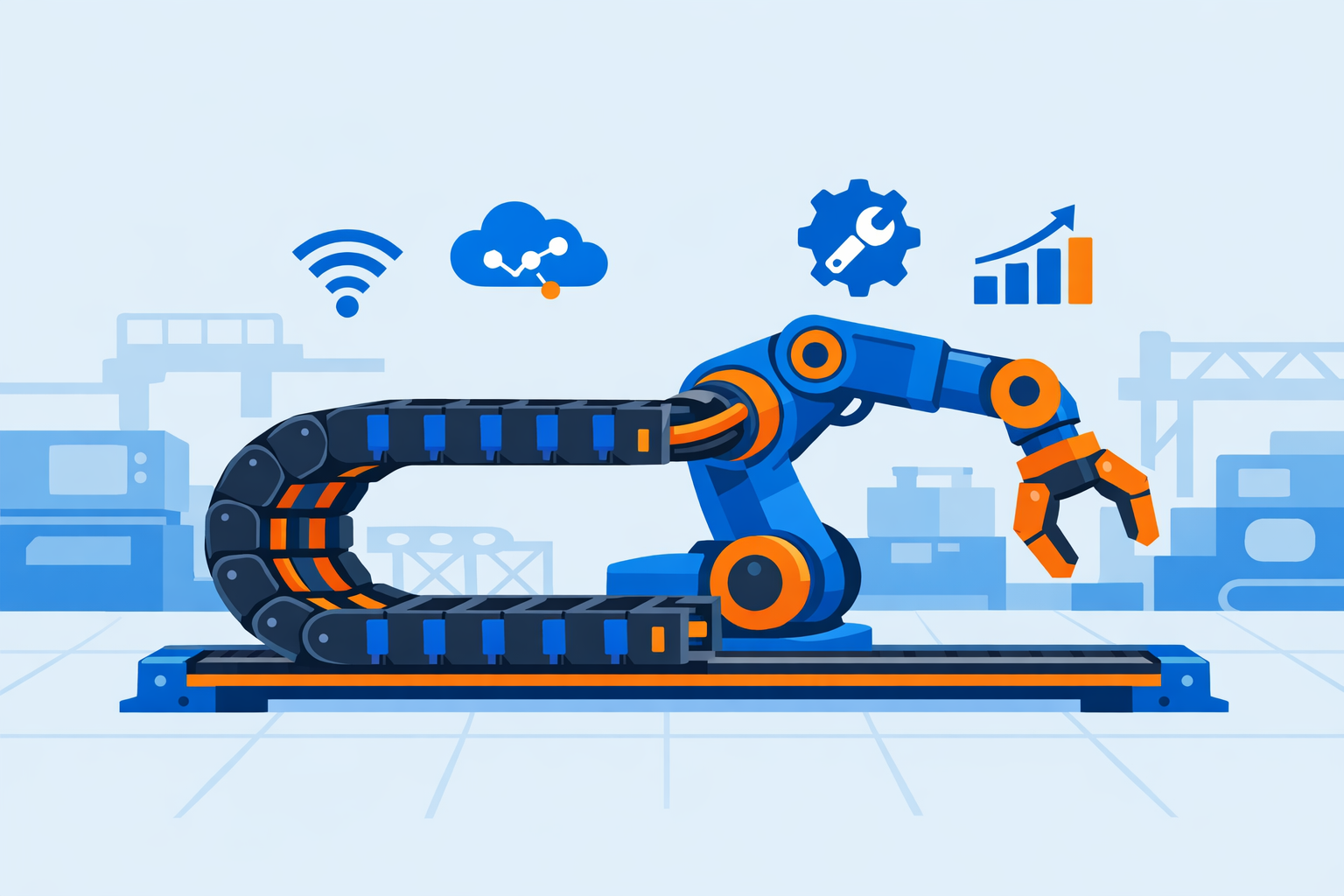
Failure modes represent a central concern. In high-cycle environments, standard cables may fail within weeks. High-flex designs, constructed with finely stranded conductors and abrasion-resistant jackets such as polyurethane (PUR) or thermoplastic elastomer (TPE), achieve over 10 million cycles.High-Flex cables engineered for 10 million+ cycles, using fine copper strands and PUR/TPE jackets (source). Mechanical issues such as corkscrewing, due to improper twisting or bend radius, can cause failures unless installation practices address these risks.Corkscrewing and improper bend radius are leading failure modes (source).
Compliance with regulatory and safety standards further influences both supplier selection and purchasing decisions. Drag chain cables increasingly meet flame-retardant standards including IEC 60332-1-2, UL VW-1, and FT2, as well as oil resistance and RoHS (Restriction of Hazardous Substances)/CE certification demands for industrial applications.Flame-retardant cables meeting IEC 60332-1-2, UL VW-1, FT2, with oil resistance and RoHS/CE compliance (source). Yet, the lack of unified drag chain standards introduces compatibility challenges, leading many end users to source both chains and cables from the same manufacturer.No explicit standard for drag chain but customers often prefer same manufacturer chains and cables for compatibility (source).
Outlook
Drag chain cable demand is expected to grow through 2035, driven by ongoing automation-especially in the Asia-Pacific region. Suppliers capable of delivering modular, traceable, high-flex, and safety-certified cables are positioned to meet evolving industry expectations for reliability and lifecycle risk management.