Executive summary. E-commerce fulfillment is entering a phase where kitting and pack-out tasks are too complex and labor-intensive to scale manually. Kitting robots-supported by advanced perception, warehouse management systems (WMS), and digital twins-are moving from pilot initiatives to core infrastructure. These systems are reshaping throughput, accuracy, and the economics of regional logistics networks through 2035.
Global data on warehouse robotics and automation indicates sustained double-digit growth, propelled by e-commerce, labor constraints, and the need for resilient supply chains near consumption markets. Analysts estimate the warehouse robotics market at USD 4.9-6.5 billion in the mid-2020s, rising to USD 17-25 billion by 2030-34, with mid- to high-teens compound annual growth rates (CAGR).[1] Modular, interoperable, and precise kitting robots are becoming fundamental to operators' capacity planning, capital expenditure (CapEx), and workforce strategy.
E-Commerce Fulfillment Pressure: Why Kitting Is Becoming a Structural Bottleneck
E-commerce and omnichannel fulfillment have pushed demand toward smaller orders, more SKUs, and frequent kit assembly. Many operations now assemble multi-SKU kits for subscriptions, promotions, and pre-assembly batches feeding downstream manufacturing.
Labor economics heighten this trend. Analyses estimate that warehouse labor represents about 60-65% of e-commerce fulfillment costs, including wages, training, and overtime.[2] Logistics sectors in North America and Europe face ongoing labor shortages and high turnover, even as overall e-commerce growth moderates from its pandemic peak.[3]
Kitting and pack-out tasks are especially labor-intensive:
- High pick density per order, often dozens of SKUs per kit
- Frequent kit reconfiguration for marketing and product updates
- Tight service-level agreements (SLAs) for next- or same-day fulfillment
- Ergonomic strain from repetitive motion and handling awkward items
Without automation, these steps limit peak-season capacity, regardless of upstream storage or inbound efficiencies.
From Niche to Core: Kitting Robots in the Warehouse Automation Stack
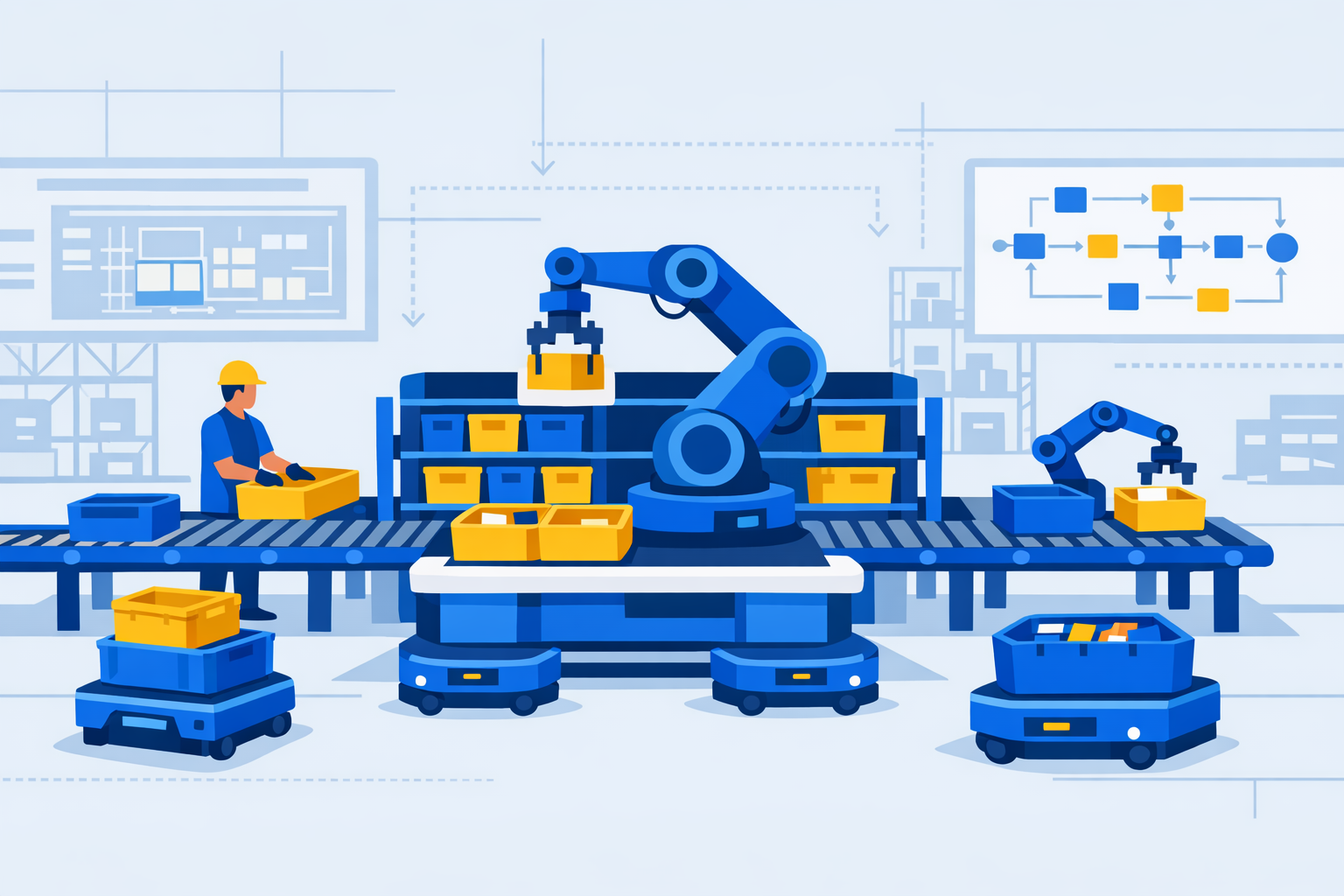
Kitting robots integrate three components historically found in separate systems:
- Autonomous movement (AMRs and shuttles) to deliver totes, trays, or shelves to workstations
- Robotic manipulation (robots and cobots with grippers and force/torque sensors) for pick-and-place tasks
- Perception and control (AI vision, WMS/WCS orchestration) for SKU identification, kit validation, and flow coordination
Research on mobile manipulation and robotic kitting in industrial and automotive logistics demonstrates robots' ability to assemble complex kits with part recognition and collision avoidance.[4] Commercial systems are extending these capabilities to e-commerce, which faces greater SKU variety and demand volatility.
In current warehouse automation, kitting robots are deployed alongside:
- Automated storage and retrieval systems (AS/RS)
- Goods-to-person shuttles and carousels
- Conveyor and sortation networks
- Robotic palletizing and depalletizing cells
Instead of monolithic, "lights-out" systems, operators implement modular work cells-kitting, packing, returns, value-added services-reconfigurable as product lines and volumes change.
Performance Benchmarks: How Automated Kitting Changes Throughput and Accuracy
Manual vs. automated picking and kitting
Benchmarks show a clear performance difference:
- Manual picking productivity averages about 50 units per hour per worker, versus up to 600 order lines per hour at a robotic station.[5]
- Robotic picking error rates approach 0.5%, compared with 2-3% for typical manual picking.[6]
- Automated bin-picking cells maintain 400-800 picks per hour, depending on item type and presentation.[7]
Though figures vary by system and product mix, automated picking and kitting systems increasingly match human dexterity while delivering consistent output and integrated traceability.
Comparative view: manual, goods-to-person, and robotic kitting
| Mode of operation | Typical pick rate (items/lines per hour per station) | Typical error profile | Labor profile | Space implications |
|---|---|---|---|---|
| Manual discrete picking in aisles | ~50-120 units | ~2-3% order line error rate (human) | High; relies on labor for all tasks | Wide aisles, low vertical storage |
| Goods-to-person with human pickers | ~300-600+ lines | Lower than manual due to guidance | Moderate; fewer workers with higher productivity | High-density storage at pick stations |
| Robotic kitting/piece-picking cells | ~400-800 picks | ~0.5% or below with vision verification | Supervision, exception handling, maintenance focus | Compact cells; flexible placement near conveyors |
Mixed human-robot work cells are increasingly common, with robots handling repetitive, high-volume tasks and human staff focusing on exceptions and quality control.[8]
Accuracy, traceability, and rework
Automated kitting cells utilize vision, barcode/RFID, and WMS rules at the pick point. This supports:
- Real-time SKU validation
- Automated weight and size checks at pack-out
- Full traceability linking kits to batch, lot, or serial numbers
AI-driven perception systems reduce recurring errors over time and can recommend process improvements when mis-pick patterns emerge.[9] In fields like pharmaceuticals and electronics, accuracy and traceability are as vital as throughput.
ROI and Total Cost of Ownership: Evaluating Modular Kitting Lines Through 2035
Market-level signals
Warehouse automation is shifting from discretionary to necessary investment. One global study forecasts warehouse automation growth from USD 28.7 billion in 2023 to nearly USD 76 billion by 2030, mainly from e-commerce and logistics.[10] Industry reports indicate payback periods for warehouse robotics of two to five years, with some projects delivering returns in under 24 months.[11]
These timelines are consistent with equipment depreciation cycles and support planning for modular kitting cell deployment.
Total cost of ownership (TCO) for kitting robots
TCO comprises the following:
- CapEx: robots and cobots, end-of-arm tooling, conveyors, safety systems, infrastructure
- Software and integration: WMS, WCS/WES licenses, robot management software, ERP/MES integration
- OpEx: maintenance, spare parts, energy, support staff, and training
ROI frameworks note that labor savings alone do not capture the full picture. Experts highlight that non-labor outlays-such as space optimization, error reduction, and overhead-can represent up to 50% of fulfillment costs per order.[12]
Sample ROI structure for kitting automation
Typically, ROI modeling links investment to lower cost per order and higher peak capacity with metrics such as:
- Baseline: annual order volume, labor hours, wages, error rates, space and energy use
- Post-automation: labor reduction, changes in peak staffing, error-related cost savings, deferred facility expansion
Many organizations now employ sensitivity analysis to assess volatility in demand, wage rates, and energy prices, given the multi-year planning horizon.[11]
Designing for Flexibility: Digital Twins, Space Allocation, and Cross-Docking
Digital twins for optimization
Digital twins-virtual models of layouts, processes, and control logic-help reduce risk before hardware implementation. Academic and commercial research supports the use of digital twins for optimizing flow, compliance, and capacity.[13][14]
Digital twins allow evaluation of:
- Placement of kitting cells relative to AS/RS and packing lines
- Buffer sizes for inbound totes and outbound kits
- Human-robot interaction patterns
- Effects of alternative conveyor routings on congestion and throughput
Space allocation and flow decoupling
Kitting robots reshape internal warehouse space:
- Compact cells can be positioned near cross-dock doors or staging areas
- High-density storage supports greater inventory within the same footprint
- Modular layouts enable reconfiguration as product and kit demands evolve
In cross-docking environments, robotic kitting links inbound, kitting, and outbound processes more tightly. Just-in-time kitting at line-side can be maintained using digital twins to track inventory within minimum/maximum constraints.
Interoperability and Open Architectures: Building Multi-Vendor Robot Ecosystems
Movement toward multi-vendor ecosystems introduces integration complexity. Kitting robots must seamlessly interact with conveyors, AS/RS, AMRs, and WMS/ERP platforms.
WMS providers increasingly offer native automation orchestration, with standardized interfaces for warehouse control systems and robot fleets.[15] Warehouse control systems connect this layer with material handling equipment and synchronize order and inventory data.[16]
On the robotics front, standards such as the Standard Robot Command Interface (SRCI) are emerging to align control protocols across manufacturers.[17] Integration with REST APIs, MQTT, and cloud platforms expands the feasibility of mixed robot fleets in a single facility.
Interoperability is crucial through 2035 because it:
- Reduces vendor lock-in
- Simplifies technology upgrades
- Supports phased automation with mixed manual and robotic kitting
Resilience, Labor Markets, and Regionalization Through 2035
Kitting robots are integral to supply chain restructuring and regionalization initiatives.
Research in 2024-25 finds that over half of surveyed European and US companies have reshored or nearshored production to address resilience.[18] Other studies project that by 2030, nearshoring could represent about 30% of European freight, with Western Europe and Germany investing substantially in infrastructure.[19]
As operations and fulfillment move closer to end markets, regional warehouses face both high labor costs and strong service expectations. Kitting robots help address these pressures by:
- Reducing reliance on scarce local labor for repetitive tasks
- Providing consistent capacity during disruptions
- Supporting standardized operations across multiple regional hubs
Workforce roles shift to:
- Automation engineering and maintenance
- Data analysis, exception management, continuous improvement
- Process design for new SKUs, kits, and services
Upskilling-through training and cross-functional collaboration-will be essential for maintaining performance as automated kitting expands.
Implementation Guidelines: Hardware Selection and WMS/ERP Integration
Hardware modules
When planning kitting cells, typical considerations include:
- Conveyors: belt, roller, or modular based on item characteristics; accumulation and merge logic for variable batch sizes
- Grippers and EOAT: parallel, vacuum, or hybrid; support for diverse packaging; quick-change capabilities for assortment shifts
- Sensors: force/torque for delicate items; 2D/3D vision for identification and inspection
Selection is based on SKU characteristics and "pickability"-size, shape, rigidity, and packaging.
Integration with WMS and ERP
Kitting automation requires alignment among control logic and enterprise systems:
- WMS handles orders, inventory, and prioritization
- WCS/WES executes physical flow based on those priorities[16]
- ERP and MES track kits' production orders and billing data
Key integration steps include:
- Clear task-level interfaces (e.g., pick from tote X to kit Y)
- Real-time robot status updates to WMS
- Use of standard protocols (REST, OPC UA, MQTT) and modular integration layers for scalability[20]
A structured implementation plan usually includes:
- Process mapping for current kitting flows
- Baseline measurement of picks per hour, errors, cost per order, space
- Scenario modeling with digital twins for placement and throughput
- Pilot deployment with objective success criteria
- Phased rollout to more SKUs, kits, and sites following integration
Actionable Conclusions and Next Steps
By 2035, kitting robots are expected to be standard modules in e-commerce fulfillment centers, particularly where labor costs are high and nearshoring is advancing. Warehouse robotics investment is projected to be multi-billion dollars annually through 2035, with e-commerce, automotive, and third-party logistics sectors driving demand.[21]
For operations and engineering leaders managing technology investments:
- Quantify kitting constraints. Benchmark kitting-related labor, errors, and space usage to identify bottlenecks.
- Model modular kitting cells. Use digital twins and scenario tools to evaluate configurations and integration strategies.
- Design for interoperability and workforce evolution. Choose solutions with open interfaces and integration frameworks to support upskilling and long-term flexibility.
These steps help facilities manage demand spikes, adapt to regionalization trends, and support resilient logistics networks through 2035.
Frequently Asked Questions
How do kitting robots differ from standard robotic pick-and-pack systems?
Kitting robots are built to assemble multi-SKU kits or sub-assemblies, often with sequence or orientation requirements. In contrast, most pick-and-pack systems focus on single-SKU orders placed into shipping cartons. Kitting robots thus rely more on advanced perception, force control, and WMS integration to ensure each kit contains the correct components in proper order.
In which environments does automated kitting deliver strong ROI?
Automated kitting is most attractive in high labor-cost areas, environments with many SKUs per kit, and operations with predictable demand peaks. Subscription fulfillment, configurable products, and just-in-time assembly lines commonly realize higher ROI, especially where automation defers the need for facility expansion or consolidates manual lines into high-output automated cells.
How do kitting robots integrate with WMS and ERP?
Typically, WMS generates kit work orders and distributes them to kitting cells via WCS or WES. That system translates orders into robot-level instructions for picking, validation, and reporting. ERP or MES systems then update production orders, inventory, and billing. Standard interfaces and message schemas reduce customization and ease future upgrades.
What skills do staff need in automated kitting environments?
As automation expands, staff shift from manual picking to system oversight, troubleshooting, and process improvement. Skills now in demand include HMI operation, robot safety and recovery, dashboard monitoring, and structured problem-solving. Technical staff-including controls engineers and maintenance-are essential for uptime and system adaptation.
How should operators approach scaling kitting robots across sites?
Scaling favors standardized cell designs, unified integration, and consistent KPIs. Organizations often pilot robots at a flagship facility, then replicate optimized processes elsewhere. WMS/WES templates and robot control standards streamline multi-site deployment, while regional support hubs enable training and continuous improvement across the network.