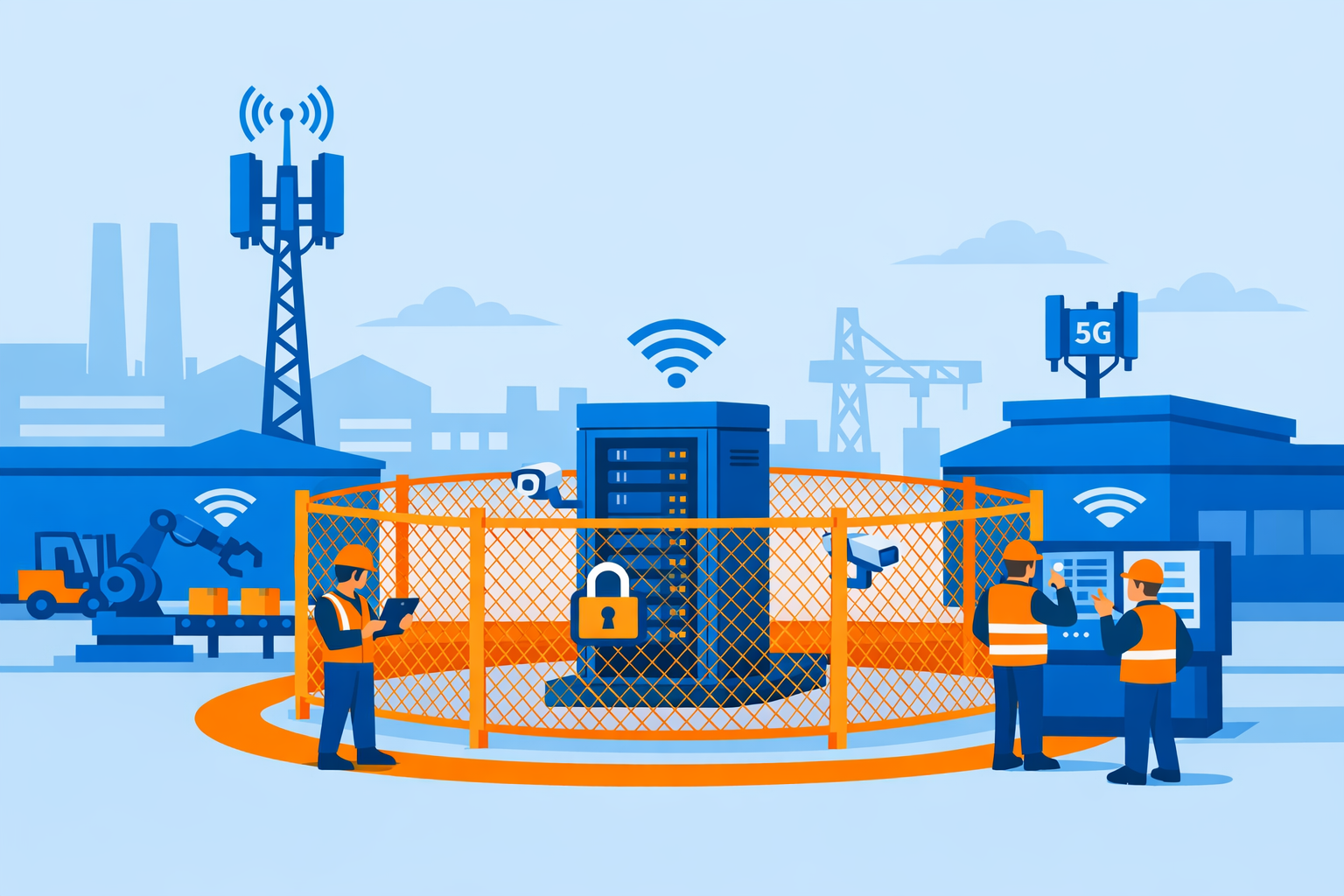
North American automotive manufacturers are moving from limited private 5G trials to full production deployments, driven by converging federal funding incentives, mandatory workforce retraining requirements, and tightening operational technology (OT) cybersecurity standards.
After years of pilots and proofs of concept, private 5G networks now operate inside production manufacturing environments across Europe, the U.S., and Asia. Automotive plants rank among the first to run production systems on private 5G rather than wired or Wi-Fi-only infrastructure. The shift coincides with federal grant programs that tie infrastructure funding to OT cybersecurity compliance and worker upskilling mandates, according to program documentation from the U.S. Department of Homeland Security and the Department of Labor.
Background
The U.S. has deployed more dedicated private 5G networks than any other country. Companies including John Deere, Dow, and Tesla use the 3.55-3.7 GHz Citizens Broadband Radio Service (CBRS) band for smart manufacturing and automation, and hundreds of private 5G networks already operate in the U.S. manufacturing sector. More than 85% of private 5G networks deployed in U.S. factories by 2032 are projected to rely on CBRS-almost all using the unlicensed General Authorized Access (GAA) tier-according to an Analysys Mason study.
As of early 2026, the global private 5G network market has reached approximately $7.57 billion, up from $5.08 billion in 2025, and is projected to hit $29.61 billion by 2030 at a compound annual growth rate of nearly 49%.
Alongside commercial expansion, federal investment is accelerating adoption. Through the Infrastructure Investment and Jobs Act, the U.S. Department of Homeland Security (DHS) is providing $91.75 million in FY 2025 to address cybersecurity risks to information systems owned or operated by state, local, and territorial governments. The program explicitly includes workforce development as a funded objective-a requirement that automotive suppliers and OEMs accessing related grant streams must satisfy as a condition of award.
Details
Companies such as BMW and Tesla use private 5G to replace factory cables, reducing costs by up to 40% and enabling real-time vision systems for autonomous robots. Tier 1 automotive suppliers report an average 18%-22% increase in Overall Equipment Effectiveness (OEE) after deployment.
In the United States, an early benchmark has been established in Chicago. Manufacturing x Digital (MxD), the National Center for Cybersecurity in Manufacturing, operates a private 5G network deployed by Betacom and Siemens Industries-the first complete private wireless network to operate behind a Siemens firewall. The system features:
- CBRS spectrum deployment in the 3.55-3.7 GHz range
- A security framework developed with the MxD Cybersecurity Institute
- Cybersecurity built on 3rd Generation Partnership Project (3GPP) standards
- National Institute of Standards and Technology (NIST) framework compliance
- Zero-trust network segmentation principles
On the systems integration front, private 5G enables IT-OT convergence that was previously impractical. Private 5G transforms fragmented, unreliable data streams into a trusted, deterministic data plane that both OT and IT teams can rely on, allowing manufacturers to integrate long-siloed systems-including manufacturing execution systems (MES), supervisory control and data acquisition (SCADA), enterprise resource planning (ERP), and quality management-and push intelligence to the edge where decisions happen.[1]
Cloud-based processing typically introduces 200 milliseconds or more of latency, while private 5G paired with on-premise edge compute delivers roughly 10-millisecond response times-enabling decisions up to 40 times faster than cloud alternatives.
Tier 1 automotive suppliers report an average 18%-22% increase in Overall Equipment Effectiveness (OEE) following private 5G deployment, according to a 2026 global private 5G network research report.
Private 5G revenue in manufacturing is forecast to reach $1 billion in 2025 and $8.7 billion by 2030, representing a CAGR of 54.1%.
Vendors are adapting to compliance-linked procurement requirements. Siemens has expanded its CBRS-band radio unit to let U.S. manufacturers deploy private 5G on their own premises and has added edge runtime capabilities to its 5G routers, allowing applications to run directly on the device without additional hardware for real-time shop-floor data processing. Siemens is also investing in generative AI through its Industrial Copilot product, a joint venture with Microsoft to tailor generative AI tools for Industry 4.0.
Early adopters are documenting practical integration challenges. Private 5G offers strong built-in protections, but security outcomes ultimately depend on governance. Factories adopting private 5G have had to strengthen identity management, SIM and eSIM lifecycle handling, OT-IT segmentation policies, and anomaly detection. Ensuring interoperability with different 5G cores and Multi-Operator Core Networks (MOCN) gateways is considered crucial to maintaining flexibility, avoiding vendor lock-in, and enabling adaptation to site-specific requirements.
Outlook
Industry observers note that enterprises are moving from pilots to globally scalable, production-ready solutions. However, IDC Associate Vice President Alejandro Cadenas has stated that "integration complexity often remains the final hurdle" as private 5G scales to support autonomous systems operating reliably at production volume.
Momentum is further driven by spectrum policy progress, maturing deployment architectures, and growing urgency across U.S. manufacturing, logistics, energy, and government sectors to upgrade industrial infrastructure. Spectrum policy uncertainty around the CBRS band-including a 2024 proposal by AT&T to relocate current CBRS users-could take several years to resolve. A mandated band change would require rebuilding the CBRS sharing framework and the hardware ecosystem of chipsets, radios, and end-user devices.