U.S. manufacturers are moving private 5G networks and edge AI systems beyond proof-of-concept trials into full production environments, propelled in part by federal grant programs that tie technology funding to mandatory workforce upskilling commitments. The convergence of connectivity infrastructure and on-premise artificial intelligence is reshaping capital expenditure priorities at mid-market plants, even as governance, cybersecurity, and device readiness continue to complicate deployment timelines.
Federal Programs Attach Workforce Conditions to Technology Adoption
The funding push spans multiple agencies. The U.S. Department of Labor announced a $30 million Industry-Driven Skills Training Fund grant program, offering awards of up to $8 million to state workforce agencies to develop and expand employer-led training programs. Separately, the DOL awarded nearly $84 million in formula and competitive grants to all 50 states and territories in June 2025 to expand Registered Apprenticeship program capacity, with press materials noting the disbursement as a step toward the administration's goal of one million registered apprentices.
The National Science Foundation's TechAccess: AI-Ready America program supports a coordinated national network of up to 56 state and territorial hubs, with each Coordination Hub Award receiving up to $1 million per year for three years. The program emphasizes practical implementation-including hands-on assistance and workforce upskilling through experiential learning such as internships, project-based work, and apprenticeships-according to NSF solicitation documents. Congressional appropriators also directed $175 million to continue NIST's Hollings Manufacturing Extension Partnership (MEP) Program in FY2026, with language explicitly barring reductions in the number of active MEP Centers. The MEP network, which operates in all 50 states and Puerto Rico, provides funded consulting and workforce training to small and medium-sized manufacturers.
Early Adopters Demonstrate Scale Potential
Enterprise deployments confirm the pilot-to-production transition is underway. Cargill, working with NTT DATA, launched a private 5G factory connectivity strategy in March 2025 and expanded to 50 facilities across the U.S. and Europe by early 2026. The company reported a 70% reduction in cabling and setup costs compared to traditional infrastructure installations, according to CIO magazine. Coverage advantages also played a role: Cargill can deploy one private 5G access point to cover the same area as approximately nine Wi-Fi access points.
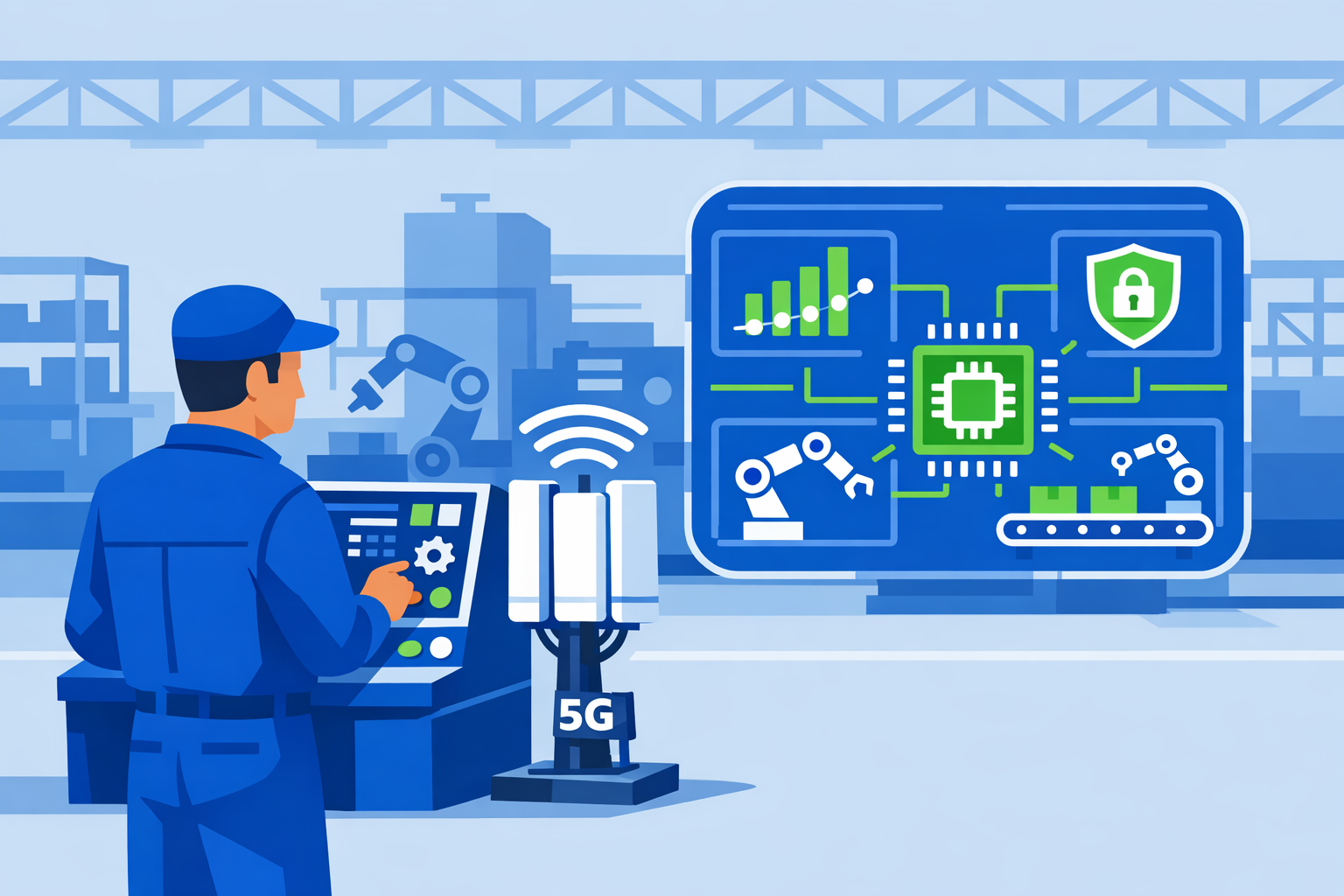
On the infrastructure supply side, Siemens announced the expansion of its industrial-grade private 5G infrastructure to the United States, enabled by a new CBRS-band radio unit, with U.S. availability targeted for Summer 2026. The CBRS (Citizens Broadband Radio Service) band allows manufacturers to deploy private networks on their own premises without acquiring licensed spectrum. Siemens also enhanced its 5G routers with edge runtime capabilities, enabling AI-ready data processing directly on the shop floor without additional hardware.
For edge AI specifically, the global edge AI market was valued at approximately $24.91 billion in 2025 and is projected to reach $118.69 billion by 2033, growing at a compound annual growth rate of 21.7%, according to Grand View Research. Manufacturing is the leading vertical driving this growth, according to multiple market analysts.
Security and Governance Shape Deployment Timelines
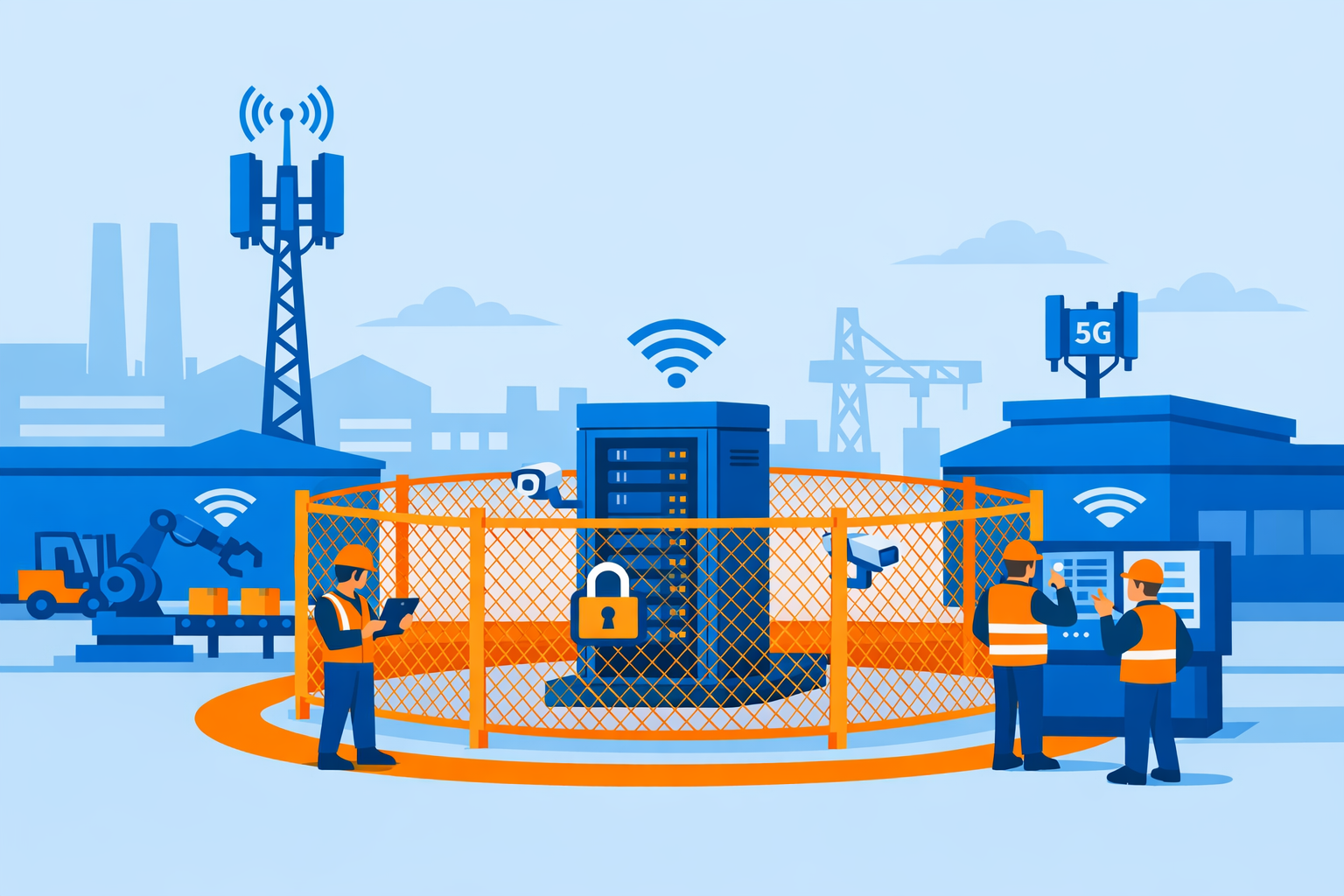
Operational experience from initial production-scale private 5G deployments has surfaced consistent governance requirements affecting project schedules and ROI calculations. According to analysis published by IoT Business News, factories adopting private 5G have had to strengthen identity management, SIM and eSIM lifecycle handling, OT-IT network segmentation policies, and anomaly detection capabilities. A recurring finding: private 5G does not replace Wi-Fi but coexists with it. Wi-Fi continues to serve tablets and low-criticality devices, while private 5G supports robotics, motion control, high-resolution video inspection, and mobile industrial assets.
Device compatibility remains a technical bottleneck. Machine-tool vendors, robot manufacturers, and sensor suppliers face antenna-integration challenges and firmware readiness issues, with device availability-not network performance-limiting scalability in several documented deployments. The gap is expected to narrow as 5G RedCap (Reduced Capability) modules mature.
Cybersecurity frameworks are also becoming standard in industrial edge platforms. At Hannover Messe 2026, Siemens announced IEC 62443-4-2-certified security functions for its Industrial Edge platform, including air-gapped operation capabilities, targeted for release in the second half of 2026. The Forrester Wave for Private 5G Services, published in Q4 2025, identified Zero Trust architecture as a baseline expectation among leading vendors, with several now offering dedicated private 5G security operations centers.
Outlook
The combination of federal grant eligibility requirements and executive orders directing AI literacy integration into registered apprenticeships is expected to formalize workforce upskilling as a grant compliance obligation rather than an optional program component. The DOL's initiative, announced in April 2026, intends to award a single national intermediary contract with a one-year base period and four option years to accelerate AI skills integration into apprenticeship programs, targeting advanced manufacturing among its priority sectors. Manufacturers pursuing federal co-investment will need to align technology deployment roadmaps with demonstrable workforce development outcomes to meet grant criteria-a requirement reshaping how plant managers and operations directors structure technology procurement and training budgets simultaneously.