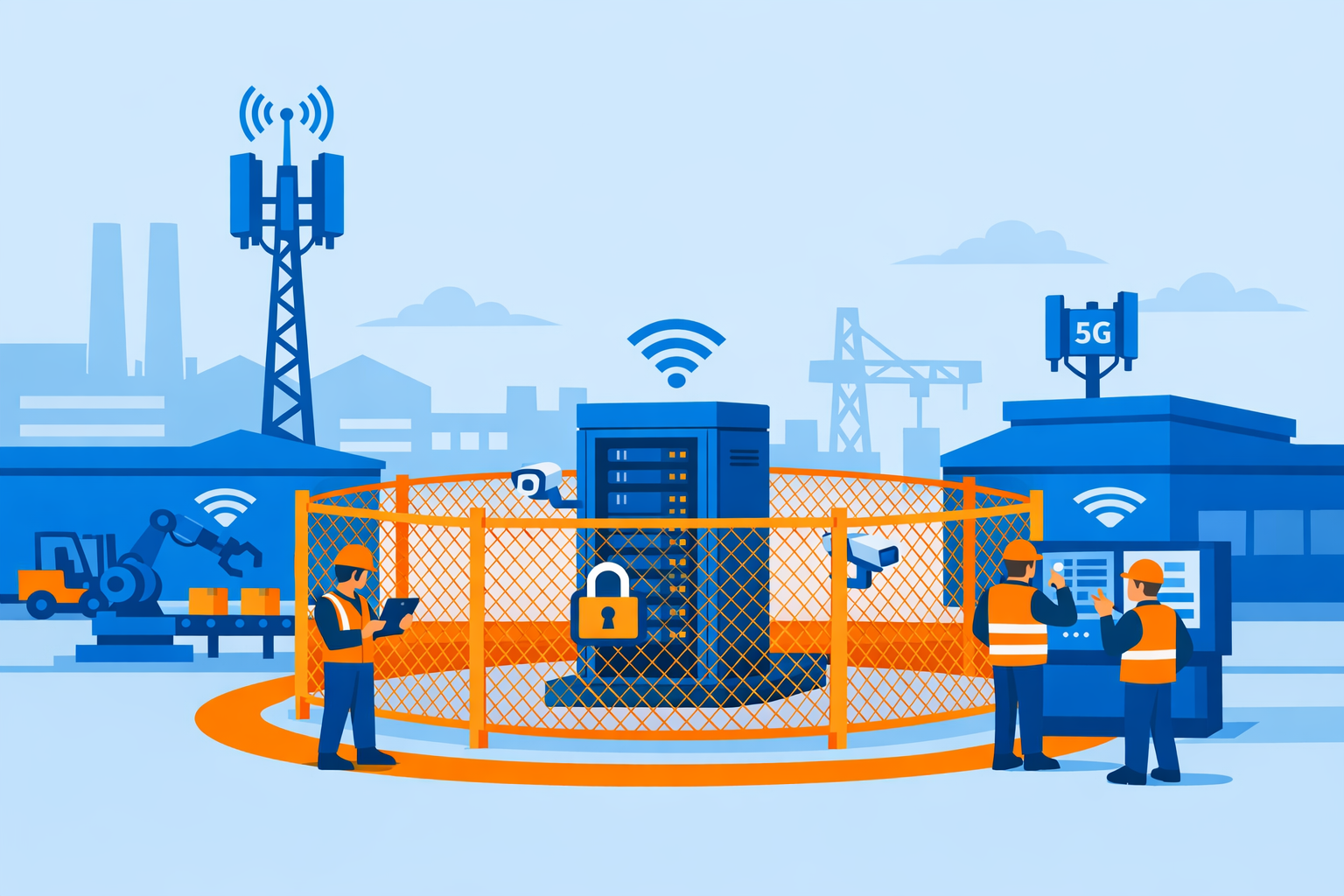
A convergence of federal grant programs, shared-spectrum policy, and falling hardware costs is accelerating the deployment of private 5G networks and edge AI across small and mid-sized US manufacturing plants. NIST's FY2026 budget stands at $1.85 billion, with Congress directing at least $55 million specifically toward AI research and measurement science, while the CHIPS and Science Act's Wireless Innovation Fund and the FCC's expanding spectrum pipeline are channeling capital directly into factory-floor connectivity and on-premise intelligence.
The CHIPS & Science Act has already delivered a nearly $44 million Wireless Innovation Fund grant to JMA Wireless in Syracuse, New York, to manufacture 5G Open RAN-compliant radio units domestically. The company committed an additional $30 million in private capital, according to a December 2024 announcement by Senate Majority Leader Chuck Schumer. Meanwhile, NIST's Hollings Manufacturing Extension Partnership (MEP), funded at $175 million annually, operates 51 centers across all 50 states and Puerto Rico, providing small and medium-sized manufacturers with technology adoption consulting, workforce training, and pathways to smart manufacturing tools including edge AI and industrial IoT.
Background
The push arrives as the private 5G market enters rapid expansion. The 5G enterprise market was valued at $5.22 billion in 2025 and is projected to reach $57.65 billion by 2033, growing at a CAGR of 30.58%, according to SNS Insider. North America led the market in 2025 with a 38.75% share, driven largely by CBRS spectrum allocation and aggressive enterprise digital transformation.
For midmarket manufacturers, the FCC's Citizens Broadband Radio Service (CBRS) in the 3.5 GHz band has been a critical enabler. CBRS allows enterprises to deploy private 4G and 5G networks without relying on traditional carriers or paying billions for exclusive licenses, according to Spectrum for the Future. Siemens announced it is bringing its industrial-grade private 5G infrastructure to the US market through a dedicated CBRS-band radio unit, with availability planned for summer 2026, targeting manufacturing, food and beverage, pharmaceuticals, and intralogistics.
Details
Early deployment data points to measurable returns. A major European automotive manufacturer that deployed private 5G with edge AI across its robotic welding and painting lines reported a 47% reduction in unplanned downtime, a 22% decrease in robotic maintenance costs, and a 30% cut in spare parts inventory over an 18-month period, according to ManufactureNow. The project achieved full ROI in 14 months.
Broader industry research corroborates these figures. AI-driven predictive maintenance delivers 10:1 to 30:1 ROI ratios within 12 to 18 months of implementation, with maintenance cost reductions of 18-25% compared to preventive approaches and up to 40% versus reactive maintenance, according to iFactory. The edge AI hardware market reached $32.8 billion in 2026 and is projected to grow to $122.8 billion by 2035 at a 17.9% CAGR, per Research Nester.
Practical hurdles remain. According to IoT Business News, early deployments confirm that private 5G does not replace Wi-Fi; factories are segmenting networks, with Wi-Fi serving tablets and low-criticality devices while private 5G supports robotics, motion control, high-resolution video, and mobile industrial assets. Integration with legacy OT systems requires tight synchronization with PLCs and properly configured handovers. The top barrier cited in surveys is the skills gap, as maintenance technicians need data literacy training while data scientists need to understand mechanical failure modes.
Outlook
The FCC is executing a spectrum pipeline to deliver 800 megahertz of additional spectrum by 2034, which will further expand capacity for industrial private networks. CESMII, the Clean Energy Smart Manufacturing Innovation Institute, has formalized a partnership with NIST MEP to jointly promote smart manufacturing adoption among small and medium-sized manufacturers, creating a national pathway from grant application to factory deployment. For plant managers and operations directors evaluating capital expenditure cycles, the combination of federal funding, CBRS spectrum access, and proven edge AI ROI data has shifted private 5G from a pilot-stage experiment to a near-term investment case.