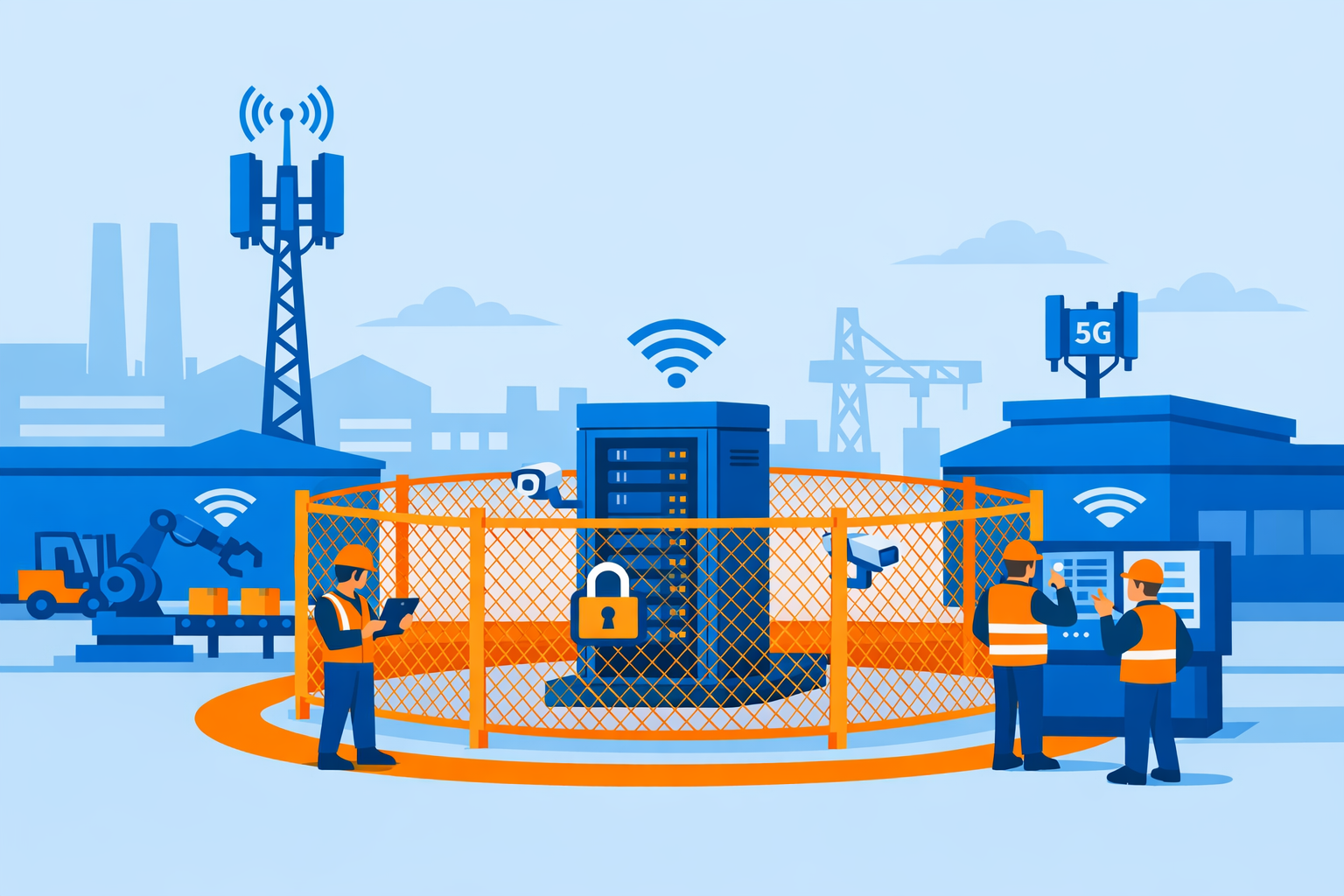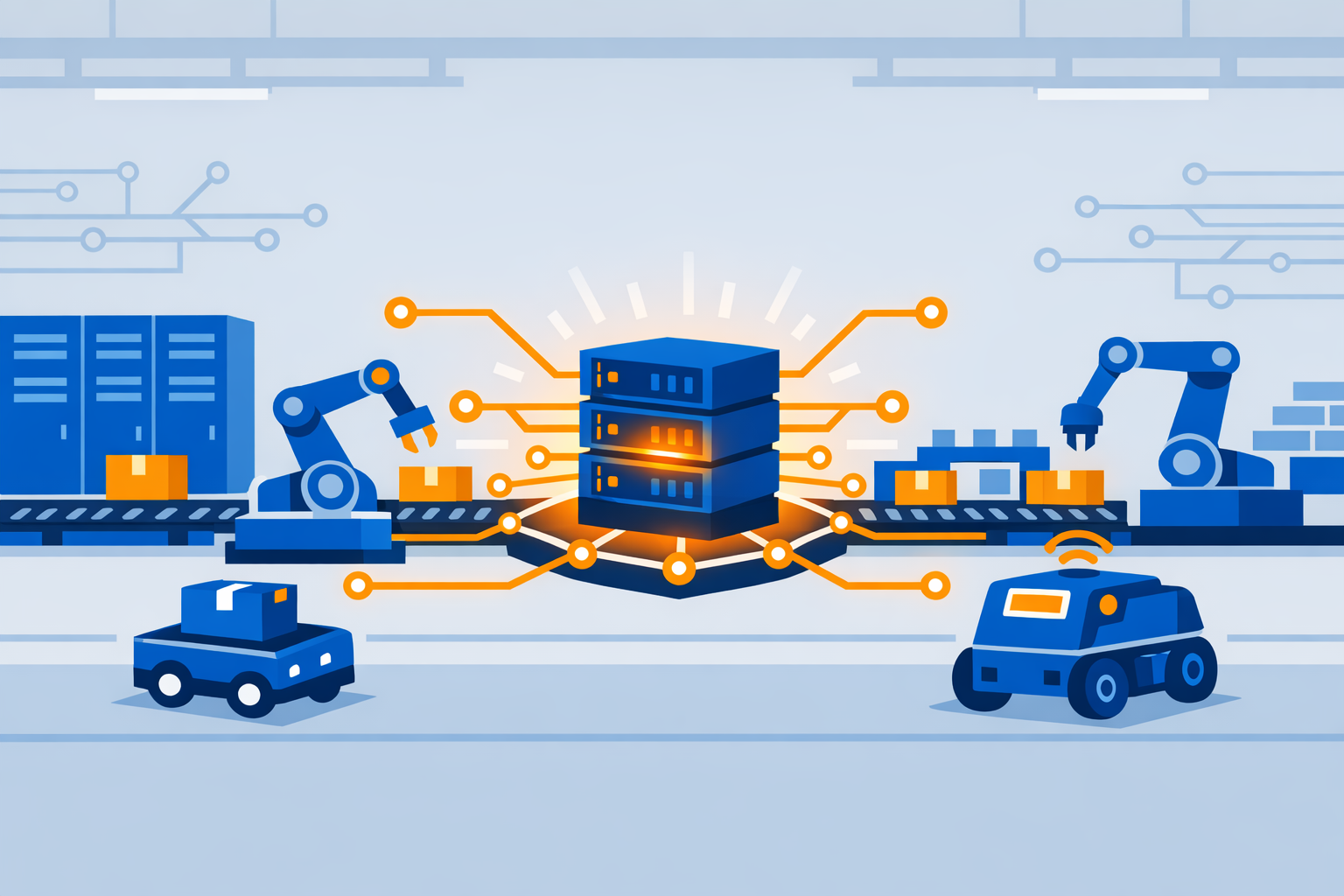
U.S. manufacturers are advancing private 5G and edge AI deployments from proof-of-concept phases into full production, driven by falling infrastructure costs, new federal spectrum policy, and a vendor ecosystem mature enough to support factory-wide integration with existing operational technology (OT) systems.
The United States is now home to more than 1,200 operational private 5G deployments as of early 2026, spanning automotive assembly plants in Michigan, semiconductor fabs in Arizona, and smart warehousing complexes in Texas and California. The global private 5G network for industrial IoT market was valued at $6.4 billion in 2025 and is projected to reach approximately $43.8 billion by 2034, expanding at a compound annual growth rate of 23.5%.
Background
After years of pilots and proofs of concept, private 5G networks now operate inside real manufacturing environments across Europe, the U.S., and Asia. Automotive plants, semiconductor facilities, machinery workshops, and advanced logistics hubs are among the first to run production systems on private 5G rather than wired or Wi-Fi-only infrastructure.
The United States holds a structural advantage in this transition. The Citizens Broadband Radio Service (CBRS) 3.55-3.7 GHz band has facilitated over 16,000 Priority Access Licenses (PALs) and 70,000+ General Authorized Access (GAA) deployments as of Q1 2026, dramatically lowering spectrum acquisition costs for industrial operators. John Deere, Dow, and Tesla are among companies using the CBRS band for smart manufacturing and automation. Hundreds of private 5G networks have already been deployed in the U.S. manufacturing sector, and Analysys Mason estimates that figure will rise to more than 2,500 by 2032.
Federal investment is reinforcing private-sector momentum. Through two competitive funding rounds, NTIA has provided $592 million for 27 projects focused on research, testing methodologies, and improving Open Radio Unit products and capabilities. Separately, the CHIPS & Science Act provided $43.9 million to JMA Wireless to pioneer domestic manufacturing of 5G Open Radio Access Network (O-RAN)-compliant radio units and upgrade its facilities in Central New York.
Details
The most prominent U.S. factory-floor deployment to emerge in 2025 is Hyundai Motor Group's Metaplant America (HMGMA) in Ellabell, Georgia. The $7.59 billion facility celebrated its grand opening on March 26, 2025, and is designed to produce up to 500,000 electric vehicles annually at full capacity. Future Technologies, the lead system integrator, deployed Nokia's private cellular core and radio network systems. Beyond quality control, the private 5G network supports a comprehensive AI-driven manufacturing ecosystem, with all processes-order collection, procurement, logistics, and production-optimized using AI and real-time data. The facility employs over 200 autonomous mobile robots for materials handling, enabled by the network's consistent, low-latency communication.
On the vendor side, Siemens announced it is bringing its industrial-grade private 5G infrastructure to the United States via a new CBRS-band radio unit. The dedicated unit opens the door for U.S. manufacturers to deploy Siemens' private 5G on their own premises, fully independently, serving manufacturing, food and beverage, pharmaceuticals, intralogistics, heavy industries, and crane operations. Siemens has also enhanced its 5G routers with edge runtime capabilities, allowing apps to run directly on the device-eliminating the need for additional hardware and enabling real-time, AI-ready data processing on the shop floor.
The performance case for pairing private 5G with on-premise edge compute is well established. Cloud-based processing typically introduces 200 milliseconds or more of latency, while private 5G paired with on-premise edge compute delivers around 10-millisecond response times, enabling decisions up to 40× faster than cloud alternatives.[1] By 2025, over 40% of large factories ran at least five production-grade AI models at the edge, up from 12% in 2023.
ROI signals from early deployments are measurable. End-user organizations have credited private cellular network installations with productivity and efficiency gains of 20% to 90% for specific manufacturing, quality control, and intralogistics processes; cost savings as high as 60%; and an uplift of up to 80% in worker safety and accident reduction, according to SNS Telecom & IT. Early deployments confirm that value stems from new automation capabilities, not connectivity cost savings. Manufacturers that achieved the strongest ROI used private 5G to unlock new workflows: robotized movement of goods, real-time video analytics, condition monitoring, and flexible production-line reconfiguration.
Scaling from pilots, however, has exposed consistent integration challenges. Private 5G can deliver predictable low latency, but factories found that results only meet expectations when the network is tightly integrated into the OT ecosystem. Production systems depend on precise synchronization with programmable logic controllers (PLCs), stable scheduling in the 5G core, and properly configured handovers for mobile robots. Without OT alignment, even strong networks initially exhibited jitter or inconsistent robotic responses. Security outcomes also depend heavily on governance: factories adopting private 5G had to strengthen identity management, SIM and eSIM lifecycle handling, OT-IT segmentation policies, and anomaly detection.
Outlook
The market is shifting from single-site pilots to multi-site rollouts, signaling maturity and scalability, according to ARC Advisory Group. Global spending on private 5G and LTE network infrastructure for vertical industries is projected to grow at a compound annual growth rate of approximately 22% between 2025 and 2028, eventually exceeding $7.2 billion by the end of 2028. Spectrum policy remains a near-term risk: AT&T has proposed relocating current CBRS users from the 3.55-3.7 GHz band to the 3.1-3.3 GHz band to open the existing allocation for full-power licensed use. Discussion of such proposals continues in Washington, creating uncertainty for manufacturers that have already invested in CBRS-based infrastructure.