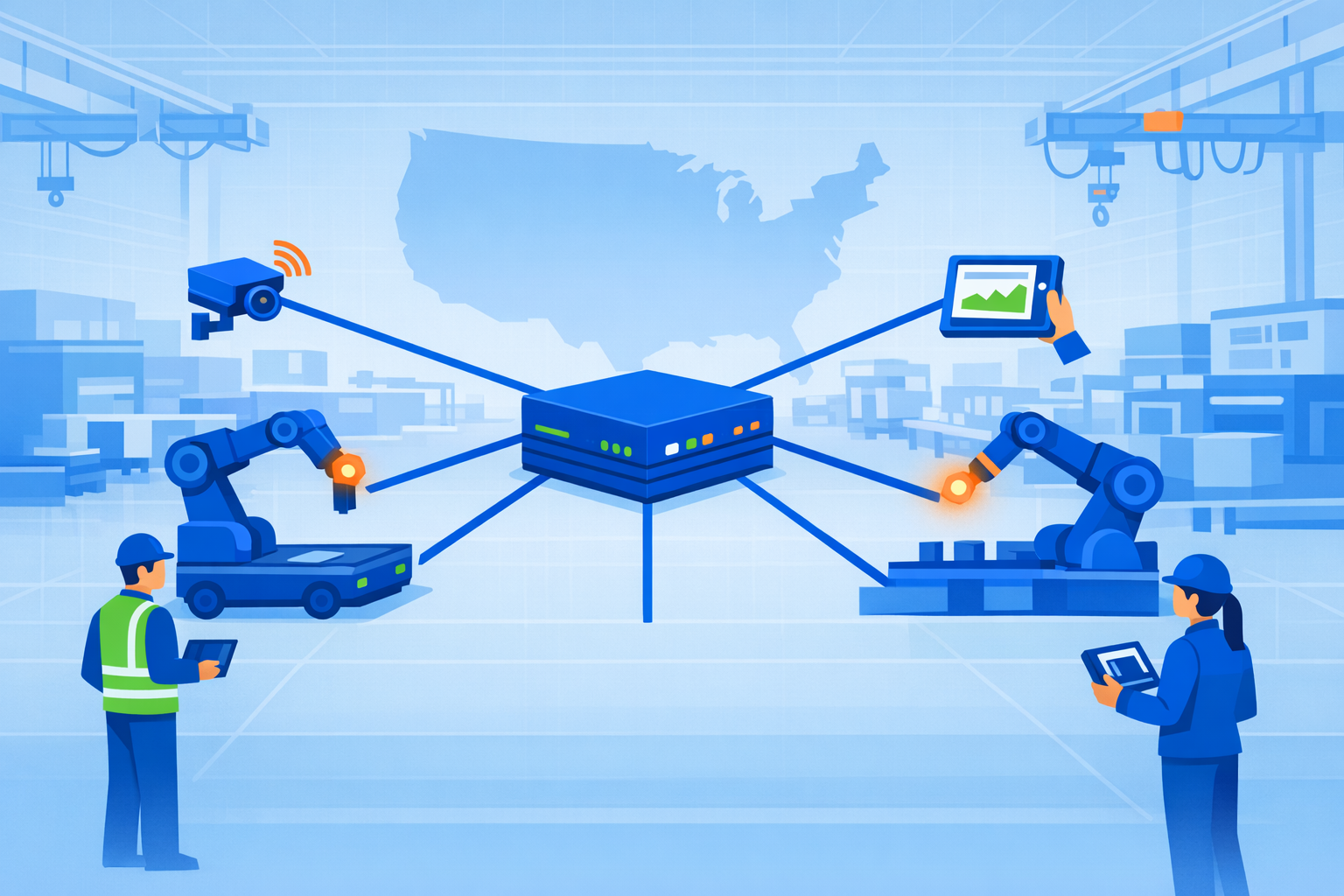
Industrial manufacturers and logistics operators across the United States are accelerating private 5G and edge artificial intelligence (AI) deployments beyond pilot programs, committing to multi-site rollouts that position wireless connectivity as core operational infrastructure rather than experimental technology.
Background
After years of pilots and proofs of concept, private 5G networks are running inside production manufacturing environments across Europe, the U.S., and Asia. Automotive plants, semiconductor facilities, machinery workshops, and advanced logistics hubs are among the first to operate production systems on private 5G rather than wired or Wi-Fi-only infrastructure. The transition reflects growing recognition that legacy network architectures cannot meet the latency and reliability demands of modern automation. The global industrial AI market reached $43.6 billion in 2024, with compound annual growth of 23% projected through 2030, when the market is expected to reach $153.9 billion, according to IoT Analytics. The global private 5G market is valued at $3.9 billion and projected to reach $17.6 billion by 2030, representing a 35.4% compound annual growth rate.
Market momentum extends beyond headline numbers. Revenue growth for private 4G/5G radio access network (RAN) sales reached approximately 20% above 2024 levels by year-end 2025, following 40% growth over 2023, according to Dell'Oro Group. Dell'Oro Group estimates that private 4G/5G contributes a "mid-single-digit share" of total global RAN sales in 2025, a figure expected to rise through the decade.
Details
One of the clearest signals of the pilot-to-production shift came in February 2026, when NTT DATA announced that Cargill had deployed private 5G across 50 manufacturing and processing facilities globally. After years of cautious pilot testing, Cargill scaled private 5G to 50 sites in six months working with NTT DATA and Celona, treating the technology not as a single-use Industry 4.0 fix but as foundational connectivity to be stacked, scaled, and standardized across global operations. The initiative, launched in March 2025, is expanding at a pace of more than 100 sites per year. The rollout spans large-scale agricultural processing plants and food manufacturing facilities, the majority in the United States, with additional live deployments in Europe.
Some of Cargill's smaller warehouses had previously operated with no connectivity at all-workers tracked inventory with pen and paper. The private 5G deployment brought those sites onto electronic inventory and warehouse management systems for the first time. At Cargill's Amsterdam facility, the company deployed Boston Dynamics' Spot, an AI-powered quadruped robot that automates visual inspections and monitors for hazards such as equipment overheating in areas difficult or dangerous for human workers to access.
"In industrial environments, reliability and consistency matter more than peak speed," said Parma Sandhu, Vice President of Enterprise 5G Products and Services at NTT, in a statement. "Private 5G delivers high capacity and low latency, but the real advantage is secure, predictable connectivity across large facilities with thousands of connected devices. That reliability is what enables automation, robotics, and real-time monitoring on the factory floor."
Vendor partnerships are also scaling. NTT DATA and Ericsson forged a global partnership to establish 5G as the foundational operating layer for enterprise AI, aiming to create a clear path for enterprises to move from AI pilots to scalable, production-ready deployments across manufacturing, mining, ports, airports, energy, transportation, and smart cities. "Private 5G is the backbone for scaling AI in production, where autonomous systems must operate reliably and at scale, but integration complexity often remains the final hurdle," said Alejandro Cadenas, Associate Vice President of Worldwide Telco Research at IDC.
On the technology side, edge AI is cutting inference latency from 100 milliseconds or more to under 15 milliseconds in manufacturing environments, enabling control loops that cloud architectures cannot support. Verizon and NVIDIA began demonstrations in early 2025 showing practical deployments combining private wireless with containerized AI services.
Despite rapid deployment growth, early adopters are identifying structural implementation challenges. Initial production deployments show that private 5G can meaningfully improve automation reliability, enable greater robot fleet density, support quality inspection through real-time video, and unlock more flexible production-line architectures. However, performance depends heavily on RF engineering, device maturity, OT integration, spectrum strategy, and organizational readiness. Although core networks and indoor radio units have matured, many industrial devices are still transitioning to native 5G. Machine-tool vendors, robot manufacturers, and sensor suppliers face antenna-integration challenges and firmware readiness issues. In several deployments, device availability-not network performance-limited scalability.
Workforce and governance gaps present an equally pressing constraint. Industry analysts estimate a shortfall of 2.4 million 5G-skilled workers globally by 2026. Private 5G offers strong built-in protections, but security outcomes ultimately depend on governance. Factories adopting private 5G have had to strengthen identity management, SIM and eSIM lifecycle handling, OT-IT segmentation policies, and anomaly detection. Security is increasingly treated as a primary design criterion, with leading vendors embedding Zero Trust frameworks into their private 5G offerings to address device diversity, application control, and regulatory compliance.
Outlook
NTT DATA and Ericsson have committed to delivering private 5G, edge AI, and physical AI use cases across manufacturing, mining, ports, airports, energy, transportation, and smart cities, aiming to help enterprises accelerate deployment and realize measurable return on investment. Spectrum accessibility is also improving in the U.S.: the Citizens Broadband Radio Service (CBRS) band at 3.5 GHz allows enterprises to access affordable shared spectrum without relying on expensive licensed bands. Companies can now choose between licensed, unlicensed, or hybrid spectrum. This flexibility has lowered the barrier to entry, making private 5G more accessible to small and mid-sized manufacturers. For system integrators and operations technology vendors, the shift from single-site pilots to standardized, multi-site managed services represents a defining market opportunity in 2026.