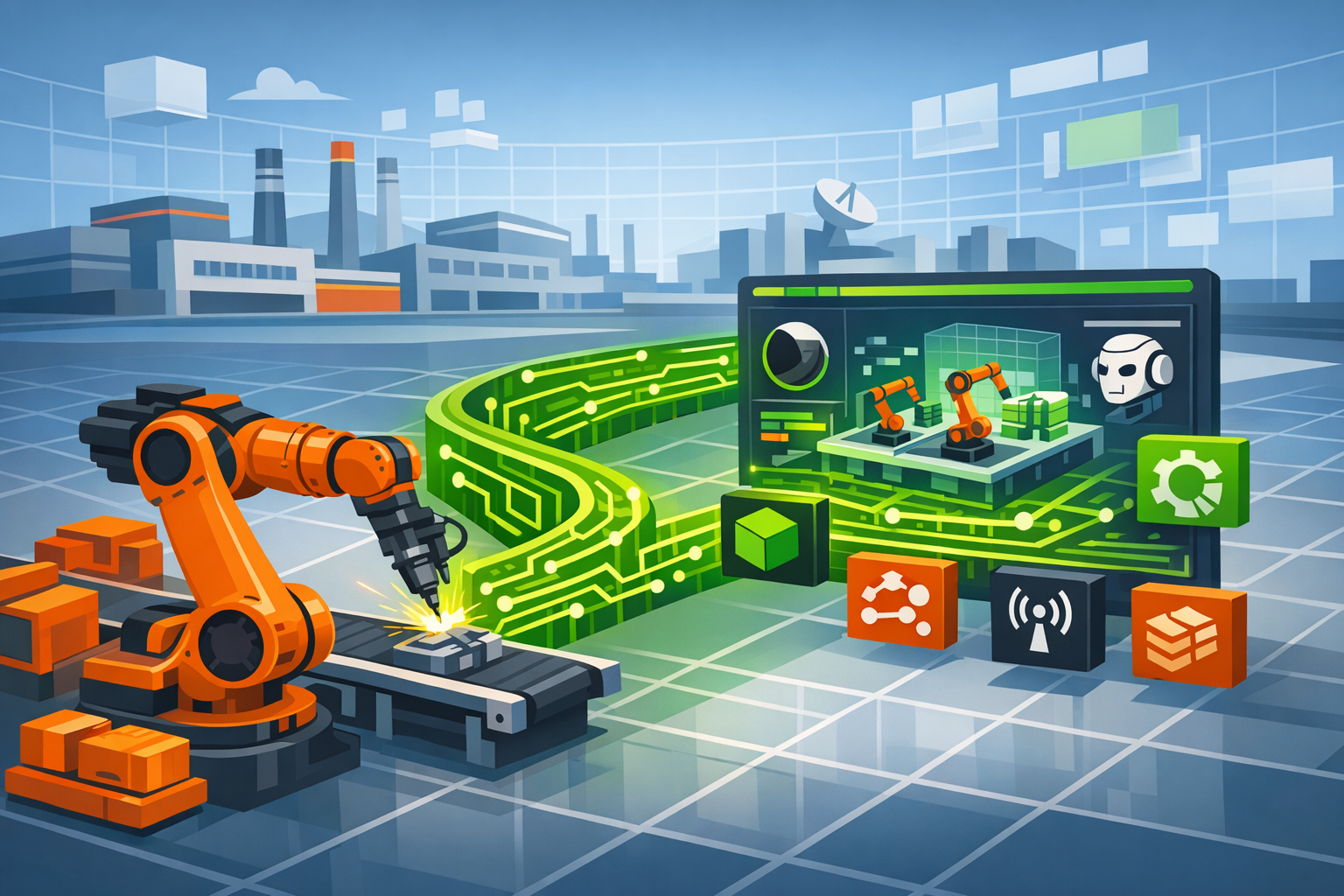
Manufacturing is transitioning from static automation to physical AI, driven by a new category of software: automation management platforms (AMPs). These platforms connect design, simulation, and shop-floor execution. NVIDIA GTC 2026 emphasized this transition, highlighting KUKA and other robotics firms integrating NVIDIA's Omniverse and Isaac frameworks into their deployment workflows. This analysis examines how AMP-style platforms, digital twins, and industrial AI are accelerating the move from laboratory innovation to production automation, and the implications for OEMs, integrators, and end-users.
Executive Summary
Industrial robotics and automation are entering a software-defined era. Digital twins, AI models, and interoperable data pipelines now determine how rapidly new automation reaches the factory floor. At GTC 2026, NVIDIA presented its physical AI stack (including Omniverse, Isaac Sim, Isaac GR00T, Jetson, and IGX Thor) as central to lab-to-factory workflows. KUKA, ABB, FANUC, and Yaskawa were showcased as early adopters of high-fidelity simulation and virtual commissioning for large robot fleets. Meanwhile, vendors such as KUKA are building AMP-style platforms based on engineering suites like iiQWorks, simulation tools, and connectivity options such as DeviceConnector. These platforms aim to reduce time-to-value for automation projects[1].
Industrial AI in Context: Demand for Faster Lab-to-Factory Cycles
The International Federation of Robotics reported about 4.66 million operational industrial robots in factories worldwide by the end of 2024[2]. Most are concentrated in automotive, electronics, and metalworking sectors, increasingly managed through software: coordinating fleets, updating skills, and validating changes without halting production.
Both digital twin and smart factory markets are expanding rapidly:
- A recent forecast values the global digital twin market at USD 24.48 billion in 2025, with projections reaching USD 384.79 billion by 2034[3].
- The smart factory market is estimated at about USD 227.73 billion in 2025, with continued growth expected[4].
- Dedicated AI-in-manufacturing platforms are smaller but growing swiftly, with the market set at USD 7.49 billion in 2025 and USD 27.25 billion by 2034[5].
Manufacturing investments align with these trends:
- Rockwell Automation's 2024 report found that 95% of manufacturers are using or evaluating smart manufacturing technologies, and 83% expect to use generative AI in operations during 2024[6].
- Deloitte's 2025 survey indicates 29% use AI or machine learning at facility or network levels, with many standardizing architectures and data models for larger deployments[7].
Amidst this, GTC 2026 positioned the industrial AI stack as an end-to-end "AI factory" and demonstrated how robotics vendors and OEMs are converging on AMP-style architectures.
GTC 2026: Physical AI, Omniverse and Robotics at Scale
GTC 2026 expanded on NVIDIA's AI factory narrative: an integrated stack of compute, networking, storage, and software to optimize physical operations using data. For machinery and manufacturing, several announcements stand out:
Physical AI and robotics leadership
- NVIDIA unveiled new Isaac simulation frameworks, Isaac GR00T N robot models, and Cosmos world models designed for training and validating intelligent robots.[8]
- NVIDIA identified KUKA, ABB Robotics, FANUC, YASKAWA, and other partners using Omniverse and Isaac for validating robot fleets and production lines with accurate digital twins[8].
Industrial software and digital twins
- Siemens, Dassault Systèmes, PTC, and others are building agentic AI workflows and digital twins on NVIDIA Omniverse and CUDA-X, ranging from vehicle aerodynamics to factory simulation.[9]
- Earlier work positioned Omniverse as a "physical AI operating system" for digitalization, with partners including Ansys, SAP, Schneider Electric, and adopters such as Foxconn, GM, and Mercedes-Benz.[10]
Digital-twin-driven factory automation
- Foxconn's Fii Omniverse Digital Twin (FODT) projects model entire factories virtually-including robot cells and AGVs-prior to deployment.FODT leverages Omniverse, Isaac Sim, and NVIDIA components to simulate layouts, robot tasks, and material flow, allowing rapid iteration before hardware investment[11].
These developments illustrate the construction of software bridges between virtual design and physical deployment. KUKA and other robot makers are aligning their software ecosystems to function as such bridges.
What an Automation Management Platform (AMP) Looks Like in Practice
Here, AMP refers to a functional software layer unifying simulation, configuration, orchestration, and analytics across diverse automation systems. In a smart factory, a typical AMP stack includes:
- A digital twin core with 3D plant models, process logic, and physics-based simulation
- Robotics software for cell design, offline programming, and virtual commissioning
- Industrial AI engines for perception, planning, predictive maintenance, and quality analytics
- Connectivity and data management linking PLCs, robots, MES, and enterprise IT
- Operations tooling for deployment, monitoring, and lifecycle management of AI models and automation recipes
KUKA's Software: An AMP Component
KUKA's software ecosystem shows how AMPs can be implemented:
- iiQWorks, KUKA's suite for digital manufacturing, offers lifecycle coverage for robot systems: configuration, simulation, programming, and commissioning, supporting consistent data exchange between planning and production[1].
- KUKA.Sim and Visual Components extend simulation to support mixed fleets and non-KUKA equipment.[12]
- KUKA.DeviceConnector exposes controller data over OPC UA and MQTT, enabling higher-level monitoring, analytics, and supervisory control[13].
When integrated with NVIDIA's Omniverse and Isaac for simulation and robot learning, these tools approximate an AMP: a software bridge for rolling out lab-developed designs and process logic across distributed factories while maintaining feedback and observability.
Digital Twins at the Core of Lab-to-Factory Workflows
Digital twins are crucial for shortening commissioning times and reducing automation risks.
From Offline Programming to Factory-Scale Twins
Offline programming and cell simulation are established for CNC and robot integration. The trend moves toward factory-scale twins that:
- Model entire lines and plants, including robots, conveyors, AGVs/AMRs, buffers, and human stations
- Support physics-based simulation for collision checking, throughput, and ergonomics analysis
- Integrate real-time industrial AI for vision, anomaly detection, and reinforcement learning-based optimization
NVIDIA Isaac Sim, built on Omniverse, targets this space-enabling digital twins, synthetic data generation, and interactive simulation.[14] KUKA and other robot vendors' integration of these frameworks aligns proprietary tools with an expanding ecosystem.[8]
Traditional vs Digital-Twin-Centric Deployment
The following table compares traditional automation deployment with AMP and digital-twin-centric deployments. Figures below are indicative.
| Aspect | Traditional Automation Deployment | AMP + Digital-Twin-Centric Deployment |
|---|---|---|
| Concept validation | Small physical pilot cell | Virtual pilot in factory twin; minimal physical tests |
| Change impact assessment | Manual FMEA, expert review | Automated scenario sweeps in simulation |
| PLC/robot integration | On-site programming and tuning | Offline programming, virtual commissioning, then download |
| Time to first production part | Weeks-months after delivery | Days-weeks after hardware install (twin ready) |
| Optimization cycle | Infrequent, manual | Continuous, AI/data driven |
| Vendor lock-in risk | High (custom vendor code) | Lower with open standards (OpenUSD, OPC UA, MQTT, ROS 2) |
Many manufacturers adopt hybrid models, but GTC 2026 suggests that virtual-first deployment is becoming a reference for new smart factory projects.
Interoperability and Avoiding Vendor Lock-In
Vendor lock-in concerns persist across hardware, PLCs, and robotics software. GTC 2026 announcements and KUKA's tools highlight several interoperability strategies.
Open Scene and Data Standards
- OpenUSD and Omniverse offer neutral scene, material, and behavior representation. CAD-to-OpenUSD bridges-for example, PTC Onshape into Isaac Sim-allow multi-OEM robot cells to validate in shared twins.[9]
- OPC UA and MQTT are emerging as standard protocols for equipment telemetry, as shown by KUKA.DeviceConnector, enabling AMP platforms to manage mixed fleets without custom drivers.
- ROS 2 and standardized interfaces are being adopted in research and select industrial cobot projects, facilitating custom AI behaviors and later integration.
Governance and Multi-Vendor Architectures
Deloitte's study shows manufacturers are setting architecture, data, and training standards at the enterprise level for AI deployments.[7] For AMPs, this often involves:
- A unified data model covering equipment, products, and events across MES, SCADA, and AI systems
- A catalog of approved connectors and APIs for integrating robots, machines, and sensors
- Model lifecycle policies for AI model versioning, validation, and rollback
In this context, KUKA's and NVIDIA's stacks function as plug-in subsystems rather than monolithic solutions.
Operational Payoffs: Predictive Maintenance, Quality, and Throughput
Predictive maintenance and quality control are prominent early applications for industrial AI.
- Research and case studies document predictive maintenance's effectiveness in reducing unplanned downtime and stabilizing output.[15]
- Rockwell's survey identified quality control as manufacturers' top AI/ML use case, surpassing energy management or supply chain optimization.[6]
AMPs, when combined with digital twins and connected robotics, support:
Condition monitoring and forecasting
- Robots and CNC machines transmit telemetry via OPC UA/MQTT to AI models and databases
- Digital twins simulate faults and drifts to test predictive algorithms
AI-driven quality inspection
- Vision models, trained on synthetic or real data, execute on edge devices like Jetson, sometimes within robot controllers[11]
- Inspection results are fed back into twins to analyze process or design issues
Throughput and flow optimization
- Scheduling and routing agents are tested on factory twins, with solvers like NVIDIA cuOpt for AGV routing or line balancing[11]
For plant managers, the main shift is the ability to apply lab-developed improvements fleet-wide via the AMP bridge.
Implementation Patterns for OEMs, Integrators, and End-Users
Structuring Pilots for Measurable ROI
Effective lab-to-factory pilots generally exhibit:
- Limited, high-impact scope (e.g., a robot cell with frequent changeovers)
- Digital-twin validation with defined parity metrics (cycle time, scrap rate, utilization)
- Incremental deployment: start in monitoring mode, transition to advisory, then closed-loop control after safety is proven
- Cross-functional teams including operations, IT/OT, safety, and data staff to bridge lab, simulation, and production
Modular Software Designs
Manufacturers are moving toward modular AMP stacks to avoid new silos:
- Use Omniverse/OpenUSD or similar for scene representation to connect CAD, simulation, and visualization
- Standardize on OPC UA, MQTT, REST APIs for telemetry and control commands, enabling equipment interoperability
- Encapsulate AI services with APIs so models can be replaced without recoding control logic
- Separate safety-critical control from non-safety AI functions, even on shared edge hardware such as IGX Thor or Jetson[16]
Workforce and Organizational Change
Data and vendor roadmaps suggest smart factory and industrial AI tend to redeploy labor rather than eliminate it.Rockwell's 2024 report noted that 94% of manufacturers expect to maintain or grow their workforce, prioritizing reskilling[6].
Key skills for AMP-style lab-to-factory deployments:
- Simulation and digital twin engineering
- Data engineering and MLOps for industrial settings
- Controls and safety expertise
- Change management for adapting procedures and maintenance practices in software-driven automation
Regulatory and Cybersecurity Considerations
As AI-enabled automation reaches production, several non-technical risks emerge:
OT-edge cybersecurity
- AMPs increase connectivity and may link to cloud services, introducing new vulnerabilities
- Best practices include network segmentation, zero-trust onboarding, and consistent patching for controllers and AI runtimes
Model governance and traceability
- AI models in safety-critical or quality applications may require rigorous audit trails and versioning for compliance
Data sovereignty and industrial AI clouds
- Initiatives like the European Industrial AI Cloud emphasize jurisdiction-resident data use with GPU infrastructure[17]
- AMPs must ensure compliance for cross-border deployment or multi-plant analytics
Functional safety integration
- Standards increasingly require deterministic fallback and explainable failure modes for AI-augmented systems
- Safety-certified layers must remain distinct from probabilistic AI, even within unified environments
Conclusions and Next Steps for Manufacturers
GTC 2026 highlights a structural change in automation: AI-enabled software bridges now connect design, digital twins, and production. KUKA's integration into NVIDIA's ecosystem, combined with its digital engineering and connectivity tools, reflects the evolution of robot OEMs toward AMP-style platforms.
Manufacturing leaders can prioritize:
- Defining architecture: establish how digital twins, robotics software, industrial AI, and existing systems will interact, specifying standards
- Piloting virtual-first deployments: select production lines to demonstrate measurable gains with smart twins and AI robotics
- Fostering interoperability: choose solutions supporting OpenUSD, OPC UA, MQTT, and ensure both KUKA and non-KUKA assets operate in unified twins
- Developing workforce capabilities: create training programs for simulation, data, and controls engineers working with AMPs
- Embedding governance early: address model management, cybersecurity, and safety as built-in requirements
As physical AI advances, factories increasingly resemble adaptable robots. Manufacturers treating AMP bridges as core infrastructure will unlock benefits while maintaining resilience and flexible vendor choices.
Frequently Asked Questions
How is a digital twin different from traditional simulation in factory automation?
Traditional simulation models isolated elements, such as a robot cell or CNC, for layout or programming checks. A digital twin is a live, system-level replica continually updated to reflect the actual factory.
Differences include:
- Scope: twins span whole lines or plants, covering equipment, workers, and logistics
- Data link: real-time telemetry synchronizes the twin to the physical asset
- Decision support: AI models operate directly on twin-connected data for forecasting and optimization
In AMP architectures, the digital twin validates automation before deployment.
What investments are required to start building an AMP-style lab-to-factory bridge?
Common investments include:
- Software: robotics simulation (KUKA tools, Omniverse/Isaac Sim), digital twin platforms, data and MLOps systems
- Edge infrastructure: industrial PCs or servers with GPUs near factory lines
- Connectivity: standardized OPC UA/MQTT gateways and secure networking
- Skills: cross-functional teams for simulation, data, and controls
Manufacturers often begin with a strategic pilot on a key line using current robot assets before scaling up.
How can manufacturers avoid becoming locked into a single vendor's ecosystem?
Avoid lock-in by:
- Adopting open formats/protocols (OpenUSD, OPC UA, MQTT, REST APIs) for data and scenes
- Requiring export/import support for vendor-neutral configurations
- Maintaining an independent data lake or historian
- Negotiating contracts ensuring access to data and models after platform changes
Enforcing governance at the enterprise level is key, as highlighted by GTC 2026's push for open model ecosystems.
Where does predictive maintenance usually start in a smart factory roadmap?
Predictive maintenance starts with critical assets-robot groups, CNCs, presses, or bottleneck conveyors. Typical steps:
- Install telemetry (vibration, torque, temperature, cycle counts)
- Establish a monitoring dashboard with analytics
- Introduce pilot AI models, validated in the digital twin or advisory mode
AMP integration enables predictions to influence scheduling, part planning, or adaptive robot programming.
How do AMP-style platforms coexist with existing PLC, DCS, and SCADA systems?
AMPs augment, not replace, real-time controls:
- PLC, DCS, and safety systems retain responsibility for deterministic operations
- AMPs host twins, AI, and orchestration proposing set points or programs
- Integration is handled via standardized gateways-OPC UA servers, brokers, or APIs
This approach lets factories leverage AI and digital twins while maintaining established safety and reliability with legacy automation.