Unplanned downtime in high-precision manufacturing can cost up to $1 million per hour[1]. For mid-sized plant operators-running facilities of 200 to 800 employees with capital budgets in the tens of millions-that figure has historically kept advanced connectivity and AI in the realm of strategic aspiration rather than operational reality. Federal grant programs are changing that calculus.
Across several states, recipients of funding tied to programs including the CHIPS and Science Act's Tech Hub initiative, NIST's Manufacturing USA network, and FY2025 National Defense Authorization Act (NDAA) appropriations are moving decisively from proof-of-concept pilots to production-scale deployments. The pattern emerging from these facilities reveals not just a technology upgrade cycle, but a structural shift in how mid-market manufacturers architect smart factory strategies.
The Federal Funding Landscape
The federal investment pipeline supporting manufacturing digitization has grown substantially. Building on the July 2024 announcement of $504 million for 12 Tech Hubs, total awards now exceed $700 million for 18 centers of excellence focused on jobs and industries of the future. The FY2025 NDAA extended this further, appropriating up to $500 million for the Tech Hubs Program with proceeds from a spectrum auction run by the Federal Communications Commission.
Alongside the Tech Hub program, NIST has pursued a parallel track targeting AI adoption in manufacturing. NIST is investing $20 million, in partnership with the MITRE Corporation, to establish two centers advancing AI-based technology solutions to strengthen U.S. manufacturing and cybersecurity for critical infrastructure. Those two centers-the AI Economic Security Center for U.S. Manufacturing Productivity and the AI Economic Security Center to Secure U.S. Critical Infrastructure from Cyberthreats-represent a deliberate pairing of production efficiency with cyber resilience.
The longer-horizon signal is the forthcoming AI for Resilient Manufacturing Institute under the Manufacturing USA program. NIST plans to announce its award for the institute, which carries up to $70 million in investment over five years from NIST and at least that much in nonfederal funding. The institute will bring together expertise in AI, manufacturing, and supply chain networks to promote manufacturing resilience.
| Program | Agency | Funding | Manufacturing Relevance |
|---|---|---|---|
| Tech Hubs (CHIPS & Science Act) | EDA / Commerce | $700M+ awarded to 18 hubs | Critical technology scale-up incl. advanced mfg. & AI |
| AI for Resilient Manufacturing Institute | NIST / Manufacturing USA | Up to $70M over 5 years | Edge AI deployment R&D; supply chain resilience |
| AI Economic Security Centers | NIST / MITRE | $20M | AI manufacturing productivity & OT cybersecurity |
| MEP National Network | NIST | Ongoing | Assists small/mid-sized manufacturers with digitization |
| FY2025 NDAA Tech Hub Expansion | EDA / FCC Spectrum Auction | Up to $500M additional | Broadens tech hub reach; spectrum proceeds fund 5G deployments |
From Pilot to Production: What the Transition Requires
The majority of manufacturers that initiated Industrial IoT (IIoT) programs between 2019 and 2022 stalled at the proof-of-concept stage. Despite clear ROI potential, many still struggle to move AI initiatives from isolated pilots to scalable, factory-wide solutions-challenges rooted not only in technical gaps but in data readiness, organizational alignment, and evolving regulatory expectations.
Federal grants are proving effective at breaking this logjam-not purely through capital injection, but by imposing deployment discipline that internal budget cycles rarely enforce. Grant recipients report that documentation requirements-covering architecture standards, cybersecurity controls, and workforce readiness plans-function as de facto implementation roadmaps.
The deployment pathway emerging across grant-recipient facilities follows a consistent sequence:
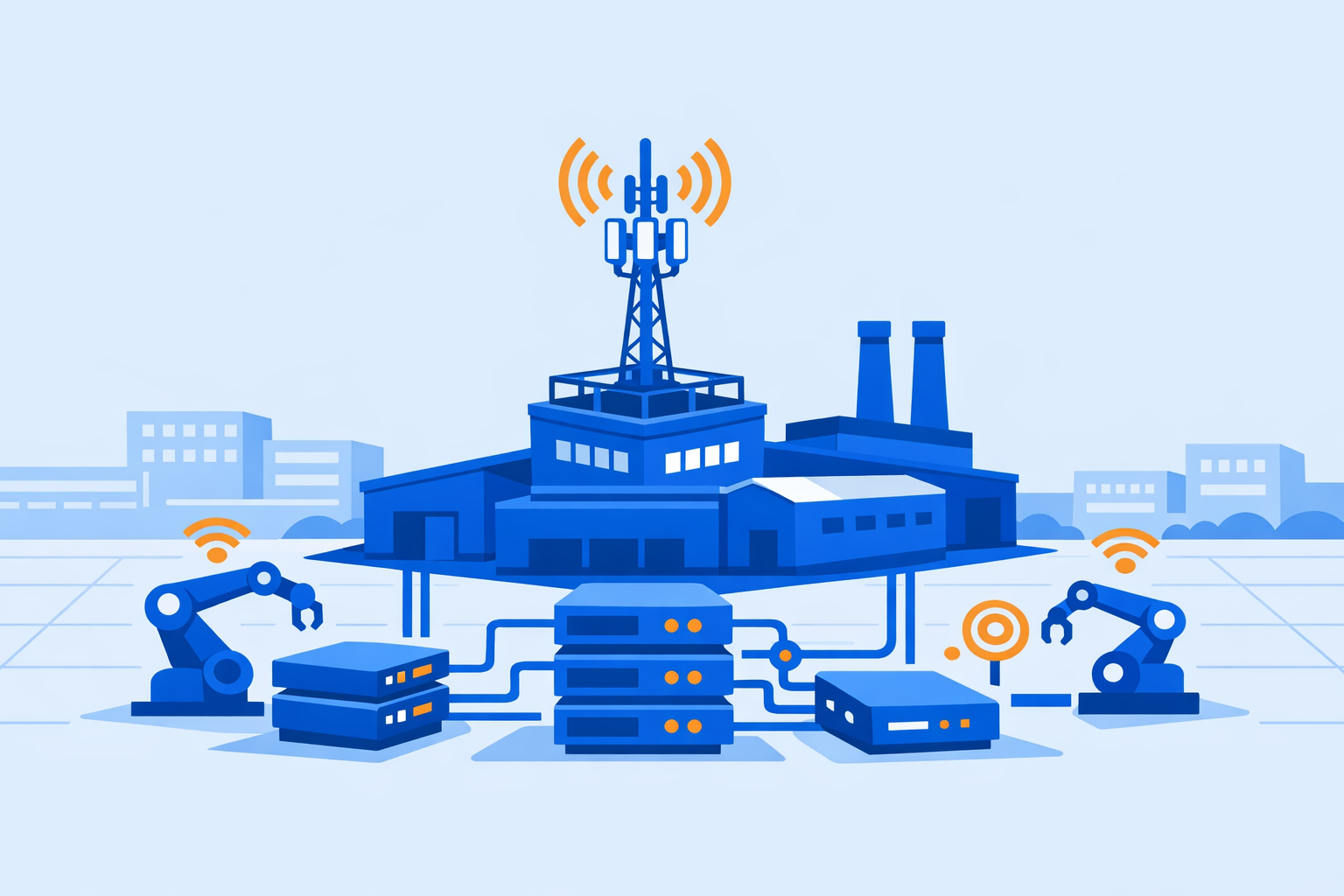
1. Establish a private 5G backbone. The manufacturing sector holds the largest share of the private 5G market, driven by Industry 4.0 adoption and the need for real-time automation, machine communication, and predictive maintenance. Private 5G enables secure, low-latency connectivity in smart factories, enhancing operational efficiency and digital transformation. Facilities are deploying Citizens Broadband Radio Service (CBRS) spectrum-based networks offering sub-20-millisecond latency within the plant perimeter, without sharing bandwidth with public carriers.
2. Deploy platform-agnostic edge compute. A notable trend among grant recipients is the deliberate avoidance of single-vendor edge lock-in. Facilities are selecting edge compute hardware and software stacks that ingest data from heterogeneous sensor networks-legacy programmable logic controllers (PLCs), new IIoT nodes, and vision systems-under a common data governance layer.
3. Operationalize AI at the edge. Wireless sensors monitor equipment across multiple data points via power-optimized 5G connections, while gateway edge devices correlate, synthesize, and analyze vibration and temperature patterns, triggering detailed diagnostics when anomalies emerge. Facilities are also establishing model lifecycle management practices-formal processes for versioning, retraining, and auditing AI models deployed on the floor.
Plant-Floor Benefits: Where the ROI Is Materializing
The business case for private 5G and edge AI is sharpening as early grant recipients report first-year results. Industry benchmarks provide useful context:
- Predictive maintenance: AI-driven predictive analytics can increase failure prediction accuracy up to 90% while reducing maintenance costs by 12%, according to industry analysis[2]. The global predictive maintenance market reached $10.93 billion in 2024 and is projected to surge to $70.73 billion by 2032 at a compound annual growth rate (CAGR) of 26.5%.
- Downtime reduction: Predictive maintenance is cutting downtime and AI-driven optimization is reducing energy waste on production floors. AI can lower manufacturing maintenance costs by 25-40%.
- Quality and waste: 78% of production facilities utilizing AI reported a waste reduction, and AI-driven energy management systems achieved an average energy savings of 12%.
- ROI timeline: Most high-impact manufacturing AI systems achieve payback within 6-18 months, but "time to first measurable value" is often as short as 6-10 weeks with modular deployments.
Beyond maintenance, private 5G unlocks line reconfigurability-the ability to redeploy wireless sensors and edge nodes when a production line changes configuration, without re-cabling. In today's volatile demand environment, this capability is drawing attention from operations directors managing frequent SKU changeovers.
Cybersecurity: The Non-Negotiable Prerequisite
Federal grant programs referencing NIST standards and CHIPS Act requirements are pushing cybersecurity from a compliance checkbox to a structural design requirement. The threat environment gives that push urgency.
Ransomware attacks in the industrial sector spiked 87% year-over-year in 2024, making manufacturing the top ransomware target for four consecutive years, according to Dragos research[3]. As OT and IT networks increasingly converge, 75% of OT attacks begin as IT breaches, adding complexity to OT security. The average cost of a manufacturing sector data breach reached $4.97 million in 2024, per industry analysis[4]-not including business interruption losses.
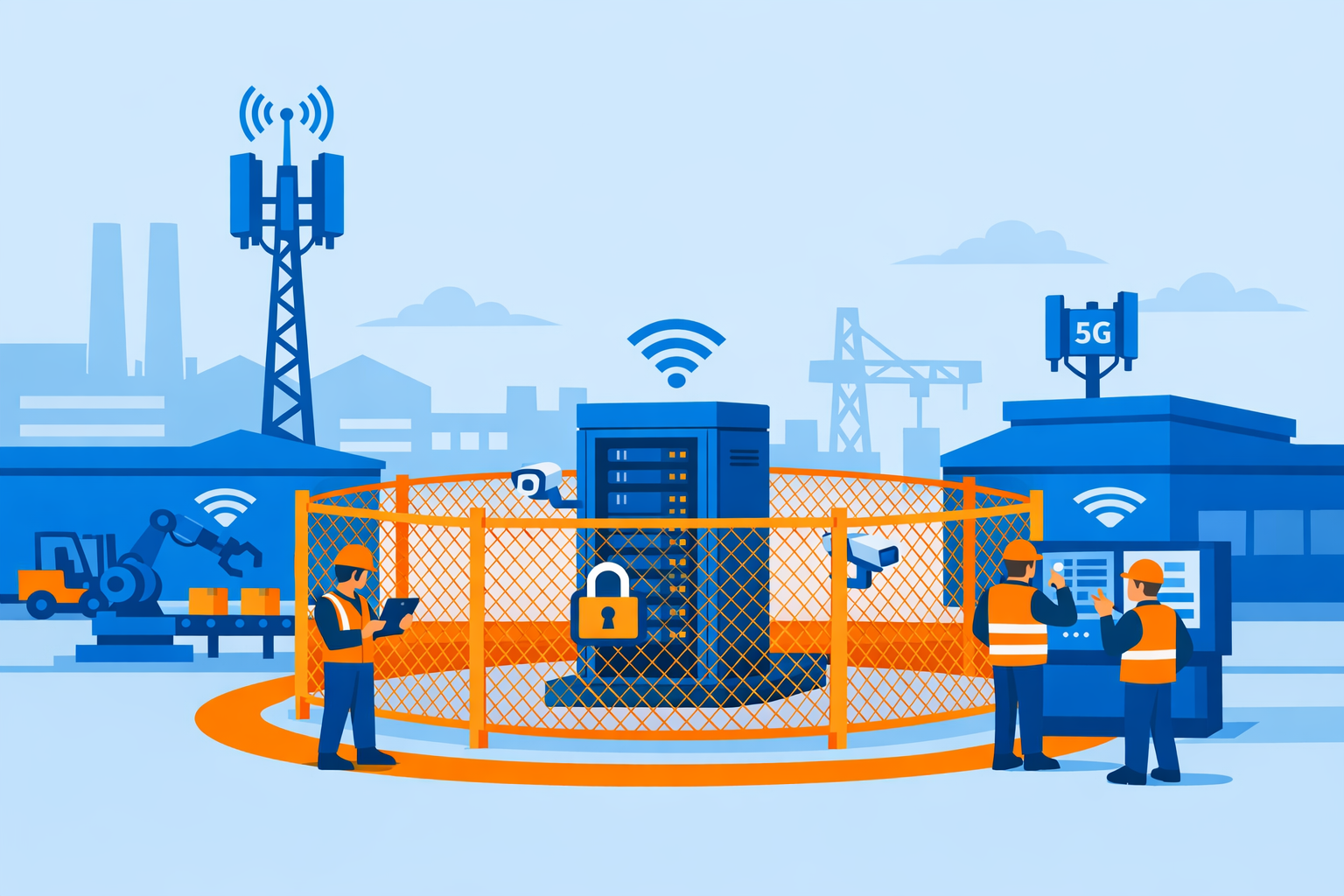
5G and wireless connectivity expansion increases the attack surface for industrial IoT devices while creating new requirements for wireless security and device authentication. Facilities deploying private 5G networks on grant funding must address OT security architecture from day one.
Cybersecurity is a grant condition, not an afterthought. Federal programs aligned with NIST and CHIPS Act requirements increasingly mandate that recipient facilities demonstrate adherence to frameworks such as NIST CSF and ISA/IEC 62443. OT network segmentation, device identity management, and incident response planning should be treated as prerequisites to deployment.
Best practices cited by security specialists include network segmentation with logical micro-segmentation for IoT/OT zones, strong device identity, and strict access controls to reduce lateral movement when a device is compromised. Public and private 5G networks remain vulnerable without robust zero trust models; integrated systems should deliver end-to-end zero trust enforcement, device microsegmentation, and AI-based anomaly detection across edge, cloud, and 5G networks.
The Deployment Pathway: Pilot to Production Scale
The sequence applied across leading grant-recipient facilities illustrates a repeatable blueprint:
Step 1 - Secure Federal Funding: Document the use case, ROI projection, and cybersecurity compliance plan against program requirements.
Step 2 - Deploy Private 5G Network Infrastructure: Stand up a dedicated CBRS or licensed-spectrum private 5G network covering the plant floor; establish segmentation between IT and OT zones.
Step 3 - Integrate Edge Compute Nodes: Deploy platform-agnostic edge servers near high-value assets; connect IIoT sensors for vibration, temperature, energy draw, and vision inspection data.
Step 4 - Operationalize Edge AI Models: Implement models for predictive maintenance, automated quality inspection, and process optimization; institute model lifecycle management practices.
Step 5 - Govern and Scale: Define KPIs (uptime, defect rate, energy intensity, time-to-market). Apply auditable, standardized configurations for internal governance and external compliance; expand to additional production lines.
KPIs and the 12-24 Month Horizon
Industry observers and grant administrators are converging on a common set of measurable outcomes that define whether a deployment has reached production scale:
- Overall Equipment Effectiveness (OEE) improvement, targeting ≥5 percentage points within 12 months
- Unplanned downtime frequency and duration, with leading programs reporting 30-50% reductions
- First-pass yield and defect rate, with AI-driven quality inspection targeting ≥25% defect reduction
- Energy intensity per unit produced, tracked against AI optimization baselines
- Cybersecurity incident metrics, including mean time to detect (MTTD) and mean time to respond (MTTR) for OT anomalies
A 2024 McKinsey survey indicated that over 65% of large manufacturers have initiated or completed IoT sensor deployment for core assets, a number projected to exceed 85% by 2026. Mid-sized facilities receiving federal grants are working to close the gap with larger counterparts-and the trajectory of current programs suggests the next 12 to 24 months will be decisive.
The blueprint being assembled by grant recipients-standardized architecture, AI model governance, cybersecurity-by-design, and a clear KPI framework-may ultimately prove more valuable than the grant funding itself. It is a repeatable deployment pattern that other facilities, regardless of funding source, can adapt and apply.
For plant managers and operations directors evaluating where to begin, the signal from current program data is clear: factories that move from pilots to production-grade private 5G and edge AI deployments-with robust security and measurable governance-are establishing competitive positions that will be difficult to replicate in two to three years. Broader analysis of how AI automation and lean practices are converging across sectors reinforces that the window for first-mover advantage in this space remains open but is narrowing.