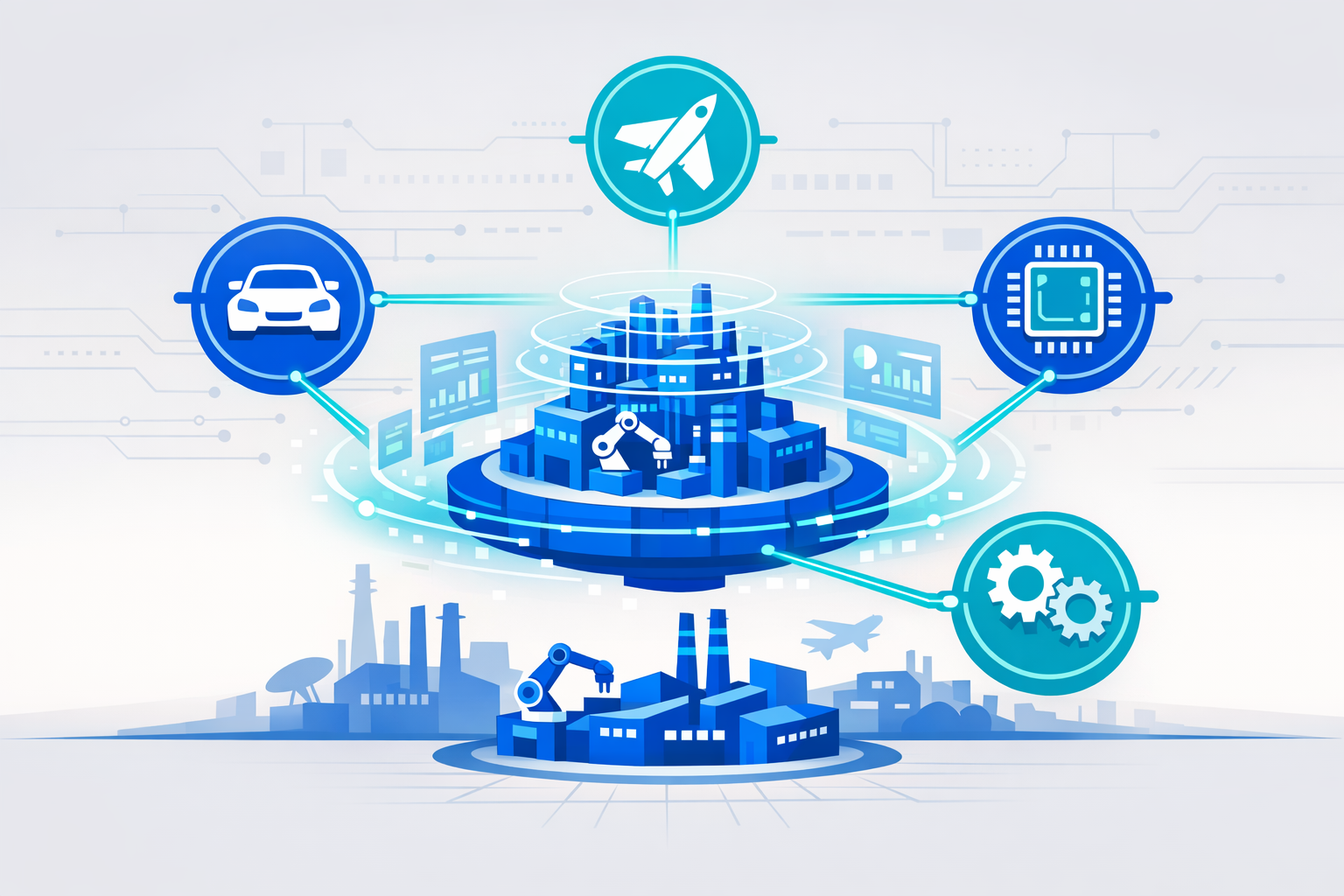
Manufacturers in automotive, aerospace, electronics, and related sectors are advancing AI-driven automation and lean initiatives by sharing innovations across industries. Siemens's Nanjing Lighthouse Factory, recognized by the World Economic Forum for its productivity and quality improvements through digital twins and ongoing AI integration, illustrates this convergence of electronics and automation. "We call our Nanjing facility a 'digital-native factory'," Siemens stated, highlighting its virtual design approach, which enabled cost-efficient construction during pandemic constraints. This methodology demonstrates how cross-sector strategies can reduce deployment timelines. Nanjing is Siemens's fifth Lighthouse Factory, following Amberg, Erlangen, Fürth, and Chengdu, according to World Economic Forum recognition.[1]
Background
Cross-industry collaboration is facilitating scalable AI and lean manufacturing practices. Technologies such as digital twins, AI-enabled vision systems, and workflow automation are increasingly applied across manufacturing disciplines. Recent analysis emphasized how integrating AI Vision, SAP Product Lifecycle Management (PLM), and workflow automation can remove organizational silos and improve end-to-end efficiency.[2] Automotive sector examples underscore this trend: an AI-powered 5S audit system reduced audit duration by 50% and lowered operating costs by 99.8%, highlighting the benefits of combining lean and AI approaches.[3]
Details
Manufacturers face persistent challenges-data interoperability, workforce skill gaps, and standards-which are being addressed through collaborative ecosystems. Research reveals that only 20% of manufacturers have production assets with data suitable for AI models, and 70% of executives are emphasizing upskilling rather than new hiring. Participation in high-performing partner ecosystems correlates with more growth opportunities compared to traditional mergers and acquisitions.[4] Companies such as Siemens, BMW, and Bosch are pairing AI tools with workforce development. Examples include AI microlearning and augmented reality/virtual reality (AR/VR) training, which have decreased onboarding times by 30-40%; AI copilots that enable 50% faster decision-making; and AI vision using synthetic data, which has shortened quality inspection model training time by 66%.[5] In automotive logistics, Stellantis implemented AI-driven vision systems and autonomous mobile robots (AMRs), resulting in an 11% reduction in transformation costs, a 23% decrease in energy consumption, and 40% fewer quality issues since 2021.[6]
Outlook
Manufacturers are likely to further accelerate cross-sector AI and lean adoption by expanding collaborative hubs and ecosystem platforms aimed at improving interoperability and workforce capabilities. Ecosystems that prioritize data readiness and skills development are positioned to deliver faster time-to-value and greater operational resilience.