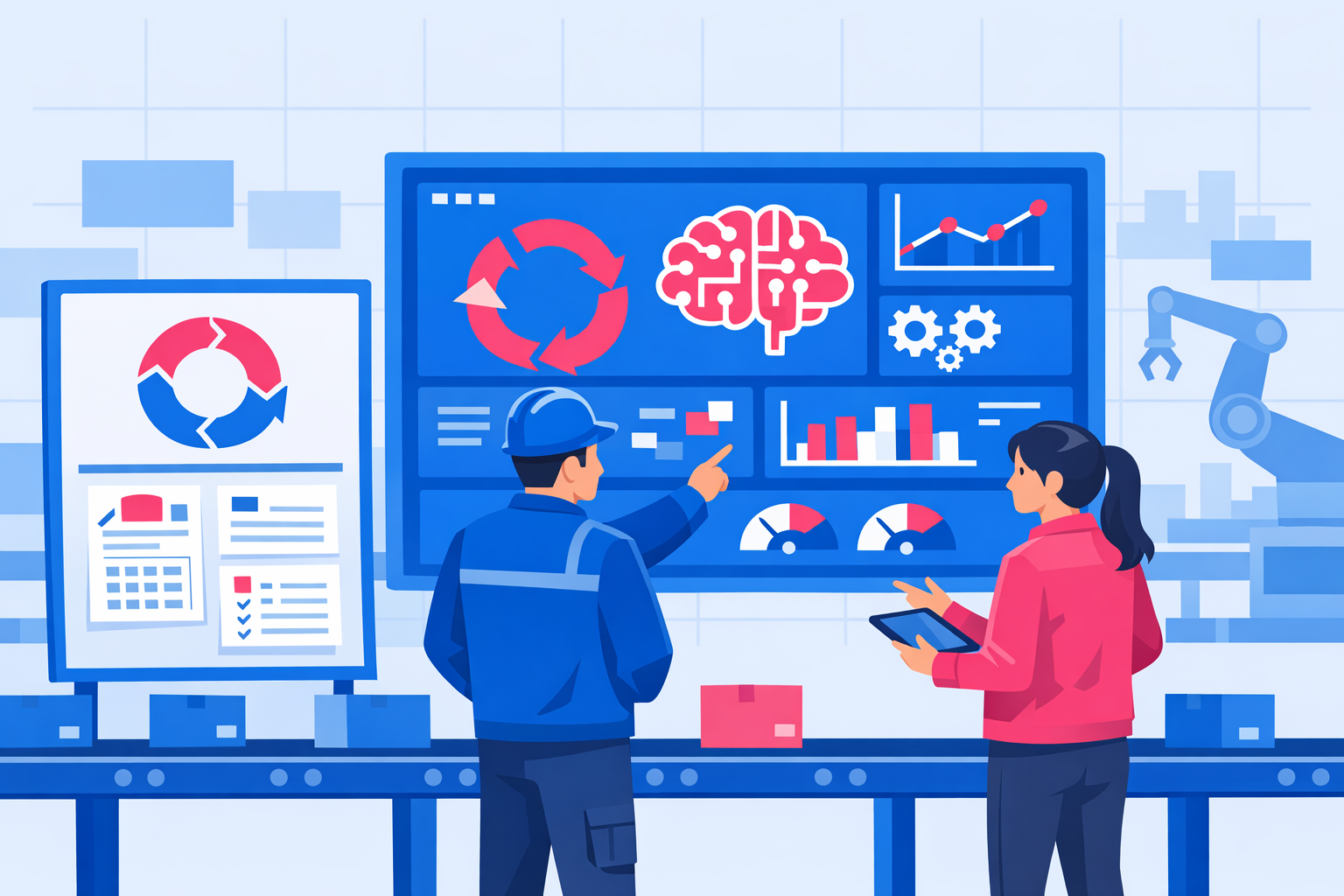
New industry data indicates that manufacturers embedding lean principles before deploying artificial intelligence are significantly more likely to move AI beyond the pilot stage and achieve measurable returns - while those skipping this foundation risk joining the majority of industrial AI projects that stall before reaching production.
Background
An MIT study, The GenAI Divide: State of AI in Business 2025, found that while generative AI holds promise for enterprises, roughly 5% of AI pilot programs achieve rapid revenue acceleration; the vast majority stall, delivering little to no measurable impact on profit and loss. The pattern is consistent across industrial sectors. Recent global research shows that 61% of industrial organizations now deploy AI in live environments rather than experimenting in isolation, yet only 20% have reached truly scaled, mature adoption.
The structural barriers are well-documented. Despite growing interest and clear ROI potential, many manufacturers still struggle to move AI initiatives from isolated pilots to scalable, factory-wide solutions. Challenges stem from gaps in data readiness, organizational alignment, and evolving regulatory expectations. Most manufacturers still operate with fragmented data ecosystems: legacy MES/SCADA systems, siloed PLC data, and inconsistent sensor quality.
Details
The McKinsey COO100 Survey, conducted in mid-2025 with 101 senior operating executives at organizations with revenue of at least $1 billion, identified infrastructure deficiencies as a primary constraint. 46% of surveyed COOs report limitations in their data or IT/OT systems, with outdated infrastructure cited by 19% and poor data quality by 18% as factors slowing progress. On average, respondents gave the lowest priority to workforce enablement, IT/OT infrastructure, and cybersecurity - the same foundations that determine whether AI deployments can scale safely and sustainably. Without them, even advanced automation tools risk stalling at pilot stage.
Lean manufacturing's role as a prerequisite for AI scalability is gaining traction among practitioners and researchers. Even as factories adopt robotics, IoT sensors, and digital dashboards, lean provides the cultural backbone - without it, technology becomes fragmented, disconnected from daily work, and ultimately ineffective. Studies show many early Industry 4.0 projects failed to deliver value, with only 14% of companies rating their smart factory initiatives successful as of 2019, often because they adopted technology without a lean mindset and ended up "digitizing waste." The consensus now holds that lean should guide digital transformation: get processes right, then apply technology to enhance them.
Process standardization underpins AI model performance. According to Bain & Company, most AI pilots fail to scale to full production, often because of poor data quality, unclear ownership, and inconsistent governance. Pilots frequently succeed because they rely on offline, nonproduction datasets that have been manually cleaned; when scaling begins, underlying data issues resurface and halt progress. A robust data strategy, governance framework, and operating model are no longer optional - they are core enablers of AI value realization.
The OT/IT convergence gap remains a structurally distinct challenge for manufacturers. A 2025 Gartner survey found that 61% of manufacturers rate their OT/IT integration as "basic" or "non-existent," capping AI maturity at Stage 1 regardless of data science capability. Survey research based on 1,000 industry leaders shows that while 57% of organizations report some level of IT/OT collaboration, a significant proportion still operate with limited or no meaningful cooperation. Fully converged teams remain rare.
Workforce enablement is directly linked to ROI velocity. BCG's Smart Factory Workforce Report 2025 found that manufacturers investing in shop-floor digital upskilling achieve 2.3x faster AI time-to-value. A 2025 Nash Squared survey shows the AI skills shortage now outstrips even big data and cybersecurity gaps. Without the required skills, pilot projects stall, business value disappears, and critical knowledge exits as seasoned operators retire.
Lean tools such as Plan-Do-Check-Act (PDCA) cycles and standard work are increasingly identified as the structural scaffolding for AI integration. The PDCA cycle thrives on structured learning, but human analysis alone can be slow with today's complex datasets. AI accelerates root cause analysis by uncovering correlations across machines, processes, and quality data, enabling teams to validate problems faster and complete improvement cycles more quickly while still respecting lean discipline. A peer-reviewed study published in April 2026 in Administrative Sciences examined manufacturers in southern Europe and North Africa and found that the convergence of lean production with AI creates new dimensions including data-driven decision-making, predictive analytics, and operational agility.
Outlook
Over the past five years, one-third of manufacturing respondents said their companies spent less than 1% of the cost of goods sold on digital and AI. When asked about plans for the next five years, only 7% intend to maintain that low level of investment - with nearly one-third planning to spend at least 5%. For system integrators and platform vendors, the implication is direct: too many organizations remain trapped in perpetual pilots, and technology is not the primary barrier to scale. Governance, culture, and clarity of value are. Manufacturers that establish standardized data pipelines and lean-aligned process documentation before expanding AI to additional lines and sites are positioned to convert isolated proofs of concept into repeatable, multi-site deployments.