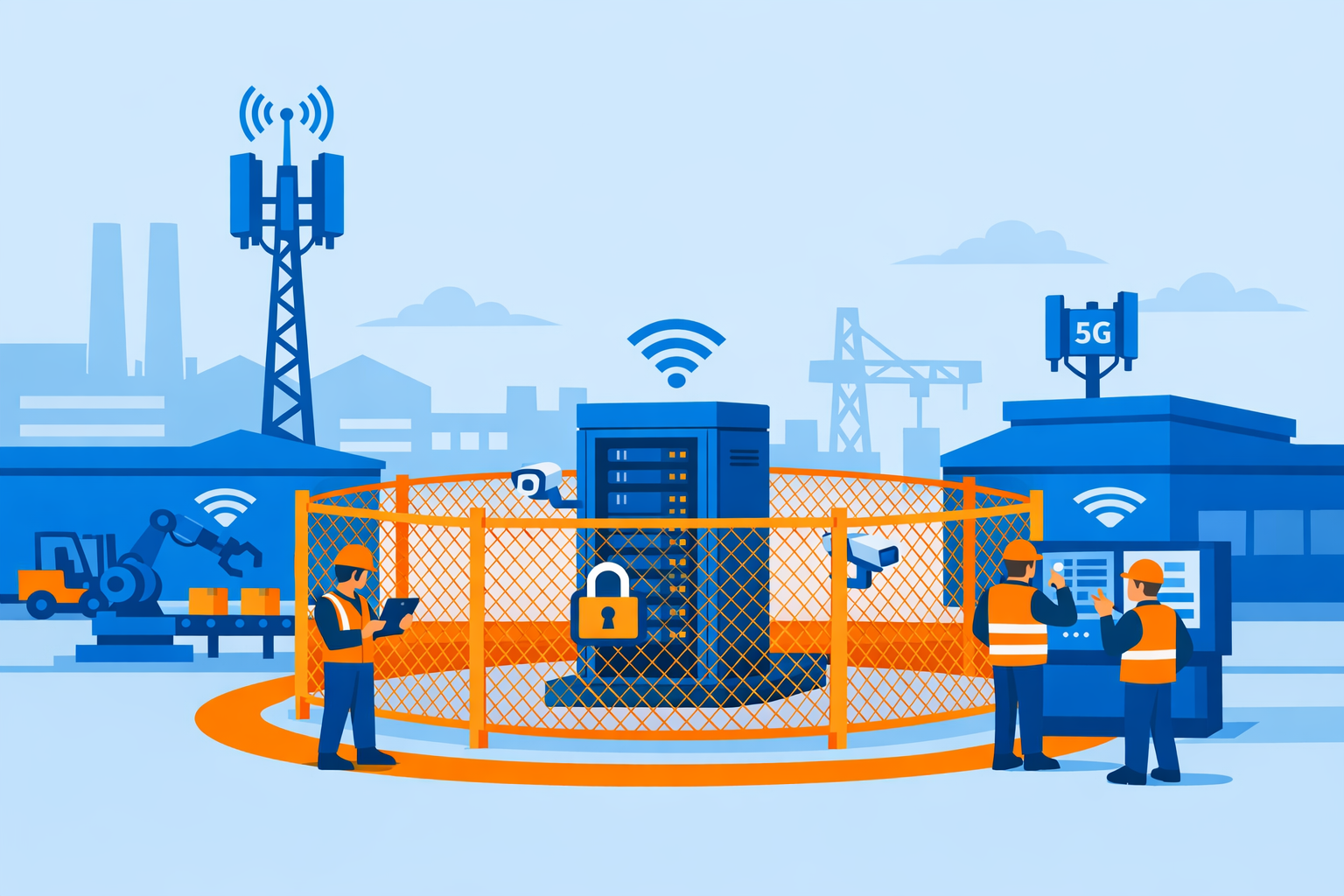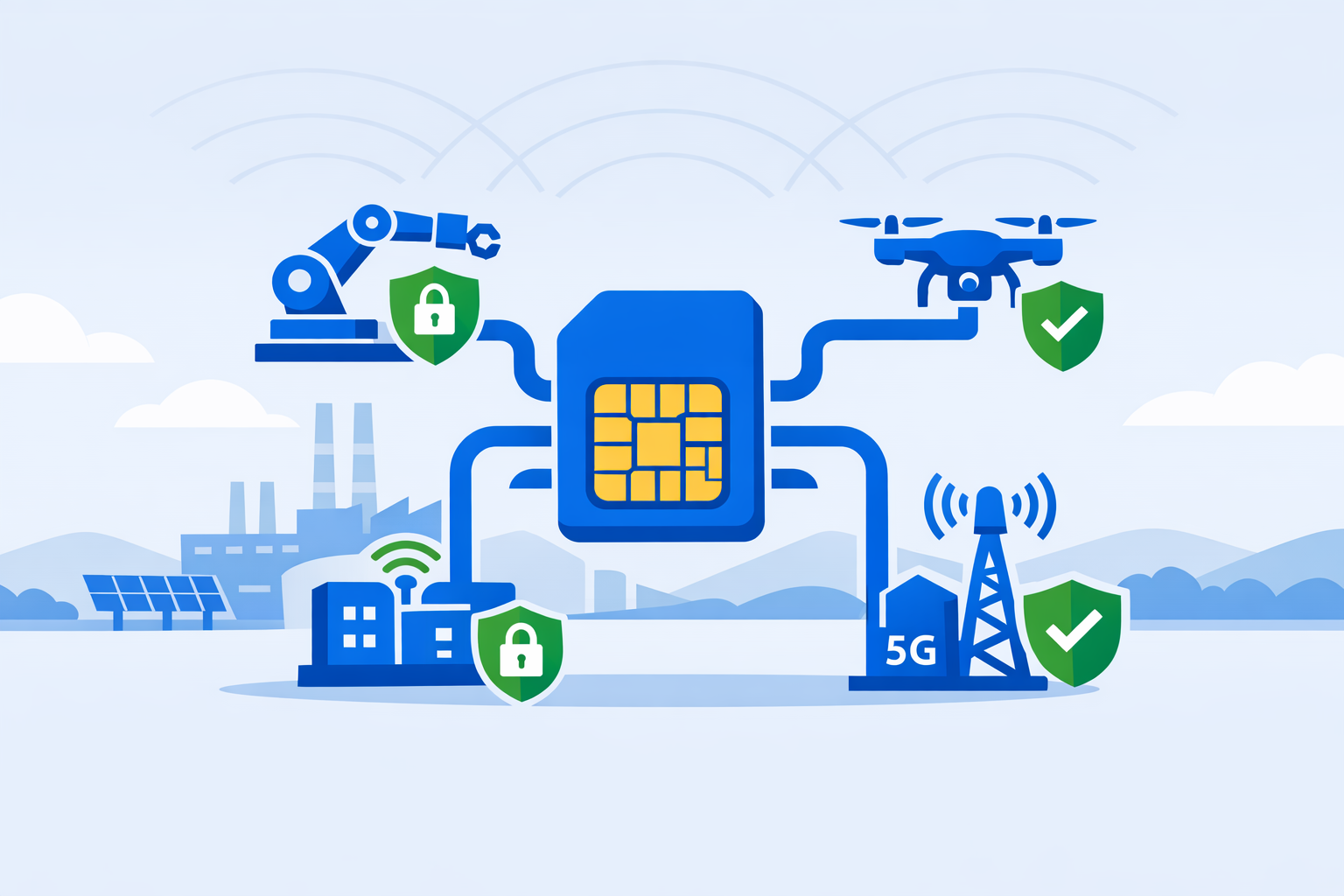
Industrial connectivity is becoming a core dependency for operations. As factories, warehouses, mines, utilities, and airspaces integrate more autonomous systems, IoT SIM cards are shifting from commodity components to critical infrastructure.
This article analyzes the role of cellular IoT connectivity in safety- and mission-critical control loops, the impact of eSIM and provisioning standards, evolving risk and policy landscapes, and patterns for architects and operations leaders to build resilient SIM-based infrastructure.
From Optional Add-On to Industrial Nervous System
Adoption statistics reflect the central role of cellular IoT in industry.
Global cellular IoT connections surpassed 4 billion by the end of Q3 2024 and are forecast to reach roughly 4.2 billion by early 2025. These links now support production assets, mobile robots, field equipment, and drones, rather than just low-risk telemetry.
Key factors advancing IoT SIMs as critical infrastructure:
Shift from soft to hard control loops
Initial deployments focused on condition monitoring, metering, and tracking. Currently, cellular links enable remote control of autonomous mobile robots (AMRs), automated guided vehicles (AGVs), and drones operating beyond visual line of sight (BVLOS).Convergence of OT, IT, and cloud
Machine states and safety logic increasingly depend on cloud-hosted services. Loss of cellular connectivity may now interrupt production or impact safety, not just delay reporting.Industrial 5G capabilities
5G Ultra-Reliable Low-Latency Communications (URLLC) supports high reliability and millisecond-level latency for automation, robotics, and unmanned vehicles.
Regulators are reflecting this shift, with telecommunications networks in many jurisdictions classified as critical infrastructure. This reclassification has direct implications for IoT SIM governance.
Downtime Economics: Why Connectivity Now Affects Safety and OEE
Connectivity failures in mid- to large-scale plants quickly result in significant costs.
Industry analyses estimate that unplanned industrial downtime typically costs from tens of thousands up to US$500,000 per hour, with sector averages around US$260,000 per hour in manufacturing. In high-throughput sectors like automotive, costs can reach millions per hour.
If cellular connectivity only supports non-critical telemetry, such outages are tolerable. As SIM-connected systems:
- orchestrate robotic fleets,
- transmit safety-related video and sensor data, and
- close control loops for process adjustments,
a loss of mobile connectivity now causes production stops, quality issues, or safety incidents.
Soft vs. Hard Control Loops
Industrial sites increasingly distinguish between:
Soft loops
Use cellular for monitoring, metering, logistics, and predictive analytics. Interruptions mainly reduce visibility.Hard or safety-adjacent loops
Use cellular for robot coordination, remote driving, emergency stops, and drone navigation. Here, connectivity is integral to safety.
Organizations are migrating critical functions to cellular hard loops. Regulators and insurers are focusing more on network design, SIM behavior, redundancy, and management controls.
Connectivity Options for Industrial Automation: Where SIMs Fit
Public 4G/5G vs. Private Industrial 5G
5G introduces URLLC and massive Machine-Type Communications (mMTC) for industry. Reports indicate 5G URLLC can reach reliability of 99.999% or higher for control uses, versus typical public 4G reliability near 99%.This reliability gap is significant for real-time robot control.
Private 5G networks, often on dedicated spectrum, host the core on-site. Case studies demonstrate that private industrial 5G can achieve extremely high availability:
- Industrial private 5G for autonomous mobile robots has shown end-to-end connectivity reliability close to 99.9999% in controlled settings.
SIM cards remain essential, serving as security and access anchors for both private and hybrid 5G.
Comparing Connectivity Options
A simplified comparison shows where SIM-based cellular best supports critical automation:
| Connectivity option | Typical latency & reliability | Operational control | Fit for critical automation & drones |
|---|---|---|---|
| Public 4G/LTE | 20-50+ ms, ~99% availability (best-effort) | Limited control over core & routing | Suitable for non-critical telemetry; limited for strict safety use cases |
| Public 5G (enhanced mobile) | Sub-20 ms, improved reliability; URLLC emerging | Moderate; depends on operator features | Fit for mobile assets, early BVLOS where strict determinism not required |
| Private 5G (industrial URLLC) | Sub-10 ms in deployment; 99.999-99.9999% target | Full local control of core, policies, slices | Strong for robotics, time-sensitive control, safety-related video |
| Industrial Wi-Fi/proprietary RF | Highly variable; site-dependent | Local but often fragmented | Effective for cell-level control; limited for wide-area or BVLOS |
| LPWAN (NB-IoT, LTE-M, LoRaWAN) | Seconds-minutes latency; power-optimized | Good for telemetry | Not for real-time control; useful for distributed sensing |
SIM cards and profiles authenticate devices, select available networks, and route traffic, making SIM design central to safety and availability.
Inside the SIM Layer: Physical SIM, eSIM, and iSIM in Industrial IoT
From Plastic SIM to Embedded Secure Elements
Removable SIMs still feature in industrial gateways and routers. However, environmental and lifecycle demands have driven adoption of:
- eSIM (embedded SIM/eUICC) - soldered, tamper-resistant chips on PCBs, able to host multiple operator profiles and support remote provisioning.
- iSIM (integrated SIM) - functionality integrated in the modem system-on-chip (SoC) for smaller footprint and less power use in constrained devices.
Standardization is rapidly advancing:
- GSMA maintains three primary eSIM standards: SGP.02 for machine-to-machine, SGP.22 for consumer, and SGP.32 for large-scale IoT, published in May 2023 to support server-driven remote profile management.
- SGP.32 enables field provisioning or changes without pre-configuring profiles at manufacturing.
These advances make SIM connectivity more programmable and centralize control, while increasing the consequences of misconfiguration or compromise.
SIM Management Platforms and MVNO Ecosystems
Most industrial fleets use connectivity management platforms (CMPs) and IoT-focused virtual network operators rather than single direct relationships with mobile network operators.
Market analysis shows a few dozen IoT MVNOs now manage about a quarter of global cellular IoT connections outside China, approaching 200 million connections and generating roughly US$2 billion annually.
CMP features critical for industrial automation include:
- Multi-operator profile and roaming/local breakout support
- SIM-level policy enforcement (rate limits, firewalling, IMEI locks)
- Real-time usage monitoring and anomaly detection
- APIs for provisioning, suspension, decommissioning
- Event hooks to operations centers (e.g., alarms for roaming, spikes, or re-association)
Effective SIM management is necessary for plants relying on cellular control, especially with fleets of hundreds or thousands of robots, sensors, or drones.
Zero-Touch Provisioning and SIM Lifecycle Management
Provisioning at scale is increasingly automated, with the SIM at its core.
Zero-touch provisioning allows IoT devices to configure and connect automatically, without manual setup, by retrieving settings and security material from cloud services upon first power-on.
For cellular, this matches the SGP.32 approach:
- Devices ship with a limited bootstrap profile.
- On activation, devices contact an eSIM management service.
- Operational profiles, such as regional MNOs or private network credentials, are downloaded and activated over the air (OTA).
- Profiles can be updated as assets cross borders, change ownership, or shift use cases.
A mature SIM lifecycle strategy covers:
- Onboarding - Secure key injection, identity binding, initial profile download.
- Operations - Quota, roaming, anomaly management, and posture monitoring.
- Change management - Controlled profile swaps for coverage, cost, or data needs.
- Retirement - Deactivation, credential revocation, and auditable disconnection.
For robotics and drone operators, zero-touch provisioning is necessary to avoid manual intervention across distributed assets.
Security: SIMs as Hardware Root of Trust-and Attack Surface
Threat Landscape at the SIM and Connectivity Layer
SIMs are often viewed as secure, but history shows they are vulnerable.
- The Simjacker exploit enabled attackers to target SIM application toolkit implementations via malicious SMS for device tracking and other actions.
- A recent eSIM test profile vulnerability allowed attackers with physical access to install custom applets on some eUICC chips, potentially impacting billions of devices before patching.
These cases highlight the need for ongoing vulnerability management, secure updates, and vendor risk assessments for SIMs.
Other industrial IoT risks include:
- Weak/shared credentials and poor key storage
- Unencrypted command and control channels
- Insufficient network segmentation
- Ungoverned OTA firmware update processes
Security Controls Centered on the SIM
Industrial deployments are using SIMs as hardware roots of trust:
- Device identity binding - Linking SIM (ICCID, IMSI) to device identifiers (IMEI, serial), aiding in anti-spoofing.
- Network access control - Restricting SIMs to specific APNs, cores, and IP ranges; enforcing mutual TLS.
- IoT SAFE and secure elements - Isolating keys and cryptographic processes in SIMs or associated hardware.
- Continuous monitoring - Leveraging CMPs to spot unusual movement, traffic, or profile changes.
SIMs now serve as root-of-trust elements and require robust governance.
Drones and Unmanned Systems: SIMs in BVLOS Operations
Unmanned aircraft systems (UAS), particularly drones, are prominent users of SIMs in safety-critical roles.
Cellular-Connected Drones
5G and LTE support:
- Command-and-control (C2) for BVLOS
- Real-time video and sensor streams
- Telemetry and health data
Industry reporting notes that 5G enables continuous BVLOS, high-rate video streaming, and more stable performance in congested RF environments than unlicensed links.
Regulations recognize connectivity's safety function:
- FAA Remote ID in the US requires most drones to broadcast identifying/location data during flight.
- EU rules define UAS categories and requirements for BVLOS, including air traffic integration.
Cellular-based functions rely on IoT SIMs and profiles for compliance and safety.
Redundancy Patterns for UAV Connectivity
Critical UAS operations often adopt:
- Dual modems with multi-operator or separate SIMs
- Cellular (4G/5G) combined with satellite or licensed RF for failover
- Policy-driven routing to ensure minimum link quality for C2
These require coordinated SIM provisioning and policy controls, with logs for aviation compliance.
Policy, Regulation, and Data Sovereignty: SIMs in a Critical Infrastructure Context
Telecommunications and industrial digitalization policy is converging with expectations for IoT SIM infrastructure.
Critical Infrastructure Designation and Vendor Risk
National and regional authorities increasingly designate 5G networks as critical infrastructure:
- EU proposals aim to phase out equipment from "high-risk" suppliers in critical infrastructure, citing cybersecurity and strategic issues.
- German guidance classifies some public/private 5G as KRITIS (critical infrastructure), requiring enhanced security and resilience.
These requirements impact IoT deployments by mandating supplier diversity, incident reporting, and transparent SIM management.
NIS2 and Secure Communications in Industrial Contexts
The EU's updated Network and Information Systems (NIS2) Directive expands the scope of essential/important entities and sets cybersecurity obligations.
NIS2 mandates access control, asset management, multi-factor authentication, secure communication, and incident reporting for covered entities, with member states maintaining operator lists.
For IoT SIM users in automation and robotics, this means:
- Documented authority over SIM/profile actions
- Encrypted, segmented cellular communications
- Due diligence for SIM vendors, eSIM providers, and MVNO partners
Data Sovereignty and Traffic Localization
Data sovereignty concerns shape SIM strategies by:
- Favoring local breakout designs to keep traffic within borders
- Using on-premises 5G cores, with SIMs enforcing access
- Placing contractual/technical limits on SIM management platform locations and data storage
Interest is growing in multi-IMSI and eSIM approaches to achieve localization without hardware redesign.
Practical Design Patterns: Balancing Redundancy, Cost, and Governance
Industrial operators are employing repeated patterns as IoT SIMs become critical:
1. Tiered Criticality and Connectivity Design
- Classify assets (e.g., safety-critical, production-critical, non-critical)
- Assign connectivity architectures accordingly:
- Safety-critical: private 5G, dual/multi-operator eSIMs, strict QoS and monitoring
- Production-critical: single-operator with SLAs, failover paths
- Non-critical: cost-optimized, tolerant of higher latency/outages
2. Centralized SIM Governance Across IT, OT, and IoT
- Establish oversight forums with OT, IT, network security
- Maintain a single SIM inventory and asset record
- Integrate SIM events into SIEM and operations dashboards
3. Provider Selection Criteria for Industrial IoT SIMs
- Coverage/redundancy - Native multi-network access; local breakout; private 5G support
- eSIM/iSIM & SGP.32 readiness - Remote profile management for unattended devices
- Security posture - Certifications, vulnerability process, transparent updates
- Policy flexibility - Fine control of roaming, traffic, and access rules
- Regulatory alignment - Data residency, NIS2-style logging, clear subcontractor roles
4. Lifecycle-Aware Architecture for Robotics and Drones
For systems with lifecycles longer than network cycles:
- Design for profile agility (e.g., SGP.32-enabled eSIM)
- Coordinate OTA firmware/SIM profile updates with rollback and staged deployment
- Integrate connectivity monitoring into fleet dashboards
Frequently Asked Questions
How do IoT SIM cards differ from consumer SIMs in industrial automation?
IoT SIM cards and profiles offer longer lifecycles, higher environmental tolerance, and different policies compared to consumer SIMs. Features include multi-operator access, dedicated APNs, static IPs, private core integration, and platform-led lifecycle management tailored to machinery.
What role does eSIM (and SGP.32) play in large-scale industrial deployments?
eSIM allows devices to host multiple operator profiles on secure elements, with remote changes or additions. SGP.32 enables devices to be provisioned and updated over the air, suitable for screenless, low-power, and intermittently connected devices, supporting responsive adaptation to new partners, tariffs, or regulations.
When is private 5G justified compared with public cellular networks?
Private 5G is warranted for deterministic latency, high reliability, and strong control over routing and data locality. Use cases include coordinated robotics, high-speed motion, and safety-related machine vision. Public networks suit remote monitoring, tracking, and non-critical automation.
How can operators balance redundancy and cost for robots and drones using cellular connectivity?
- Apply redundancy only for critical asset tiers
- Use multi-operator profiles or dual-SIMs where needed
- Combine cellular with other paths (wired, Wi-Fi, satellite, licensed RF) for failover
- Analyze data to ensure redundancy reduces risk, not complexity
How do regulations like NIS2 and aviation rules affect IoT SIM strategies?
NIS2 increases expectations for secure connectivity, incident reporting, and supply-chain management in sectors relying on SIMs. Aviation rules such as Remote ID make connectivity central to safety and compliance for drones. Both require documented provisioning, strong cryptography, anomaly alerts, and audit trails for connectivity changes.
Conclusions and Next Steps
IoT SIM cards and eSIM profiles are now foundational to automation, robotics, and drone ecosystems. As cellular links enter control and safety-critical realms, SIM design and management are central considerations.
For leaders in machinery and manufacturing, priorities are:
- Identify operations where cellular is safety- or production-critical
- Match SIM architectures (public/private, redundancy, eSIM) to criticality tier
- Integrate SIM lifecycle into cybersecurity and governance informed by emerging regulation
Treating IoT SIM infrastructure with the same scrutiny as PLC safety systems, industrial networks, and core control software is essential for reliability, security, and compliance as automation grows increasingly mobile, autonomous, and connected.