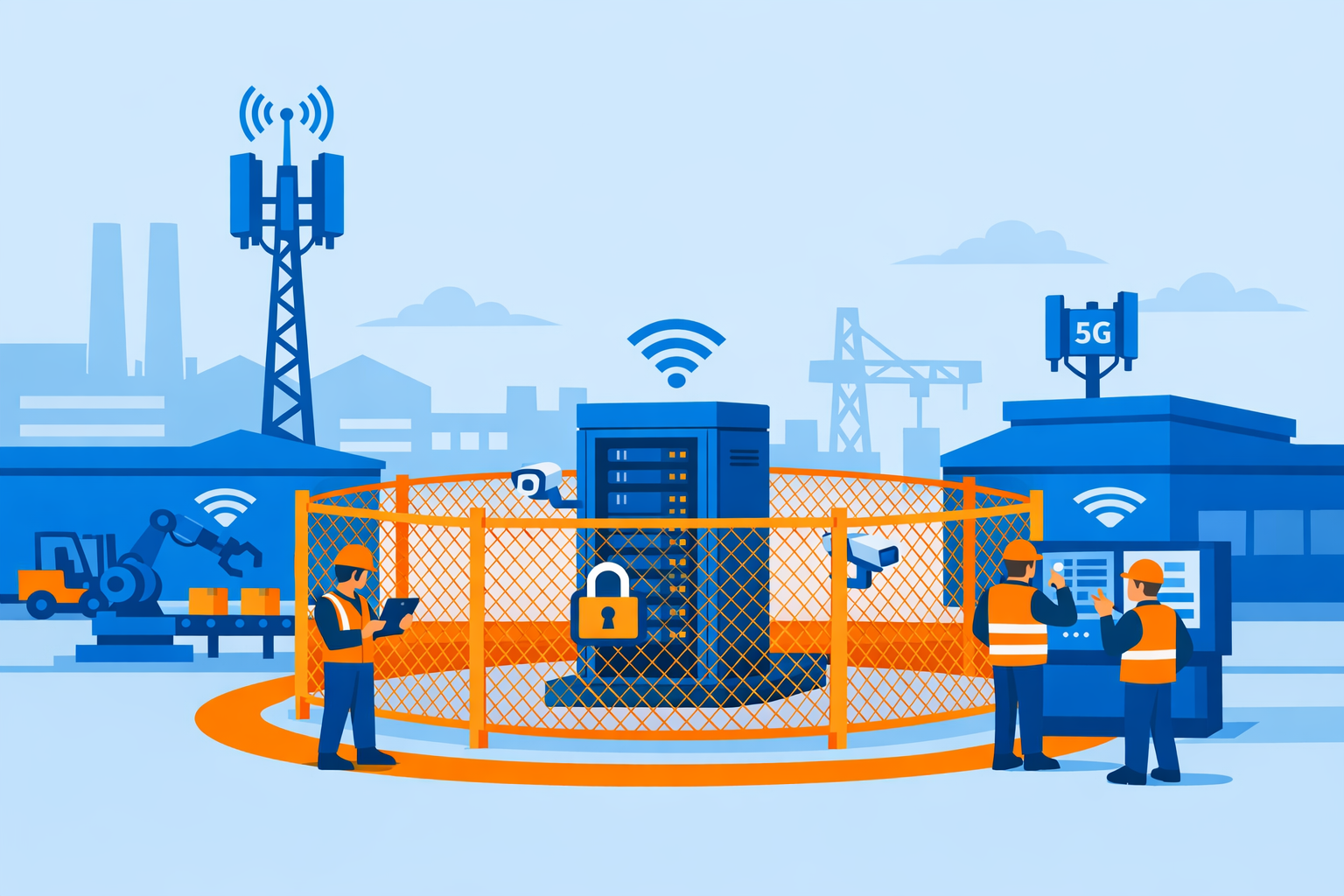
Manufacturing accounts for 38% of all U.S. private 5G installations - and that share is poised to expand sharply. A convergence of federal funding mandates, accessible CBRS spectrum, and maturing Open Radio Access Network (O-RAN) standards is giving mid-sized U.S. plants a clearer, more affordable path to private 5G than ever before. For plant executives weighing the decision, the question is no longer whether to retrofit - it is how fast to move and which grant pathways to engage first.
The Federal Funding Architecture Behind the Retrofit Wave
Two complementary federal initiatives are reshaping the economics of industrial private 5G. The first is NTIA's Public Wireless Supply Chain Innovation Fund[1], backed by $1.5 billion authorized under the CHIPS and Science Act of 2022 to promote Open RAN-compliant networks. The fund's explicit mission is to reduce dependence on a small group of dominant, proprietary vendors - a market structure that increases costs, slows innovation, and makes security vulnerabilities harder to detect and fix, according to NTIA's program documentation.
The second is the NTIA/DoD 5G Challenge[2], a prize competition that has already awarded $7 million to validate interoperable, multi-vendor Open RAN subsystems. The 2023 cycle specifically tested whether components from different manufacturers - antennas, radio base stations, 5G core software - could form a functional end-to-end 5G network without proprietary lock-in.
For mid-sized manufacturers, the practical implication is significant: vendors receiving NTIA grants must demonstrate O-RAN compliance and interoperability, generating a growing catalog of certified, mix-and-match components that OEMs and system integrators can procure with confidence. Separately, NIST's Manufacturing Extension Partnership (MEP) Centers provide federal-state matched funding applicable to connectivity infrastructure as part of broader operational technology (OT) modernization projects.
The FCC's Citizens Broadband Radio Service (CBRS) band at 3.55-3.7 GHz provides the spectrum layer. Active CBRS devices rose to over 400,000 by July 2024, with more than 71% operating in General Authorized Access mode, according to market data - underscoring demand for low-cost, license-free spectrum access that eliminates one of the largest traditional barriers to enterprise 5G.
| Program / Initiative | Agency | Funding | Manufacturing Relevance |
|---|---|---|---|
| Public Wireless Supply Chain Innovation Fund | NTIA / Dept. of Commerce | $1.5B (CHIPS & Science Act, 2022) | Open RAN R&D, multi-vendor interoperability, domestic 5G radio production |
| 5G Challenge (NTIA/DoD) | NTIA-ITS + DoD OUSD(R&E) | $7M prize purse (2023 cycle) | Validates interoperable, multi-vendor Open RAN subsystems for industrial use |
| Manufacturing USA / MEP Centers | NIST / Dept. of Commerce | Ongoing federal-state match grants | Supports technology adoption and OT modernization at mid-sized plants |
| CBRS Spectrum (3.55-3.7 GHz) | FCC | License-free / low-cost PAL access | Default spectrum path for cost-effective private 5G rollouts in factories |
Why Mid-Sized Plants Are Moving Now
The U.S. private 5G market was valued at $4.64 billion in 2025 and is projected to reach $14.21 billion by 2030, growing at a 25.09% CAGR, with manufacturing as the dominant vertical. For mid-sized facilities - metals fabrication, plastics processing, consumer goods assembly, and distribution - the drivers are operational rather than aspirational.
Deterministic connectivity for OT workflows. Public 5G networks cannot satisfy the deterministic latency, stringent security, and interference-free reliability demanded by industrial-grade IoT deployments, according to market analysts. Private 5G deployed over CBRS fills this gap. Unlike shared Wi-Fi operating in congested ISM bands, a dedicated 5G network delivers sub-5 ms latency suitable for automated guided vehicles (AGVs), autonomous mobile robots (AMRs), and closed-loop control systems.
Predictive maintenance at the edge. Private 5G enables continuous acoustic, vibration, and thermal data streams from machine assets to edge servers - the foundation of predictive maintenance programs that reduce unplanned downtime. Edge computing cuts round-trip latency to the cloud while keeping sensitive production data on-premises, a requirement for facilities subject to strict data sovereignty policies.
Retrofit without disruption. Wireless retrofits avoid tearing up floors to run cable or halting production[3], making private 5G particularly attractive for brownfield sites where trenching and rewiring would shut down production lines. Antenna arrays, small cells, and edge servers can typically be installed during scheduled maintenance windows.
Private 5G vs. Legacy Connectivity: A Direct Comparison
Plant managers evaluating the retrofit decision frequently compare private 5G against Wi-Fi 6/6E upgrades and wired Ethernet extensions. The table below summarizes the key trade-offs:
| Criterion | Private 5G (Open RAN) | Wi-Fi 6/6E | Wired Ethernet Upgrade |
|---|---|---|---|
| Latency (typical) | 1-5 ms deterministic | 5-20 ms (variable) | <1 ms (fixed nodes) |
| Mobility support | Full (AGVs, AMRs, wearables) | Limited (roaming gaps) | None |
| OT security isolation | Native slicing + SIM auth | VLAN-based (less granular) | Physical segmentation only |
| Retrofit disruption | Low (wireless, no cabling) | Low (wireless) | High (floor trenching required) |
| Spectrum control | Dedicated CBRS / licensed band | Shared ISM band (2.4/5 GHz) | N/A |
| Vendor lock-in risk | Low (Open RAN / O-RAN Alliance) | Medium (proprietary APs) | Medium (switch ecosystem) |
| Upfront CAPEX | Medium-High | Low-Medium | High |
| IIoT endpoint density | High (thousands of devices) | Medium | Low (fixed ports) |
Notably, early deployments show that private 5G does not replace Wi-Fi outright[4]. In practice, factories apply clear segmentation: Wi-Fi continues to serve tablets, laptops, and low-criticality devices, while private 5G supports robotics, motion control, high-resolution video inspection, and mobile industrial assets. Ethernet remains the backbone for ultra-critical, fixed-node systems.
OT Security: The Integration Layer That Cannot Be Overlooked
Expanding wireless connectivity necessarily widens the OT attack surface. Manufacturing is now the number-one target sector for cyberattackers, and private 5G deployments must be paired with rigorous OT security governance to avoid introducing new vulnerabilities.
Factories adopting private 5G have had to strengthen identity management, SIM and eSIM lifecycle handling, OT-IT segmentation policies, and anomaly detection. Vendors are responding: NTT DATA and Palo Alto Networks, for example, launched a managed private 5G security service[5] combining Next-Generation Firewall capabilities with OT/IoT subscriptions built for industrial environments. Nokia's MX Industrial Edge platform similarly integrates Nozomi Networks' OT/IoT monitoring directly on-premises alongside the private 5G core.
For integration teams, the PLC, SCADA, and MES layers require explicit attention. Interworking challenges persist even when interfaces follow 3GPP and O-RAN Alliance standards, NTIA's Institute for Telecommunication Sciences (ITS) noted in its Open RAN lessons-learned report - citing misconfigured timers, message-handling differences, and standards-version mismatches as common issues during integration testing. Engaging system integrators with demonstrated O-RAN certification experience is essential before procurement.
Plant managers should also align private 5G security postures with risk management frameworks analogous to NIS2 - even for U.S. facilities not directly subject to European regulation. Segmenting OT networks, enforcing zero-trust device authentication at the SIM level, and establishing OT-specific incident response plans are now considered baseline practice. For more on securing industrial connectivity infrastructure, see Industrial SIMs Boost Secure IIoT in Robotics, Packaging Lines.
Note: Fortinet's 2025 State of Operational Technology and Cybersecurity Report found that organizations with higher OT security maturity reported fewer intrusions and faster recovery times - and that OT cybersecurity oversight is increasingly a board-level responsibility.
Regional Dynamics and Procurement Cycles
Grant uptake and deployment velocity are not uniform across the country. Rust Belt states with large concentrations of metals and plastics manufacturers have been among the earliest to engage MEP Centers for connectivity upgrades, leveraging existing relationships with NIST-affiliated extension service networks. Southeastern automotive supply chain facilities have drawn on a mix of state-level incentive programs and direct vendor financing to close CAPEX gaps. Pacific Coast distribution and consumer electronics facilities, with higher existing IT maturity, have progressed faster in integrating private 5G with MES and ERP platforms.
Procurement cycles at mid-sized plants typically range from 12 to 24 months from initial feasibility assessment to go-live, with spectrum planning, safety certification, and OT change management representing the longest lead items.
Practical Takeaways for Plant Executives
1. Identify eligible grant pathways early. MEP Centers in every state can assess whether a planned OT modernization project qualifies for federal-state matched funding. NTIA's Public Wireless Supply Chain Innovation Fund targets vendors, but procurement decisions favoring O-RAN-compliant equipment align with the fund's interoperability requirements and improve long-term vendor negotiation leverage.
2. Anchor the business case on predictive maintenance and downtime reduction. ROI models grounded in measurable downtime costs - rather than abstract connectivity metrics - carry more weight internally and prove more persuasive in capital expenditure reviews.
3. Require open-architecture commitments from vendors. Specify O-RAN Alliance-compliant radio units and standardized interfaces in RFPs. This preserves the ability to swap subsystem vendors as the ecosystem matures and prevents proprietary dependency on any single integrator.
4. Treat OT security as a deployment prerequisite, not a follow-on workstream. Define network segmentation policies, SIM-based device authentication, and anomaly detection baselines before go-live. Factor security operations into the total cost of ownership (TCO) calculation.
5. Plan for a phased, coexisting network architecture. Initial deployments typically cover high-value mobility and predictive maintenance use cases, with Wi-Fi retained for general-purpose devices and Ethernet for fixed ultra-critical nodes. A phased approach reduces risk and allows OT teams to build operational familiarity before expanding coverage.
FAQ
What spectrum is typically used for private 5G in U.S. factories? Most mid-sized U.S. plants deploy private 5G on the Citizens Broadband Radio Service (CBRS) band at 3.55-3.7 GHz. CBRS offers a three-tier shared access model that allows enterprises to access mid-band spectrum without expensive auctions, significantly lowering deployment costs. Some larger facilities also use licensed mid-band spectrum for greater interference protection.
What is Open RAN and why does it matter for manufacturers? Open RAN (O-RAN) disaggregates the hardware and software components of a radio access network, enabling multi-vendor interoperability. Instead of being locked into a single vendor's end-to-end stack, manufacturers can combine radio units, distributed units, and core software from different certified suppliers - reducing costs, improving negotiating leverage, and aligning with federal grant programs that explicitly require open standards.
How does private 5G integrate with existing PLC, SCADA, and MES systems? Private 5G acts as a wireless transport layer; it does not replace industrial control protocols. Integration typically involves 5G-capable gateways or protocol translators that bridge OT protocols (such as OPC UA or Modbus) to the 5G network. System integrators must verify compatibility at each OT layer and conduct phased testing to avoid production disruptions.
What is the typical ROI timeline for a private 5G retrofit at a mid-sized plant? ROI timelines vary by use case. Predictive maintenance deployments that reduce unplanned downtime typically yield measurable returns within 12-24 months, depending on pre-existing downtime costs. AGV and AMR connectivity upgrades often show faster returns in facilities with high labor costs for manual material handling.
Is private 5G suitable for smaller manufacturing facilities? SME deployments are expanding rapidly, driven by Network-as-a-Service (NaaS) models that eliminate high upfront capital requirements. SME private 5G deployments are growing at a 29% CAGR as NaaS offerings reduce entry barriers. Smaller facilities should explore MEP Center assessments to determine whether a phased or managed-service approach is the most cost-effective entry point.