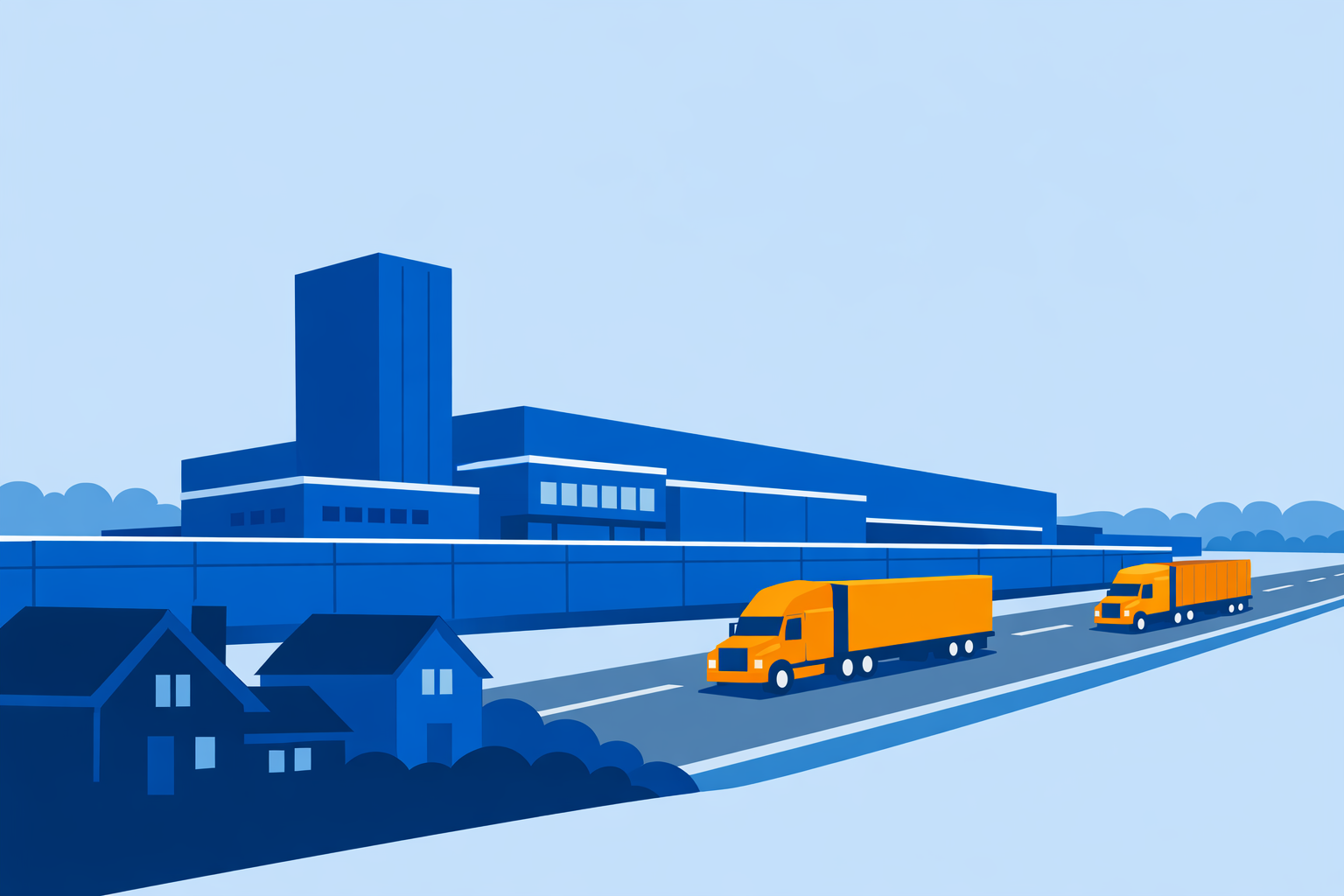
Rockwell Automation's proposed one-million-square-foot manufacturing campus in New Berlin, Wisconsin, cleared its first major public hurdle on June 1-but not without significant pushback from neighboring residents. Concerns centered on noise, traffic, building scale, and the appropriateness of heavy industrial development in an area surrounded by residential subdivisions. The Milwaukee-based industrial automation manufacturer seeks to rezone approximately 325 acres of largely agricultural land on the east side of Moorland Road, between Grange and College Avenues, to accommodate what could become its largest manufacturing facility globally.
Background
Rockwell Automation first announced the New Berlin facility in November 2025 as part of a broader $2 billion, five-year investment plan covering plants, digital infrastructure, and talent development. The company filed zoning-related applications in April 2026 to advance the project. The proposed campus, developed in partnership with SunCap Property Group, carries an estimated construction cost of $211 million to $246 million and is projected to create hundreds of jobs. According to Rockwell CEO Blake Moret, the company selected the New Berlin location due to its century-long presence in southeastern Wisconsin and access to a skilled regional workforce.
The project's scale has drawn comparisons to major greenfield industrial campuses reshaping manufacturing supply chains across the U.S.-a trend covered in depth in Industrial Campuses Reshape Supply Chains and Workforce Access. However, the New Berlin case illustrates the social license challenges that accompany such developments when sited adjacent to established residential communities.
Details
The initial building phase totals approximately 810,000 square feet of manufacturing and office space, with future expansion potentially bringing the campus to well over one million square feet. Planning documents filed with the city indicate a second building of approximately 425,000 square feet along Grange Avenue is planned for 2036, with possible further expansion to more than 800,000 square feet. The facility is intended to support electronic assembly and final assembly of industrial automation and control products. Rockwell stated most operations would occur indoors without odors, smoke, or heavy industrial processing.
Residents from the adjacent Thomson Hollow, Theofila Estates, and Red Fox Crossing subdivisions have circulated a petition opposing the project. Neighborhood representatives estimated that more than 80% of residents in those subdivisions signed the petition. Speakers at the June 1 Plan Commission hearing cited concerns about round-the-clock semi-truck traffic-a scenario city officials acknowledged was possible-a proposed building height of up to 60 feet, and the compatibility of large-scale industrial use with what residents described as a quiet, agricultural corridor. "A massive industrial plant in between all of these [residential] neighborhoods just was kind of shocking," one resident told the commission, according to the Daily Reporter.
Resident Jim Hall, who said he is not unconditionally opposed, demanded more specifics on water and energy usage before endorsing a zoning change. Rockwell officials acknowledged at the hearing that certain details remained unanswered because plans had not been finalized. The company stated it engaged with more than 300 residents through door-to-door outreach and a prior public meeting. In response to concerns, Rockwell confirmed it has adjusted plans to address noise and traffic, including directing truck traffic toward Moorland Road, minimizing overnight deliveries, and installing a sound barrier near the facility.
Outlook
The New Berlin Plan Commission, which took no action at the June 1 hearing, is expected to consider the land-use and zoning changes on July 15. The New Berlin Common Council will subsequently review those elements, and construction is not anticipated before 2027, contingent on city approvals and possible tax subsidy arrangements. Future expansion phases would require separate approvals. The regulatory process ahead-encompassing rezoning, comprehensive plan amendments, and use and architectural approvals-represents a critical test of how manufacturers balance capital investment timelines with community engagement obligations and local government authority over industrial siting decisions.