Multi-tenant industrial campuses are becoming strategic hubs that enhance supply-chain resilience, streamline logistics, and support workforce development in manufacturing regions. Recent developments in Germany and related industry trends illustrate how these campuses cluster suppliers, contract manufacturers, and logistics partners within shared ecosystems, delivering efficiencies and regional stability.
Background
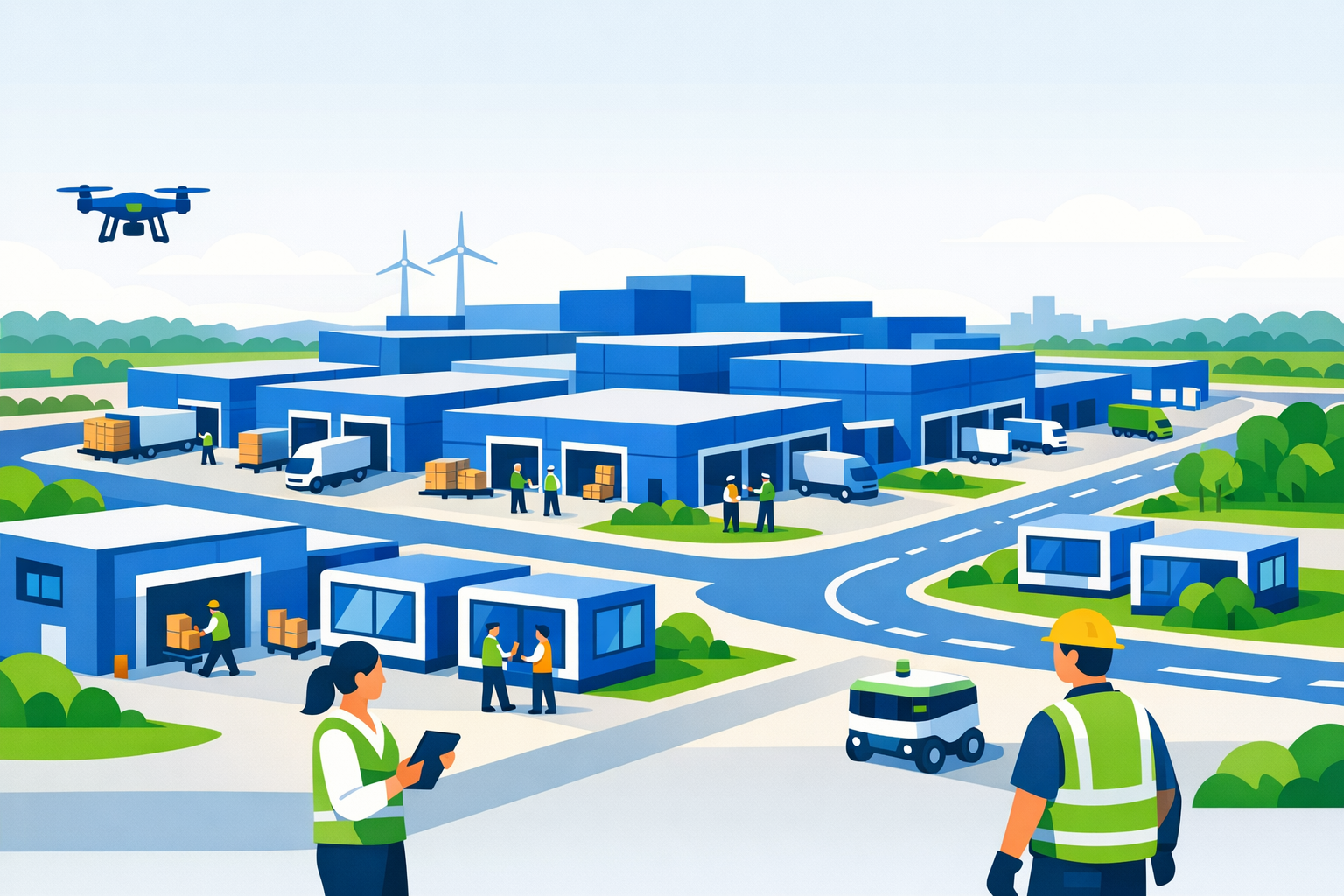
Industrial campuses unite multiple tenants on a single site, providing flexible infrastructure, shared utilities, and logistics benefits. Developers are designing large "big-box" buildings that subdivide into smaller units with modular docks and office pods, accommodating diverse users and reducing vacancy risks. Many campuses integrate light industrial or maker spaces with traditional warehouses, especially in urban infill locations, fostering community acceptance and mixed-use programming. Multi-tenant warehouse designs now allow subdivision of large speculative buildings-for example, converting a 500,000 sq ft facility into four 125,000 sq ft units using knock-out panels and docks. Circular campus designs are gaining traction by co-locating manufacturing, warehousing, and recycling so byproducts from one tenant supply another. Such formats promote supply-chain diversification and resource efficiency. According to Cushman & Wakefield's "Waypoint 2025" report, global supply-chain changes and rising costs are increasing demand for adaptable, tenant-favorable industrial real estate. The report states that tenant-friendly markets-comprising 46% globally-could fall below 30% by 2028, while landlord-favorable markets may rise to 35%. Shared campus infrastructure enables occupiers to secure space quickly amid tightening supply.
Details
In Germany, Panattoni's Campus Hannover City Centre transformed a 21.85-hectare brownfield into a multi-tenant industrial campus serving cable manufacturer Nexans and logistics startups. The site includes a large logistics park, a 20-unit business park, and modular "City Dock" space tailored for the new economy, offering 141,355 m² of lettable area and access to 2.3 million consumers within 50 km. Construction began in mid-2023, with demolition work uncovering World War II ordnance; the first phase is scheduled for completion in Q1 2024. This project shows the value of adaptive redevelopment, shared infrastructure, and strategic location in supporting resilience.
Germany is also home to EfeuCampus in Bruchsal, a multi-tenant experimental logistics campus focused on urban, autonomous, and emission-free freight delivery. Supported by European Union and Baden-Württemberg funding, the site pilots technologies such as delivery robots and cargo drones. EfeuCampus is Germany's first research area dedicated to emission-free urban logistics, including autonomous delivery systems and cargo drones. The campus demonstrates how ecosystem-based models can foster logistics innovation alongside traditional industry activity.
Emerging research highlights the resilience gained from networked industrial systems. Studies of modular product design and multi-sourcing, coupled with backup supplier strategies, support supply-chain robustness across facilities. Research on urban dense manufacturing clusters points to the importance of intelligent inventory management, dynamic buffer sharing, and adaptive replenishment for performance during disruptions. Supply-chain resilience strategies such as multi-sourcing and supplier fortification improve robustness in multi-facility networks. Dynamic inventory redistribution across logistics nodes and manufacturing sites sustains operations in densely networked urban settings.
Outlook
With ongoing supply-chain pressures and urban planning increasingly focused on sustainability and workforce development, multi-tenant industrial campuses are expected to expand. Manufacturers and policymakers are likely to consider campus models that integrate flexible real estate, collaborative infrastructure, and localized workforce training to bolster regional economic resilience and operational agility.