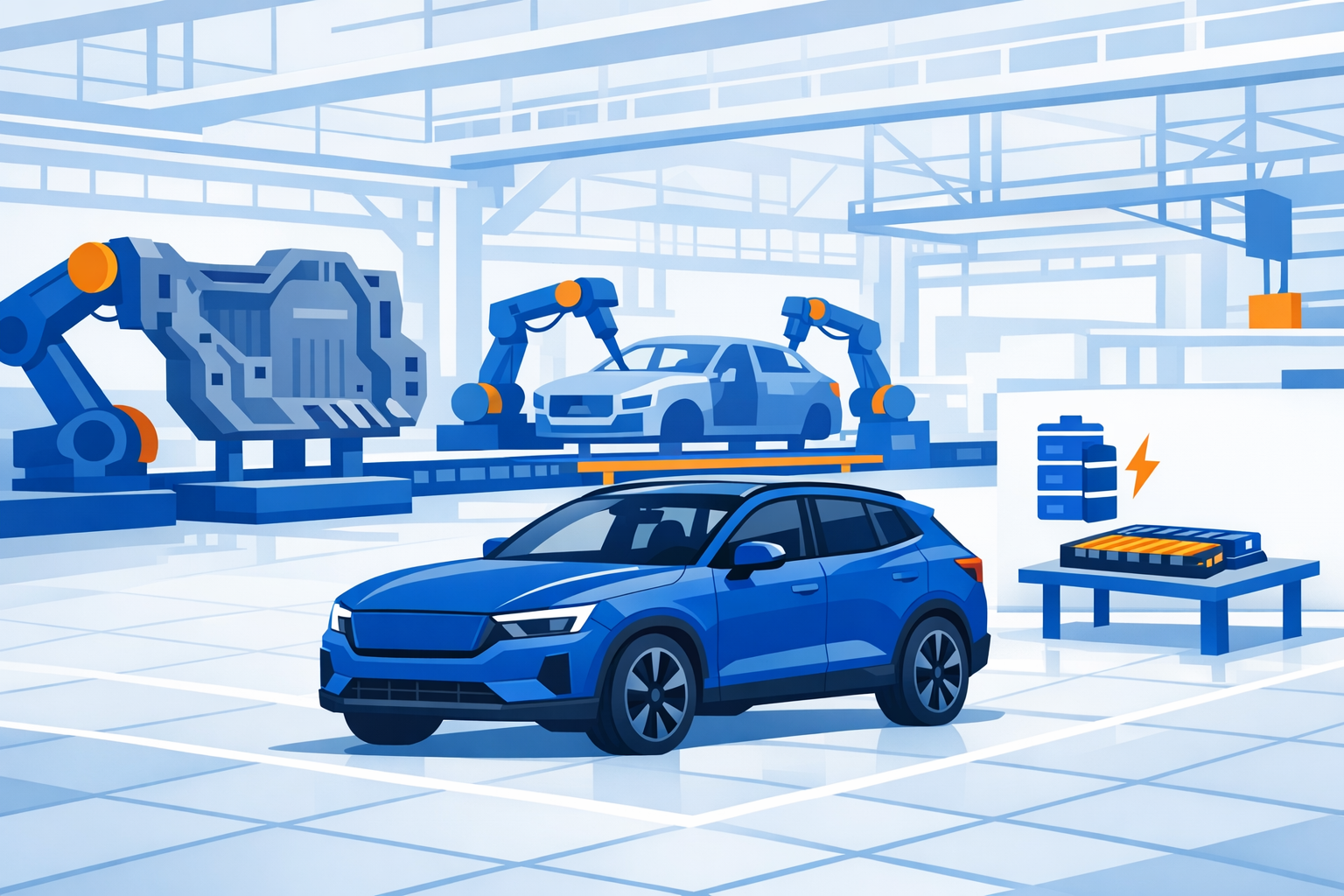
Volvo Cars has commenced mass production of its all-electric EX60 at the Torslanda plant in Gothenburg, marking the culmination of a SEK 10 billion ($1.1 billion) factory transformation that has reshaped nearly every major process in the facility's manufacturing sequence. The EX60 officially launched on January 21, 2026, becoming the first vehicle built on Volvo's new Scalable Product Architecture 3 (SPA3) platform and Sweden's first fully homegrown battery-electric vehicle produced at scale.
The launch places Torslanda at the center of Volvo's European electrification strategy amid mixed global sales performance. Volvo's battery-electric vehicle sales declined 13% in 2025 to 151,830 units, while European fully electric deliveries rose 21% in the same period, with electrified models accounting for 57% of all vehicles sold in the region. That divergence ties Torslanda's output capacity directly to the company's European profitability.
Background
Torslanda has operated since April 1964 and currently employs approximately 6,500 people across three shifts, with an annual production capacity of around 300,000 vehicles. The SEK 10 billion modernization, announced in 2022, was executed entirely around a live production facility - almost 90% of the final assembly line was rebuilt during ongoing operations without halting output of the outgoing XC60 and V90 model lines. Plant Manager Magnus Olsson, Vice President at Volvo Car Torslanda, described the concurrent scope as a four-year challenge: "We had four years to prepare and implement a plan of how to continue to manufacture 6,000 cars per week in parallel to rebuilding the complete plant."
Torslanda now operates as what Volvo designates a "mother plant" - the global reference facility for the SPA3 platform - with responsibility for transferring operational knowledge to sister plants adopting the same architecture. Volvo's new plant in Košice, Slovakia will be the second facility to deploy the SPA3 platform and megacasting technology, with Torslanda expected to provide direct technical support during that ramp.
Details
The investment spans three principal technology domains. The megacasting program, using two Bühler Carat 840 high-pressure die-casting cells, is the most structurally significant. According to Bühler, megacastings consolidate between 70 and 100 individual parts into a single die-cast aluminum component, reducing weld joints, part counts, and assembly complexity across the production lifecycle. Torslanda began producing rear floor megacast sections approximately two years before the EX60 entered series production - a deliberate departure from conventional prototype timelines designed to capture process learning earlier in the development cycle.
The second major change is in-house battery assembly. The EX60's structural battery pack is assembled from raw prismatic cells within Torslanda's dedicated battery plant, integrating cells and modules directly into the vehicle's floor structure. According to Automotive Manufacturing Solutions, in-house battery integration reduces dependence on external assembly partners and tightens quality control at a component level where performance and safety margins are especially tight. The EX60 achieves a stated range of up to 810 km on a single charge, a figure Volvo attributes in part to the structural efficiency gains from integrated battery and megacasting design.
Artificial intelligence tools have been layered into maintenance and quality workflows. According to Olsson, "the two areas that look most promising are in maintenance and quality control" - with AI monitoring equipment vibration frequencies to predict breakdowns and a chatbot system giving maintenance technicians access to supplier manuals and fault-resolution guidance. AI-based vision systems also verify correct assembly of critical components on the line.
Workforce transformation has been managed through a unified Kaizen training program. More than one-third of Torslanda's manufacturing staff are women, according to Olsson, who has emphasized diversity and continuous improvement as structural elements of the plant's operating model. All three production shifts underwent standardized four-week Kaizen training to establish a common manufacturing culture across the facility.
Outlook
Volvo targets EX60 production to reach 50% of Torslanda's total output by the end of 2026, with order books in Sweden and Germany running ahead of internal forecasts. The plant currently runs both the EX60 on SPA3 and legacy ICE and PHEV variants on earlier platforms in parallel, providing demand flexibility as EU regulatory timelines for full electrification remain subject to revision. The SPA3 platform supports multiple vehicle sizes and body types, and Volvo has indicated that all five next-generation electric models in active development will share the same technology stack - positioning Torslanda's current production ramp as the operational template for European EV manufacturing at scale.