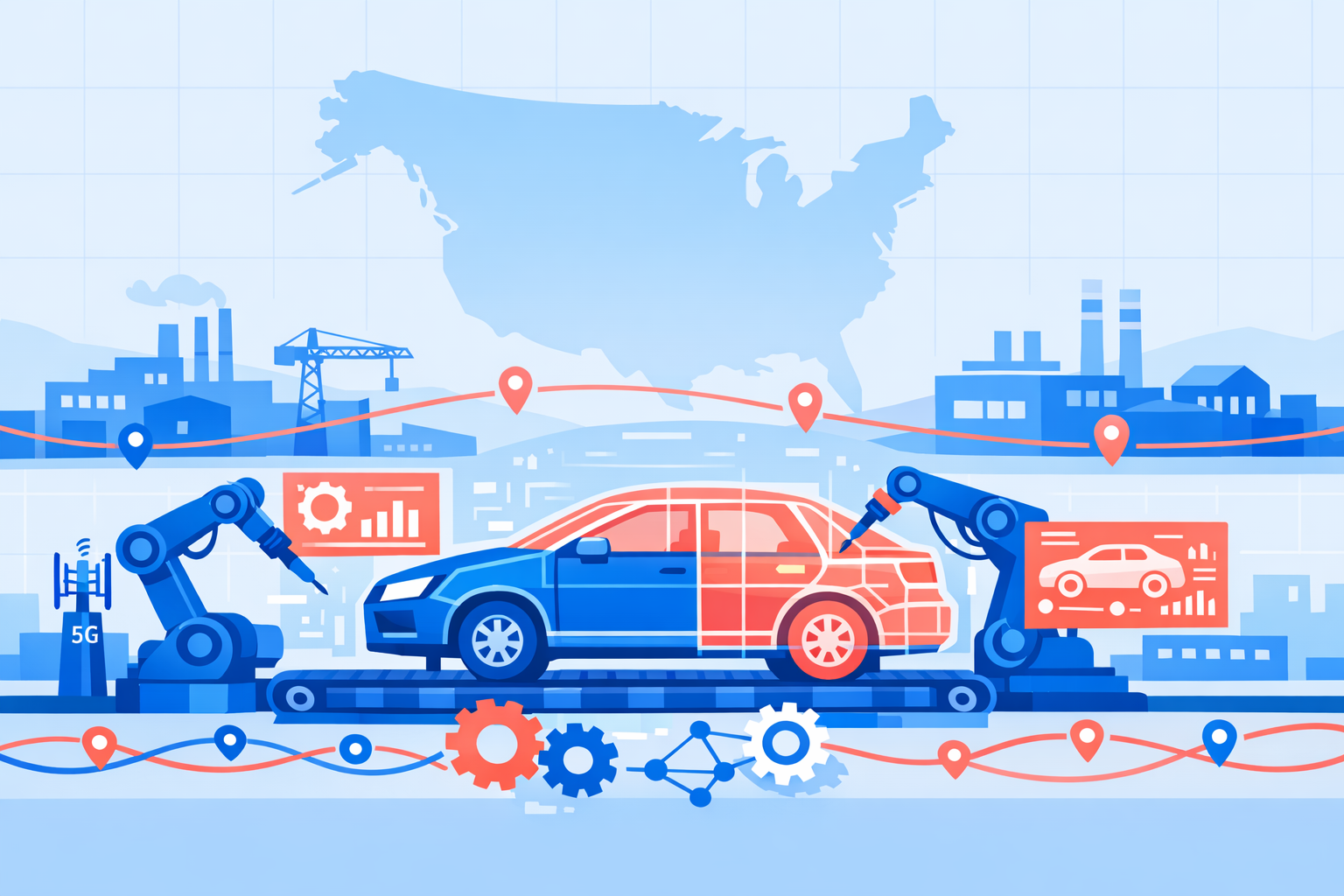
U.S. automakers have already paid more than $10 billion in tariffs on vehicles and parts imported from Canada and Mexico in 2025, according to analysis by the Anderson Economic Group. That figure - still climbing - is reshaping where companies build, how they source materials, and which vehicles reach showroom floors. The inflection point is no longer theoretical. It is a balance-sheet reality redirecting capital toward localized production and accelerating factory automation as the structural response to trade volatility.
The Cost Equation Is Shifting - Permanently
For years, global supply chain optimization meant one thing: lowest landed cost, wherever geography allowed. Tariff volatility has fundamentally reframed that calculus. Between January and July 2025 alone, automakers incurred $6.45 billion in duties on North American imports, with the full-year figure projected to exceed $10.6 billion. According to GM's own disclosures[1], the company's Q2 2025 operating profit fell by $1.1 billion due to tariff exposure, with total 2025 tariff losses projected at $4-5 billion.
The impact extends well beyond finished vehicle duties. Broad tariffs cover raw materials including steel, aluminum, copper, rare-earth materials, and semiconductors - all major components of modern vehicles. For OEMs that assumed domestic assembly would shield them, the reality is stark: even U.S.-built vehicles face tariff costs on imported sub-components sourced from affected regions.
The strategic response - though constrained by capital timelines - is unmistakable. 29% of automotive manufacturers are increasing localization, nearshoring, or regional production in direct response to tariff pressure, according to the AMS/ABB Automotive Manufacturing Outlook Survey 2025, which covered 473 industry professionals.
Nearshoring: The Promise and the Friction
Automakers and Tier 1 suppliers are accelerating plans to move critical component manufacturing from Asia to Mexico, the U.S. South, and Central/Eastern Europe. Ford, General Motors, and major foreign OEMs with U.S. operations are reassessing production geography[2], with some exploring dual-sourcing strategies that split production between domestic and foreign facilities to hedge risk.
The headline investment crystallizing this trend: Hyundai committed $21 billion through 2028 in U.S. production, including a $7.6 billion Metaplant in Georgia targeting 1.2 million annual units, incorporating vertical integration of steel, batteries, and vehicle assembly. The investment preceded the April 2025 tariff announcements by just one week - signaling that the strategic logic precedes any single policy trigger.
Yet the frictions are substantial. Building new automotive capacity requires a minimum of three years, and industry executives are explicit that long-term footprint decisions depend on policy certainty that does not currently exist[3]. New plants are highly automated - particularly in battery and EV production - meaning reshored facilities generate a relatively small number of direct jobs relative to investment scale. Hyundai's $21 billion commitment, for example, is projected to create just 14,000 direct full-time positions.
The deeper challenge is supplier ecosystem depth. Without regional Tier 2 and Tier 3 networks, new assembly plants risk becoming high-cost import hubs in a different geography - vulnerable to the same disruptions tariffs were designed to remedy.
Automation as the Structural Enabler
The arithmetic of nearshoring only works with aggressive automation. U.S. labor costs average $25-$30 per hour versus approximately $6-$7 in China, a gap that productivity and energy efficiency alone cannot close at scale. Without significant automation investment, many reshoring projects struggle to pencil out once startup subsidies and tax incentives expire[4].
Around 40% of all new industrial robot installations in the U.S. in 2024 were in the automotive sector, according to IFR data - and that concentration is deepening. The U.S. automotive industry increased robot installations by 10% in 2024[5], reflecting pre-tariff investment commitments that now carry additional strategic urgency.
The automation technologies gaining the most traction in nearshoring contexts fall into three categories:
- Collaborative robotics (cobots): Flexible, reconfigurable cells that support variable production volumes without fixed-line retooling costs. North American auto suppliers are actively piloting modular automation cell architectures that reduce setup time by up to 20% and project 15% CapEx savings over five years versus traditional fixed lines.
- Digital twins: Virtual replicas of production systems that allow manufacturers to simulate tariff scenarios, test line reconfigurations, and stress-test supplier substitutions before committing capital. The global digital twin in automotive market is projected to grow from $2.7 billion in 2025 to $28.7 billion by 2034, at a compound annual growth rate of 30.1%. Manufacturers deploying plant-level digital twins report energy efficiency improvements of 12-18% and reductions in unplanned downtime of up to 25%[6].
- Private 5G networks: Low-latency wireless infrastructure enabling real-time control of automated lines, AGV (automated guided vehicle) fleets, and predictive maintenance systems. Deployment of private 5G at Mercedes-Benz's Factory 56 enhanced collaboration between workforce and robots, improving floor safety and operational efficiency[7]. As private 5G networks mature within industrial campuses, the volume of real-time sensor data feeding digital twin models is expected to multiply significantly by 2030.
The Dangerous Automation Gap Across Supply Chain Tiers
Perhaps the most operationally significant finding from recent survey data is how unevenly automation investment is distributed across the automotive supply chain. While OEMs are actively modernizing, the supplier base beneath them remains dangerously exposed.
While 62% of new OEMs embrace automation and robotics, Tier 2 adoption falls to 31% and Tier 3 to just 23%, creating fragile nodes at the base of the chain that undermine resilience gains at the OEM level. Tariff-driven multi-sourcing strategies compound this challenge: every new supplier relationship adds procurement complexity, quality management burden, and cost pressure that single-source arrangements were designed to eliminate.
{{component:automation-tier-table}}
This gap is also a financing problem. Small and midsized manufacturers are more likely to delay or scale back robotics investment due to increased automation component costs[8] - precisely where tariff pressure makes the investment case most urgent. Emerging solutions include regional distribution alliances that give SME suppliers access to automation services at reduced entry cost, and shared automation platforms that pool CapEx across multiple Tier 2 and Tier 3 facilities.
Workforce Reskilling: The Human Side of Factory Modernization
{{component:skills-gap-callout}}
Automation adoption in nearshored facilities creates a direct workforce transition requirement. Nearly 500,000 manufacturing jobs in the U.S. remain unfilled because modern factories require digital, robotics, and AI skills that current training systems cannot supply at scale. The AMS/ABB survey identified skills shortages as a critical challenge for 37% of manufacturers[9], with the capability gap concentrated in supply chain management, simulation, and robotics programming.
For supply chain leadership, reskilling cannot be treated as an HR function - it must be integrated into CapEx planning, with workforce development programs co-designed with equipment integrators, community colleges, and regional workforce agencies. AI-cobot deployments already raise distinct maintenance and training demands that require pre-deployment curricula, not post-installation remediation.
ESG Implications: Regionalization Is Not Automatically Greener
Tariff-driven nearshoring intersects with ESG commitments in ways that demand careful analysis. On the positive side, shorter logistics distances reduce Scope 3 freight emissions. Regionalized production can also improve labor standards visibility and reduce the governance complexity of multi-tier global supply chains.
However, BCG analysis notes that manufacturers must embed climate risk in supply chain scorecards from the outset[10], as nearshored facilities powered by domestic grid mixes may carry higher carbon intensity than production in jurisdictions with lower-carbon industrial energy profiles. Automation investments that improve energy efficiency - digital twins reporting 12-18% efficiency gains - can partially offset this risk, but carbon impact must be modeled site by site rather than assumed.
Strategic Implications for Operations and Supply Chain Leadership
The emerging consensus from industry data is clear: tariff resilience and factory modernization are no longer separable decisions. The ROI framework for automation investment must now incorporate tariff cost avoidance as an explicit line item alongside traditional productivity and quality metrics.
Key strategic priorities for mid- and large-scale manufacturers:
- Prioritize modular and reconfigurable automation that preserves flexibility as trade policy evolves, rather than fixed-line capital commitments tied to single-source assumptions.
- Deploy digital twins before footprint decisions, not after - simulation of tariff scenarios, supplier alternatives, and production reconfigurations delivers the most value in the planning stage.
- Close the Tier 2/3 automation gap through financing vehicles, shared platforms, and regional alliances, or accept that supplier fragility will limit resilience gains at the OEM level.
- Treat workforce reskilling as CapEx, with ramp-up training programs built into automation deployment timelines.
- Embed ESG metrics into site selection from day one, modeling carbon intensity alongside labor, logistics, and tariff exposure in regional investment scoring.
{{component:faq-section}}
The interactive Nearshoring Automation ROI Explorer below allows operations and supply chain professionals to model tariff cost avoidance, automation payback periods, and regional ROI scores based on configurable investment levels and tariff rate assumptions.
{{widget:roi-explorer}}