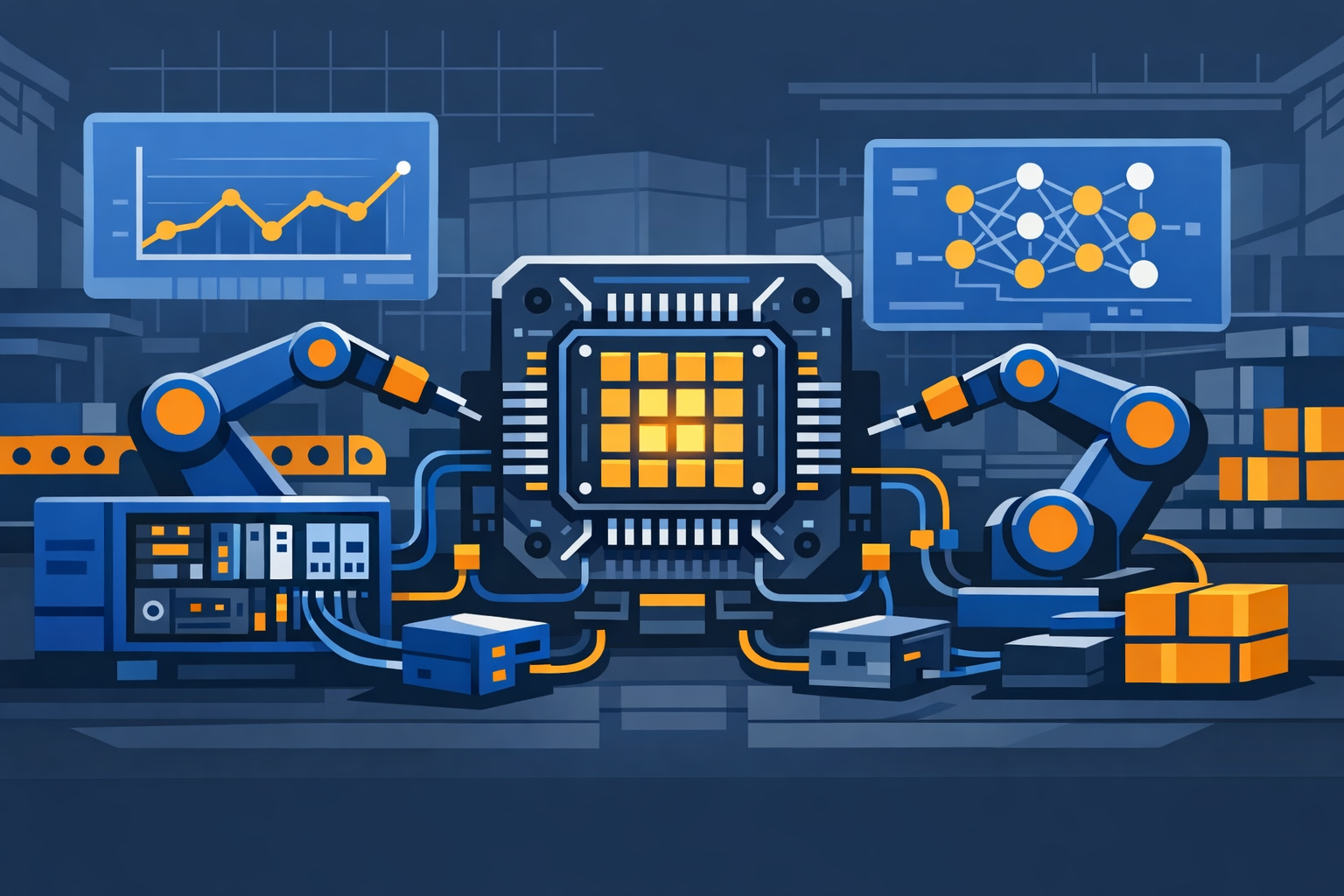
Manufacturers are increasingly implementing software-defined automation frameworks leveraging GPU-accelerated artificial intelligence (AI) to enhance shop-floor flexibility and interoperability.
Lead
A new approach is emerging in manufacturing as KUKA-through its iiQKA.mxAutomation platform-and NVIDIA demonstrate how software-defined automation, supported by GPU acceleration, connects laboratory-scale AI tools to scalable production environments. At NVIDIA's GTC 2026, the company introduced the Vera Rubin GPU architecture, targeting higher inference performance and efficiency. Simultaneously, KUKA expanded iiQKA.mxAutomation to support the open Standard Robot Command Interface (SRCI), emphasizing a shift toward hardware-agnostic, modular automation networks that simplify programmable logic controller (PLC) integration. These advancements are shaping a future of faster return on investment, flexible system deployment, and data-driven production operations.
Background
Software-defined automation moves away from rigid, hardware-dependent controls, adopting containerized, programmable layers interfacing with robotics, AI tools, and digital twins. This model fosters scalability, modularity, and real-time production line reconfiguration. Academic research, such as the XWAVE framework, demonstrates how virtualized industrial control, digital twins, and distributed computing combine to enable fully software-defined manufacturing systems. XWAVE unites virtualization of PLCs, digital twin modeling, and distributed compute to offer modular software-defined manufacturing architecture[1].
Details
At NVIDIA GTC 2026, Jensen Huang announced that the Vera Rubin architecture is now in full production. Vera Rubin delivers a fivefold increase in inference performance and reduces per-token inference cost by a factor of ten compared to the Blackwell Ultra architecture[2]. This positions GPU-accelerated infrastructures to manage inference-intensive manufacturing applications, including real-time quality inspection and adaptive robot control.
KUKA has expanded the iiQKA.mxAutomation interface in collaboration with Siemens to incorporate SRCI, enabling standardized, PLC-independent integration across robot vendors. The updated iiQKA.mxAutomation supporting SRCI will be available in Q3 2025[3]. This development streamlines deployment of mixed-robot fleets and reduces the reliance on proprietary systems.
KUKA's digital portfolio, KUKA Digital-including Device Insight, Visual Components, and mosaixx-provides cloud-based industrial software-as-a-service (SaaS) solutions. Mosaixx offers digital production workflows from simulation through AI-driven operations, supporting software-defined automation with digital twins, agile commissioning, and data-based control.[4]
Outlook
Manufacturers are positioned to adopt GPU-accelerated inference platforms such as Vera Rubin alongside open software architectures for modular, reconfigurable automation. Prioritizing pilot projects that integrate iiQKA.mxAutomation, SRCI-compliant PLCs, and GPU-enabled AI applications will be critical. Developing protocols for AI model management, cybersecurity, and data interoperability will also be necessary as factories shift toward software-defined operations.
As the Vera Rubin GPU and platforms like mosaixx evolve, production environments are expected to become more flexible, interconnected, and responsive to changing demands, offering new opportunities for productivity and return on investment.