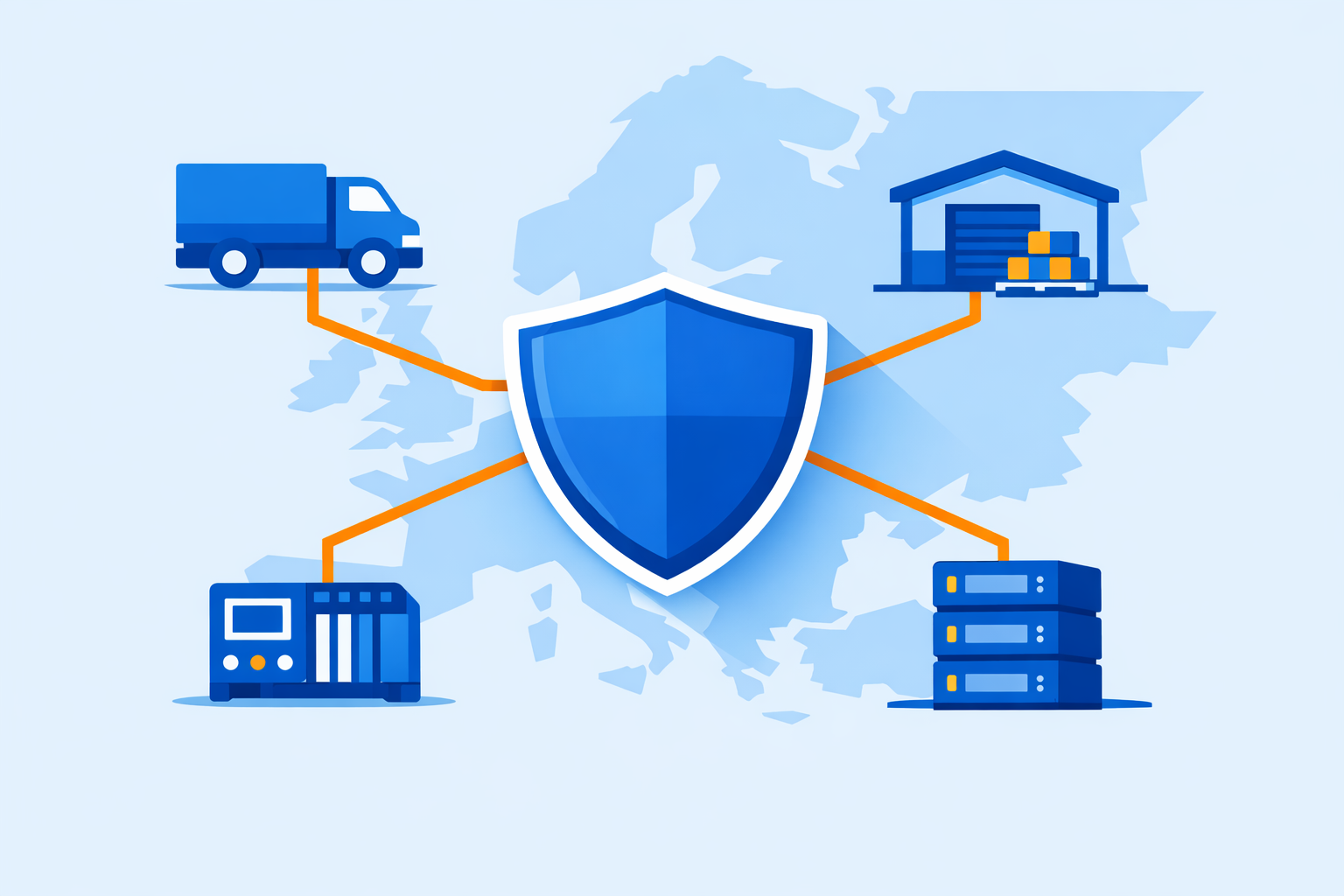
The European Union's NIS2 Directive now imposes binding operational technology (OT) security obligations on automotive and logistics suppliers, with enforcement active across several member states and financial penalties reaching €10 million per violation. The directive extends beyond original equipment manufacturers (OEMs), placing direct and indirect cybersecurity requirements on every supply chain tier - from Tier 1 system integrators to Tier 3 component vendors.
Background
NIS2 (Directive EU 2022/2555) entered into force in January 2023, with member states required to transpose it into national law by October 17, 2024. The regulation replaced the original 2016 NIS Directive and extended coverage to 18 critical sectors, including transport, automotive manufacturing, and logistics, under a two-tier classification system of "essential" and "important" entities. In transport and logistics, this encompasses road haulage operators, air and rail carriers, shipping companies, and port operators.
Germany - home to the EU's largest automotive supply base - enacted its NIS2 Implementation Act on December 6, 2025, with the national BSI registration portal activated in January 2026. Belgium, Italy, Denmark, and Slovakia have also completed national transposition, while France continues finalizing its legislation. By the October 2024 deadline, 23 EU member states faced infringement proceedings from the European Commission for incomplete transposition, creating a fragmented compliance landscape for cross-border suppliers.
On January 20, 2026, the Commission published a targeted cybersecurity package proposing amendments to NIS2, aimed at simplifying compliance for approximately 28,700 companies, including 6,200 micro and small-sized enterprises. Legislative negotiations in the European Parliament and Council are expected throughout 2026, with political agreement targeted for early 2027.
Details
Under the current directive, automotive and logistics suppliers classified as essential entities face penalties of up to €10 million or 2% of global annual turnover, whichever is higher, while important entities face fines of up to €7 million or 1.4% of global turnover. National supervisory authorities can conduct targeted audits, issue binding instructions, and impose additional security requirements on non-compliant organizations.
A defining feature of NIS2 is its supply chain reach. According to PECB Insights, the directive "does not merely target OEMs; it places direct and indirect obligations on every level of the supply ecosystem." NIS2 makes a supplier's security failure affecting an essential entity's operations grounds for regulatory consequences against both parties, regardless of whether the supplier itself was directly attacked.
For OT environments specifically, the directive mandates continuous risk assessments covering both legacy and modern control systems, including programmable logic controllers (PLCs) and industrial control systems (ICS). Incident reporting requires an initial notification to national authorities within 24 hours, a detailed root-cause report within 72 hours, and a final report within 30 days. Risk-based security measures must include access controls, network segmentation, patch management, and anomaly detection across IT and OT infrastructure, according to ENISA's Technical Implementation Guidance published in June 2025.
Supply chain security is one of NIS2's 10 core cybersecurity risk management measures, requiring in-scope entities to assess vulnerabilities specific to each direct supplier and the overall quality of their cybersecurity practices, per DLA Piper's analysis of the directive. OEMs are now embedding security audit rights and incident notification service-level agreements into procurement contracts, increasingly requiring supplier alignment with ISO/IEC 27001 and the automotive-specific ISO/SAE 21434 standard.
Germany's Federal Office for Information Security (BSI) has confirmed approximately 29,500 entities fall under NIS2 in Germany alone, while France has identified over 10,000 in-scope organizations. For automotive and logistics suppliers, size thresholds apply: companies with more than 50 employees or over €10 million in annual revenue qualify as in-scope, with essential entity classification applying above 250 employees or €50 million in turnover.
Outlook
The January 2026 amendment proposal introduces certification-based compliance pathways, allowing suppliers to demonstrate adherence through EU-recognized cybersecurity certification schemes rather than bespoke national audits. Law firm McDermott Will & Emery has characterized the proposal as "a substantive recalibration" rather than a cosmetic simplification. The proposed amendments are expected to be adopted in late 2026 or 2027, after which member states will have a 12-month transposition period. Until then, automotive and logistics suppliers must operate under current national implementations, with a three-year review of NIS2's functioning scheduled for October 2027, at which point sector-specific technical requirements are expected to be formalized at EU level.
For plant managers and operations directors, the immediate compliance priority remains conducting documented OT supply chain risk assessments, establishing 24-hour incident reporting workflows, and embedding cybersecurity clauses into supplier contracts - controls that regulators in Germany, Belgium, and Italy are already empowered to audit and enforce.
Also read: EU Strengthens OT/ICS Cybersecurity under NIS2 Expansion and Industrial Cybersecurity Expands with Budget Shifts, Framework Adoption