Intensifying enforcement of the EU's NIS2 Directive is pushing automotive and logistics suppliers to upgrade operational technology (OT) security, while driving accelerated deployment of private 5G networks and edge computing across European factory floors and distribution hubs.
Background
The NIS2 Directive replaced its predecessor, Directive 2016/1148, raising the EU's cybersecurity ambition through wider scope, clearer rules, and stronger supervision tools.[1] Member States had until 17 October 2024 to transpose NIS2 into national law. Only four countries met that deadline, prompting the European Commission to open infringement procedures against 23 Member States on 28 November 2024.
Enforcement has not stalled. In May 2025, the EU Commission issued formal "reasoned opinions"-legal warnings giving Member States a final opportunity to align with the Directive before referral to the Court of Justice of the EU. As of mid-2025, 16 EU and EEA countries have adopted NIS2; implementation deadlines vary, with enforcement rolling out into 2026. In Germany, the final NIS2 law could take effect before the end of 2025; Italy has already incorporated NIS2 into national legislation; and France is still enacting the necessary laws.
Details
The directive's reach into automotive and logistics supply chains is broad. NIS2 marks a decisive shift in how digital risk is governed across transport and automotive manufacturing. Its emphasis on the supply chain places direct and indirect obligations on every level of the supply ecosystem-from Tier 1 to Tier 3 suppliers and beyond. For manufacturers of high-risk products such as industrial machinery and automotive components, the directive expands its scope to cover both IT systems and OT.
Financial penalties are severe and extend to individuals. NIS2 transforms cybersecurity from a technical function into a board-level governance obligation: essential entities face administrative fines up to €10 million or 2% of total worldwide annual turnover, whichever is higher, while important entities face maximums of €7 million or 1.4% of turnover. Management bodies are personally accountable for compliance, and governance failures may result in temporary bans or disqualification from leadership roles.
Operationally, the directive requires manufacturers and logistics operators to meet stringent OT-specific controls. Significant incidents must be reported within 24 hours as an early warning, followed by a full incident notification within 72 hours and a final report within 30 days. Meeting this reporting window is practically impossible using manual audits alone, given that legacy OT systems were built for availability, not logging or alerting. This technical gap is now a primary driver behind private 5G adoption. Private 5G networks are operating inside real manufacturing environments across Europe, with automotive plants and advanced logistics hubs among the first to run production systems on private 5G rather than wired or Wi-Fi-only infrastructure.
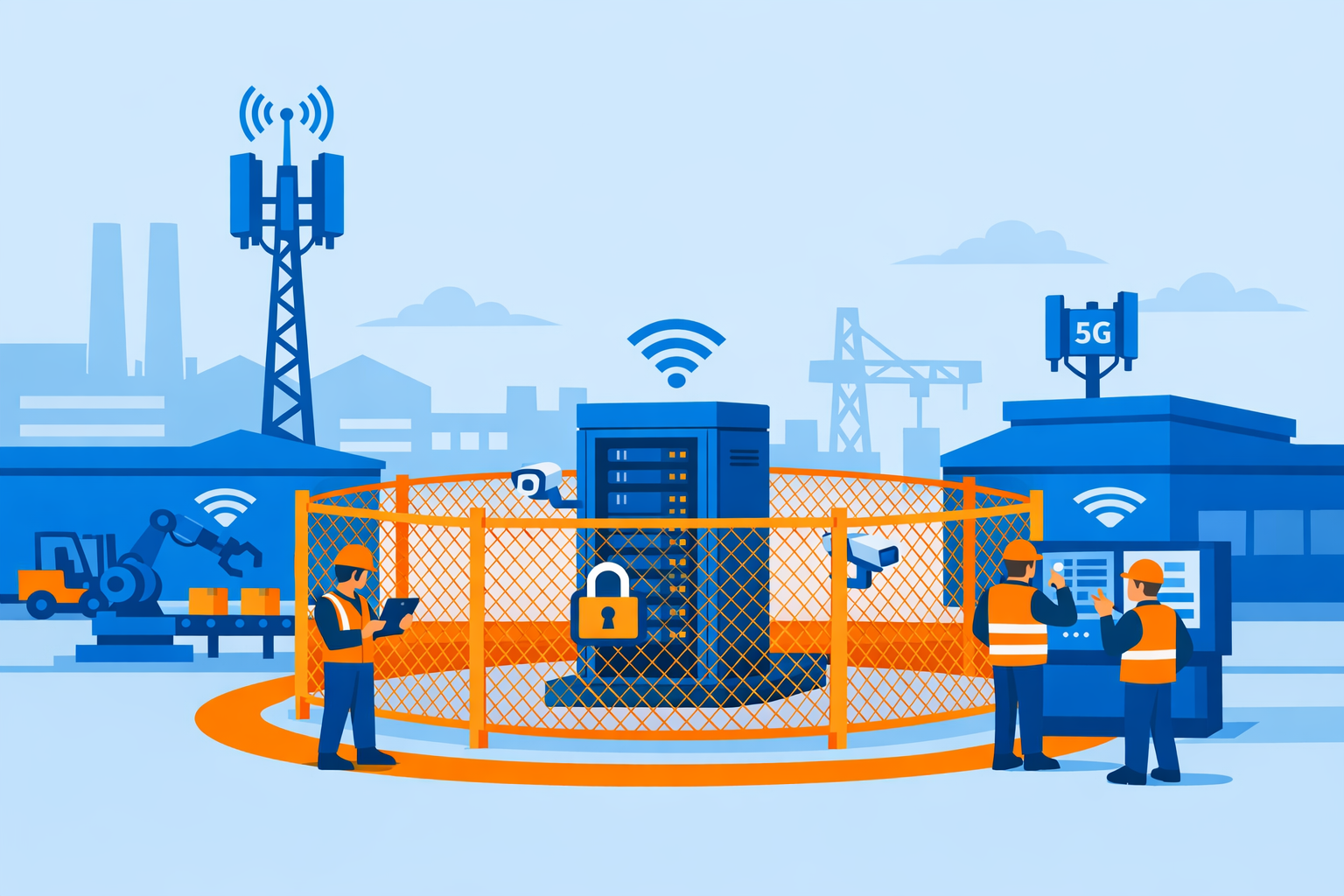
The security architecture of private 5G makes it well suited to NIS2 compliance requirements. These networks feature local User Plane Functions and on-premise Multi-access Edge Computing (MEC), providing ultra-low latency and high uplink capabilities essential for automated guided vehicles, AI-driven robotics, and smart inspection systems. Crucially, keeping traffic on-premise reduces the attack surface exposed to public internet risks. 94% of industrial companies have deployed on-premise edge computing technology alongside their private wireless networks, according to a 2025 Industrial Digitalization Report. The same report found that 81% of industrial companies found their initial on-premise edge computing and private 5G setup was cheaper than alternative options, with over half saving at least 11%.
Supply chain governance requirements under NIS2 are also reshaping procurement. OEMs are rapidly reassessing the cybersecurity posture of their supply networks-not as a preference but as a legal obligation. They must demonstrate due diligence and ongoing oversight of third-party cybersecurity risks. This is driving procurement strategy shifts, including:
- Requiring cybersecurity questionnaires during vendor onboarding
- Incorporating security clauses and audit rights into contracts
- Mandating incident notification procedures
Standards such as IEC 62443 for industrial systems and ISO/SAE 21434 for automotive cybersecurity are explicitly referenced in NIS2 guidance as applicable compliance frameworks, according to C2A Security. In Q2 2025, global cyberattacks rose approximately 21% versus the same period the previous year, with Europe recording the highest region-level increase, according to Schneider Electric analysis-underscoring why regulators are pressing ahead regardless of transposition delays.
For mid-sized suppliers, OT cybersecurity training is becoming a compliance threshold rather than a discretionary investment. Human error remains a leading OT risk, and NIS2 requires cybersecurity training for OT engineers and plant managers on phishing, password hygiene, and OT-specific threats. For many small and mid-sized suppliers, meeting NIS2 requirements may prove overwhelming due to limited resources, lack of in-house expertise, and operational complexity.
Outlook
As of 2025, detailed NIS2 security requirements have been published by several EU Member States. Implementation is actively underway across critical sectors, with many local authorities introducing sector-specific interpretations that raise security maturity expectations beyond the directive's minimum baseline. Poland has already reclassified manufacturing-including chemical production, food processing, and distribution-from "important" to "essential," triggering stricter supervisory obligations. As Germany finalizes its national implementation and France moves toward transposition, automotive and logistics suppliers operating across borders face an increasingly complex, jurisdiction-by-jurisdiction compliance landscape where private 5G and edge computing are fast becoming baseline infrastructure rather than optional upgrades.