Global adoption of two-dimensional (2D) industrial barcode scanners is rising, driven by their expanding role in Industrial Internet of Things (IIoT) deployments in manufacturing, logistics, and warehousing. Demand centers on enhanced data payloads, improved interoperability in multi-vendor settings, and measurable returns through real-time traceability and automated quality control. Germany, China, and India lead market growth, with Germany projected to register a compound annual growth rate (CAGR) of approximately 10.6% from 2026 to 2036.[1]
Background
The transition from traditional one-dimensional (1D) barcode scanners to 2D imaging scanners reflects the need for compact labeling systems that encode extensive metadata, such as batch numbers, expiry dates, and URLs, without using lengthy codes. 2D scanners streamline data capture by reading both 1D and 2D codes from any orientation, maintaining accuracy even when codes are damaged or printed poorly.[2] Earlier adoption faced obstacles due to higher initial costs and integration challenges, particularly in facilities with legacy enterprise resource planning (ERP) or manufacturing execution systems (MES). About 26% of industrial buyers reported integration as a barrier.[3]
Details
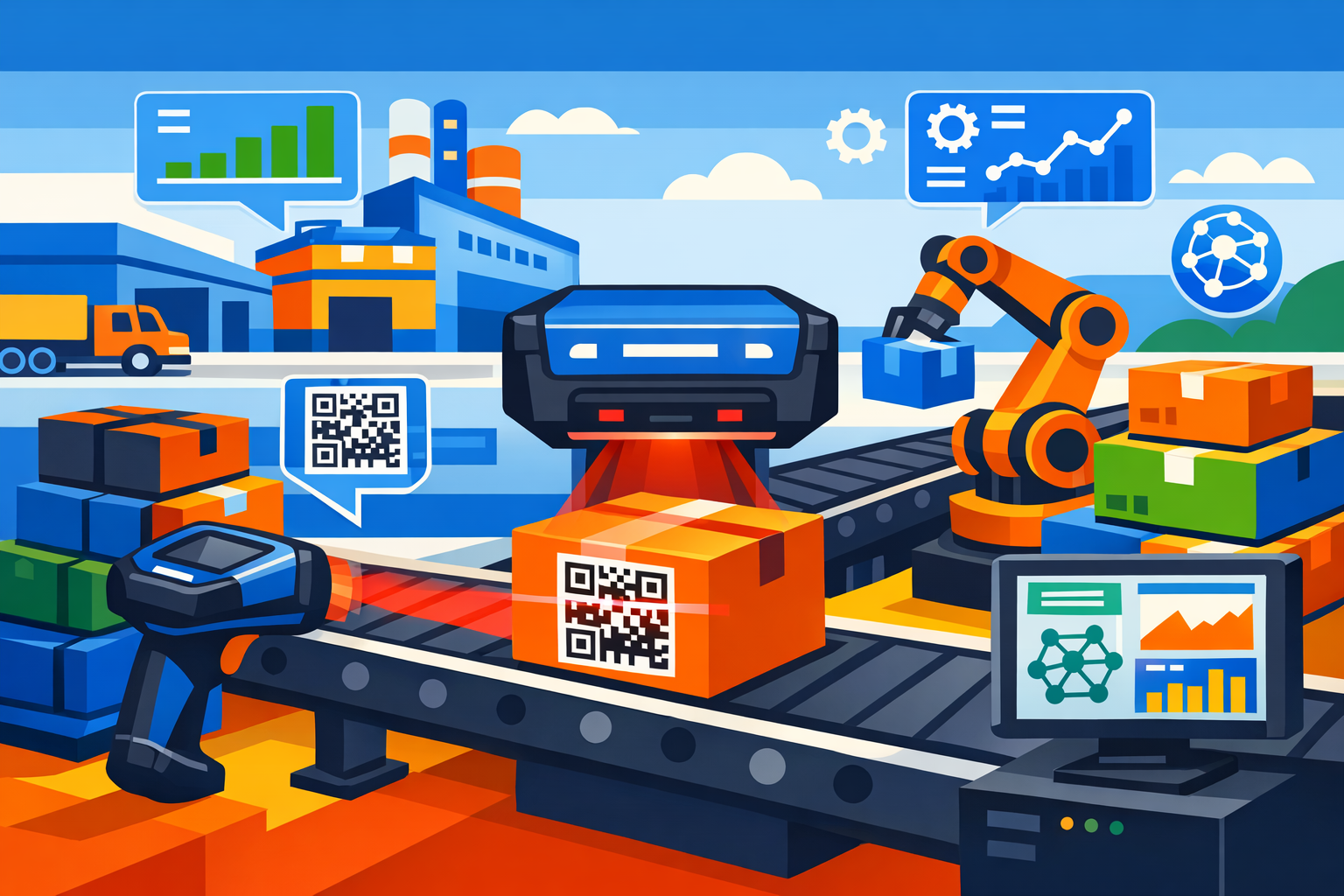
The global industrial scanner market is projected to reach approximately USD 2.6 billion in 2025, with 2D barcode scanners representing an estimated 32% share. Growth is fueled by demand from automated factories, logistics providers, and e-commerce fulfillment centers requiring rapid, accurate traceability.[4] In Germany, the 2D barcode reader sector is expected to grow at a 10.6% CAGR between 2026 and 2036, supported by strong Industry 4.0 and supply chain initiatives.[1] Fixed 2D readers are being adopted for hands-free scanning on production lines and conveyors, while handheld units remain prominent in mobile operations, accounting for about 59% of the segment in 2026.[5]
Deployments illustrate notable efficiency gains. In Japan and Germany, integrating barcode scanners with robotic and pick-and-place systems increased process efficiency by 21% and improved error detection by 33%.[3] In Shenzhen, a logistics provider used 2D codes for warehouse returns, cutting manual scanning time by nearly 40%.[6]
Outlook
Wider 2D scanner adoption is anticipated as the GS1 Sunrise 2027 initiative advances migration from 1D to 2D barcodes in retail and supply chains. Integration with ERP, warehouse management systems (WMS), and MES platforms is expected to improve.[6] Although initial investment and firmware management pose challenges, benefits in traceability, overall equipment effectiveness (OEE), and inventory visibility are expected to support continued industry adoption.