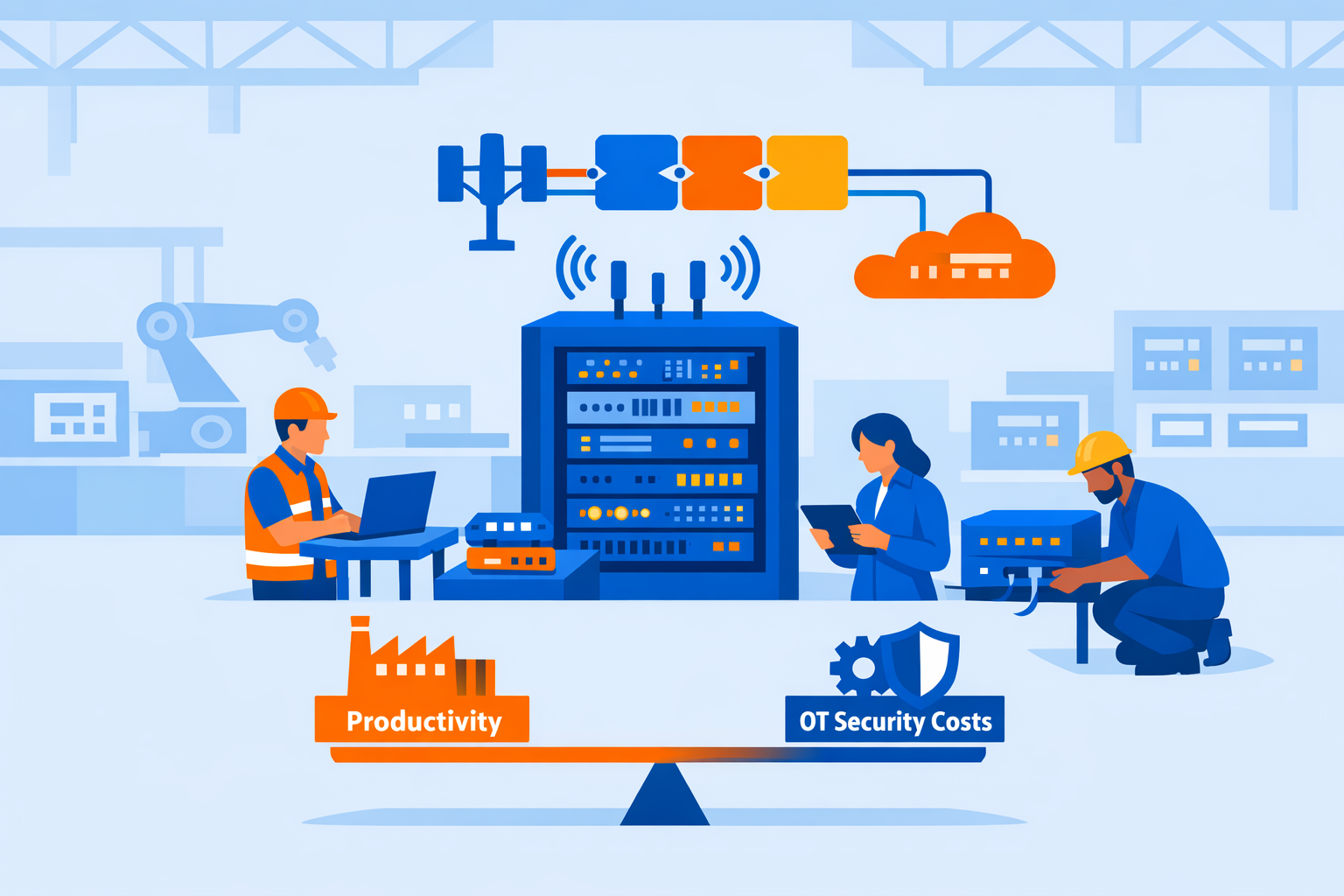
The latest round of U.S. federal Open Radio Access Network (Open RAN) grants is channeling funding into private 5G deployments across mid-sized American manufacturing facilities, accelerating a brownfield retrofit wave. Industry analysts warn, however, that operational technology (OT) security compliance and multi-vendor integration expenses are emerging as significant offsets to projected productivity gains.
Background
The NTIA's Public Wireless Supply Chain Innovation Fund, authorized under the CHIPS and Science Act of 2022, carries a total program budget of $1.5 billion to advance open and interoperable wireless networks. The fund operates through sequential Notices of Funding Opportunity (NOFOs), each targeting a distinct stage of the Open RAN ecosystem. Through the first two rounds, NTIA awarded more than $550 million across 35 projects, with round one focused on testing and research infrastructure and round two on the commercialization of open radio units. The third NOFO - which explicitly targets industry verticals including utilities, mining, and manufacturing - makes up to $450 million available for software solutions that leverage Open RAN interfaces to generate productivity gains and reduce the cost of multi-vendor integration.
The broader market context underscores why manufacturers are mobilizing. The global private 5G network for industrial IoT market was valued at $6.4 billion in 2025 and is projected to reach $43.8 billion by 2034, growing at a 23.5% compound annual growth rate (CAGR), according to market research firm MarketIntelo. Manufacturing remains the largest single industry vertical in private 5G projections, according to SNS Telecom & IT Research Director Asad Khan, who projects annual investments in private 5G for vertical industries will grow at approximately 41% CAGR between 2025 and 2028, surpassing $5 billion by end of 2028.
Grant Details and Sector Activity
NOFO 3 drew a strong response. More than 90 applications requesting nearly $3 billion were submitted to NTIA for the third funding round, far exceeding the $450 million available, according to the agency's May 2025 announcement. Acting NTIA Administrator Adam Cassady stated that the round is "about driving forward the adoption of open and interoperable networks so that American businesses can thrive in the market for wireless equipment." NTIA plans to issue grants ranging from $24 million to $50 million for industry vertical solutions and from $9 million to $18 million for integration automation solutions, according to a Department of Commerce Inspector General report published in January 2025. Grantees must complete project work within 18 to 36 months of award.
Adoption statistics reflect the manufacturing sector's urgency. In 2025, approximately 38% of global Tier-1 manufacturing enterprises had deployed or piloted a private 5G network, up from just 12% in 2022, according to MarketIntelo. SNS Telecom & IT reports tracking over 1,000 projects in the manufacturing space globally. The industrial segment of 5G infrastructure is the fastest-growing end-use category, with a 44.6% CAGR, driven by private networks for factories, ports, mines, and energy facilities, according to SNS Insider.
For Open RAN specifically, the global market was valued at $3.98 billion in 2025 and is forecast to grow to $25.27 billion by 2031 at a 36.08% CAGR, according to Mordor Intelligence, with private enterprise networks leading growth at a 33.15% CAGR between 2026 and 2031.
OT Security and Integration Costs Cloud the ROI Calculus
Despite the funding tailwind, plant operators and analysts consistently flag OT security expenditure as a material offset to 5G-driven productivity gains. According to Palo Alto Networks' 2024 State of OT Security Report, 70% of industrial organizations experienced a cyberattack on their OT environment in the preceding year, with 25% of those attacks leading to operational shutdowns. Connecting traditionally isolated OT networks to private 5G infrastructure expands the attack surface materially: OT systems often lack fundamental security controls such as firewalls, intrusion detection, and advanced endpoint protection, and their long operational lifecycles make timely security updates particularly challenging, according to NTT Data.
Lessons from early deployments confirm that security costs are not optional. Factories adopting private 5G had to strengthen identity management, SIM and eSIM lifecycle handling, OT-IT segmentation policies, and anomaly detection - governance updates that are essential for maintaining consistent security in environments where 5G centralizes wireless access, according to IoT Business News. The most successful deployments, the same report found, aligned IT, OT, automation, telecom, and safety teams from the outset - adding coordination overhead that mid-sized enterprises often underestimate.
Multi-vendor integration complexity compounds these costs. Most operators identify integration cost and complexity as the greatest barrier to 5G RAN deployment, ahead of technology maturity and supply chain considerations, according to MarketsandMarkets. Managing software updates from multiple vendors and achieving consistent lifecycle management across a disaggregated Open RAN stack requires specialized engineering resources that many small and medium-sized enterprises (SMEs) do not maintain in-house.
Large enterprises are early adopters of private 5G due to their ability to invest in infrastructure, while SMEs are gradually entering the space through compact, cost-effective solutions, according to MarketsandMarkets research. For the latter group, high initial capital investment - covering infrastructure, edge computing, software, and maintenance - coupled with uncertain ROI and regulatory compliance costs, can slow deployment, according to MarketsandMarkets. Many enterprises are consequently adopting a phased approach, with ROI timelines of 12 to 24 months cited as a common industry benchmark for private 5G deployments.
Outlook
Decisions on NOFO 3 awards are expected on a rolling basis through 2025 and into 2026, with successful grantees required to demonstrate multi-vendor prototypes targeting manufacturing and other industrial applications. The NTIA has signaled a further NOFO is planned, indicating the federal funding pipeline for Open RAN remains active beyond the current round. For plant operators, the near-term challenge will be structuring retrofit programs that sequence 5G connectivity upgrades alongside OT security hardening - rather than treating them as separate capital expenditure line items - to preserve the automation ROI that justifies the investment.