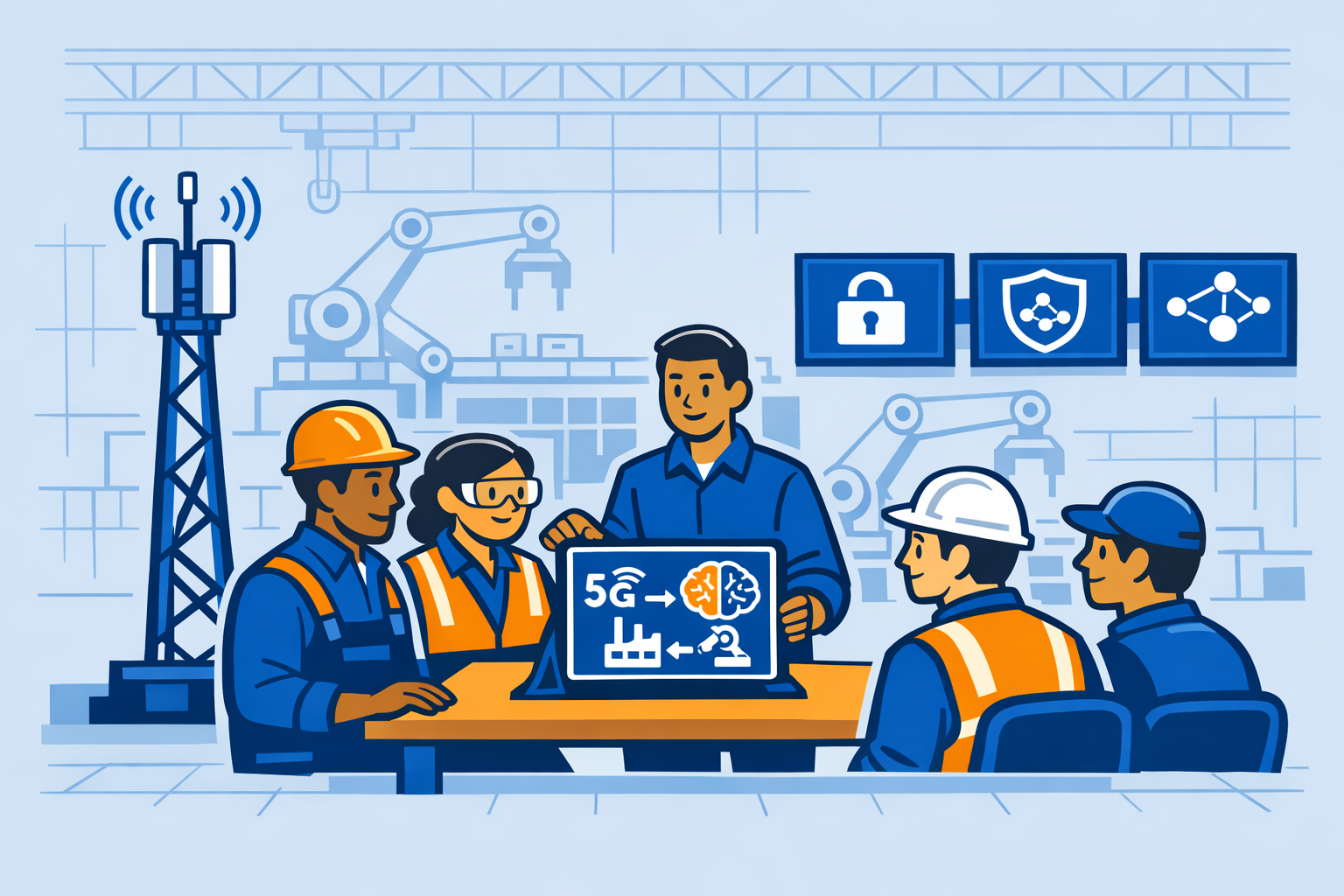
A new wave of federal grants in 2026 is conditioning funding for private 5G networks and edge AI deployments at U.S. mid-sized manufacturers on mandatory operational technology (OT) workforce training. The shift is reshaping how plant operators plan technology budgets, select vendors, and demonstrate compliance. Upskilling now stands alongside infrastructure investment as a non-negotiable grant condition, accelerating a reckoning over a widening skills gap that security researchers say already contributes directly to production-floor breaches.
Background
The funding drive spans multiple federal agencies. The U.S. Department of Labor (DOL) announced up to $30 million in funding through the Industry-Driven Skills Training Fund grant program to address critical workforce shortages. Priority industries include artificial intelligence infrastructure, advanced manufacturing, nuclear energy, domestic mineral production, and information technology. Wisconsin's Department of Workforce Development received $7.3 million in competitive grant funding to build workforce skills in advanced manufacturing and AI, as one of 14 states awarded an Industry-Driven Skills Training Fund grant from the DOL.[1] WisTRAIN grant applications are anticipated to open in May 2026 for eligible employers engaged in advanced manufacturing and AI applications such as data analytics, cybersecurity, predictive maintenance, and robotics.[2]
Separately, the DOL announced a national contracting opportunity to accelerate the integration of AI skills into Registered Apprenticeship programs. The Employment and Training Administration seeks to expand AI-related training, modernize apprenticeship programs, and strengthen the nation's talent pipeline across emerging and critical industries.[3]
The urgency behind these conditions is well documented. A 2026 report from the SANS Institute and GIAC found that the cybersecurity workforce problem is no longer about headcount - it is about capability. Teams are in place but too often lack the skills to defend against current threats. About 42% of organizations say skills gaps prevent adoption of new technologies, and another 42% report reduced monitoring capabilities. Both findings are particularly relevant in industrial settings where modernization initiatives such as the Industrial Internet of Things (IIoT) and smart manufacturing depend on secure deployment. Without the necessary skills, digital transformation itself becomes a risk vector.
Details
Grant conditions are aligning OT training requirements with recognized federal standards. In 2026, organizations are mapping strategies to frameworks such as NIST Cybersecurity Framework 2.0, IEC 62443 for industrial systems, and AI governance standards. The Cybersecurity and Infrastructure Security Agency (CISA) and its partners released guidance to address increasing business and regulatory pressures for connectivity into OT networks, noting that OT environments are more interconnected than before. Real-time analytics, remote monitoring, and predictive maintenance offer clear benefits - but also expand the attack surface.
According to the SANS Institute's 2026 report, 27% of organizations have experienced breaches directly linked to workforce skills gaps. PwC's 2026 Global Digital Trust Insights survey of 816 global industrial leaders found that gaps in OT skills and resources rank as the top threat in securing OT and IIoT, and that leaders cite AI as their top priority for closing those cyber talent gaps.
The mandatory training provisions directly affect how manufacturers select technology vendors. At Mobile World Congress 2026, Siemens announced a verified cybersecurity solution for industrial private 5G networks in collaboration with Palo Alto Networks. The solution combines Siemens' private 5G infrastructure with Palo Alto Networks' Next-Generation Firewall, tested to verify high availability, network resilience, and uninterrupted operations. This verified architecture meets IEC 62443 requirements for industrial automation and control systems security while maintaining performance characteristics essential for time-critical production applications. Grant applicants are expected to demonstrate that deployed technology integrates with training curricula mapped to such standards, tying vendor selection to compliance documentation.
Edge AI and private 5G are becoming essential infrastructure for manufacturers seeking real-time insights and operational efficiency. Manufacturers generate massive volumes of data, but legacy networks often restrict access - limiting the OT signals that AI, digital twins, and automation rely on. Private 5G removes these bottlenecks, delivering deterministic performance and continuous, high-quality data streams that turn Industry 4.0 investments into measurable results. However, a lack of cybersecurity expertise within the OT sector could derail these efforts, according to CISA guidance on securing AI in OT environments.
Data governance requirements present an additional compliance layer. For manufacturers, data governance may encompass intellectual property and trade secret protection, supply chain data-sharing requirements, and OT data integration management. According to Huntress's 2026 cyber threat report, manufacturing made up approximately 17% of cyberattacks in 2025, up from 9% in 2024. In its fifth year as the top targeted industry, ransomware attacks on manufacturers increased 61% year over year, according to Resilience's "State of Cybersecurity in Manufacturing" report.
Outlook
The Trump administration has proposed consolidating multiple DOL workforce programs into a single block grant for flexible state use through Workforce Innovation and Opportunity Act reauthorization or FY 2026 appropriations provisions. This structural change could reshape how training mandates attach to technology grant conditions in future rounds. According to the World Economic Forum's Global Cybersecurity Outlook 2026, 44% of highly resilient organizations monitor OT security, compared to only 9% of insufficiently resilient ones - a gap that federal grant architects cite as the operational rationale for mandatory training floors. Manufacturers applying for 2026 infrastructure grants should expect training deliverables, credentialing timelines, and measurable competency outcomes to function as binding compliance requirements alongside technical deployment milestones.