FANUC Corporation announced a strategic collaboration with Google on May 19, 2026, to integrate physical AI - the fusion of cognitive intelligence with autonomous physical action - into its full industrial robot lineup. The deal marks one of the largest OT/IT convergence moves in manufacturing to date. FANUC, the world's leading supplier of industrial robots and factory automation, will leverage Google's technologies to advance physical AI across its robot systems. FANUC America called the announcement a key step toward more flexible, adaptive automation for manufacturers across North America.
Background
Physical AI - the integration of cognitive intelligence with physical action - has drawn global attention following recent advances in large language models (LLMs). It encompasses robots that perceive their environment through sensors, make autonomous decisions, and execute tasks accordingly. Traditional factory automation has relied on robots pre-programmed for rigid, repetitive tasks; changing production lines has often required manual reprogramming, causing costly downtime.
Google's entry into the industrial robot stack carries significant infrastructure weight. In February 2026, Google moved Intrinsic, its robotics software subsidiary, out of the experimental Other Bets division and into its core business. Intrinsic had spent years building Flowstate, a web-based platform that enables manufacturers to build robotic applications without writing thousands of lines of code. The platform handles motion planning, machine learning integration, and task orchestration - and runs across robot arms from multiple manufacturers, including FANUC, Universal Robots, and KUKA.
FANUC had also separately announced in March 2026 a partnership with NVIDIA to integrate Isaac simulation frameworks and Omniverse libraries into its physical AI pipeline. The Google partnership adds a foundation model layer on top of NVIDIA's simulation and training infrastructure, giving FANUC a two-platform AI stack.
Details
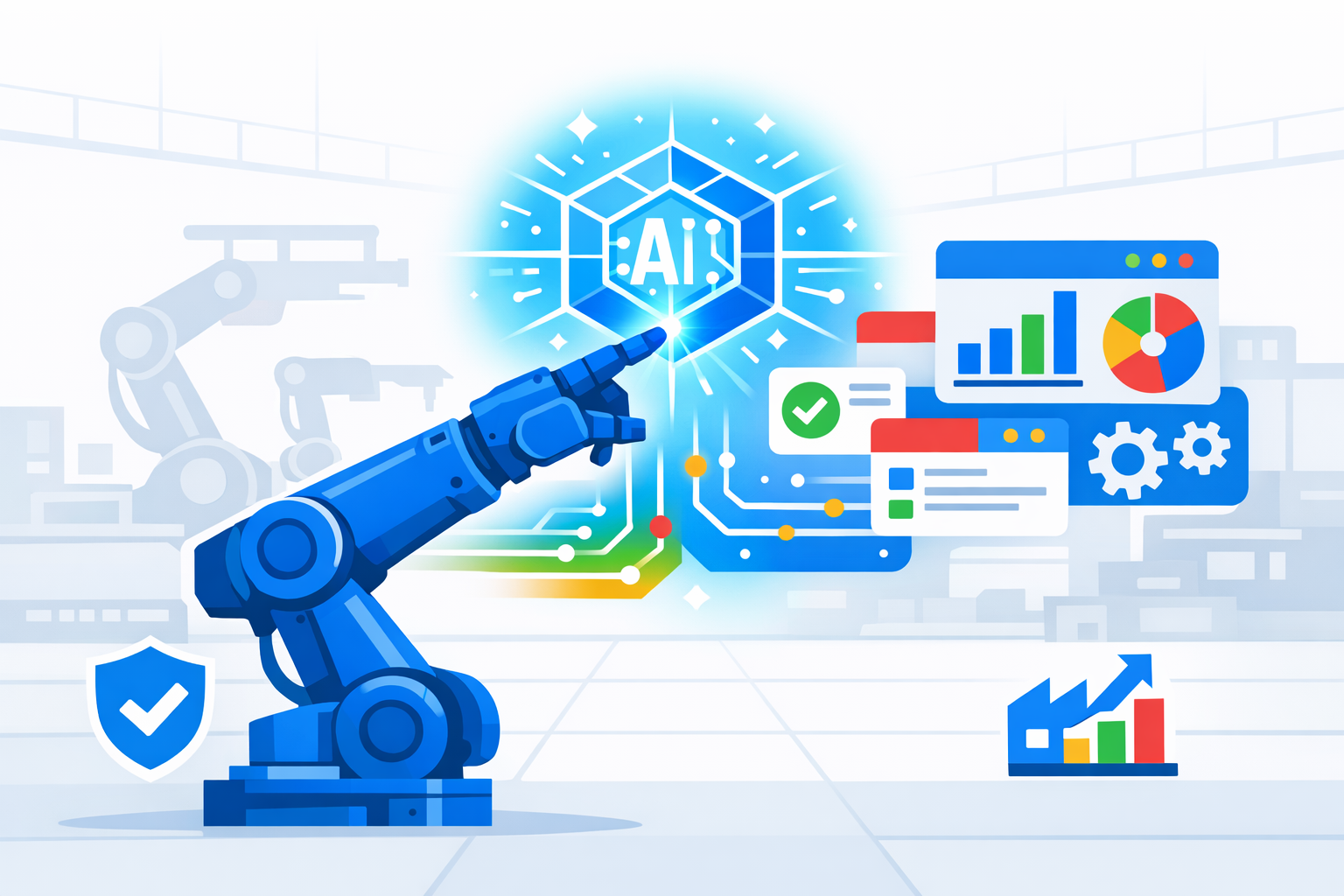
FANUC will use Google Cloud's Gemini Enterprise - the same generative AI platform powering eight million paid enterprise seats across 2,800 companies - to build industrial robot systems capable of processing natural language instructions, identifying and classifying objects in unstructured environments, and autonomously coordinating multiple robots working together. FANUC will also achieve full compatibility with Intrinsic's Flowstate development environment, enabling developers to program FANUC robots through a visual, web-based interface rather than proprietary FANUC code.
The workforce implications are direct. FANUC is applying AI to enable robots to interpret voice commands and automatically generate Python code, allowing operators to give verbal instructions, reduce setup time, and adjust processes without specialized programming skills. These capabilities offer manufacturers new ways to overcome skilled labor shortages and meet rising demands for customization and efficiency.
FANUC has shipped more than 1,000 robots equipped with physical AI capabilities since first demonstrating the technology at the International Robot Exhibition in Tokyo in December 2025, with demand continuing to accelerate. FANUC's open platform strategy includes making the ROS 2 driver source code public, allowing Python execution, and enabling high-speed external command input. Together, these moves facilitate physical AI adoption across its robot lineup - from models with a 3 kg payload to those handling 2.3 tons.
FANUC shares surged as much as 16% to an intraday record high following the announcement, according to Bloomberg. The reaction reflects investor confidence in the revenue potential of retrofitting an existing installed base. The 1.1 million FANUC robots currently operating in factories worldwide represent an upgrade opportunity that no volume of new robot sales can match.
The physical AI market is projected to grow from $1.5 billion in 2026 to $15.2 billion by 2032, a compound annual growth rate of 47%, according to market forecasts cited by analysts. The adjacent industrial robotics intelligence software market is forecast to add $49 billion by 2031 as factories shift from programmed motion to adaptive automation.
On the geopolitical front, FANUC announced in March 2026 a $90 million investment to build an 840,000 square-foot robot manufacturing facility in Pontiac, Michigan, creating 225 jobs.
Mike Cicco, President and CEO of FANUC America, stated: "Manufacturers are moving beyond the question of whether to use AI and focusing on how to apply it where it matters most - on the factory floor."
Outlook
FANUC plans to demonstrate an AI agent system for industrial robots later this month, in which collaborative and non-collaborative robots operate together using natural language instructions. Google can now offer manufacturers an end-to-end solution spanning AI models (Gemini), cloud infrastructure (Google Cloud), robotics software (Intrinsic Flowstate), and research expertise (Google DeepMind).
For plant managers and operations directors evaluating integration roadmaps, the convergence of open-source frameworks such as ROS 2, cloud-based AI inference, and hardware-agnostic development environments signals that barriers to AI-enabled automation are narrowing. Questions of data governance, cybersecurity across OT/IT boundaries, and operator retraining at scale remain critical implementation factors for facilities of all sizes.