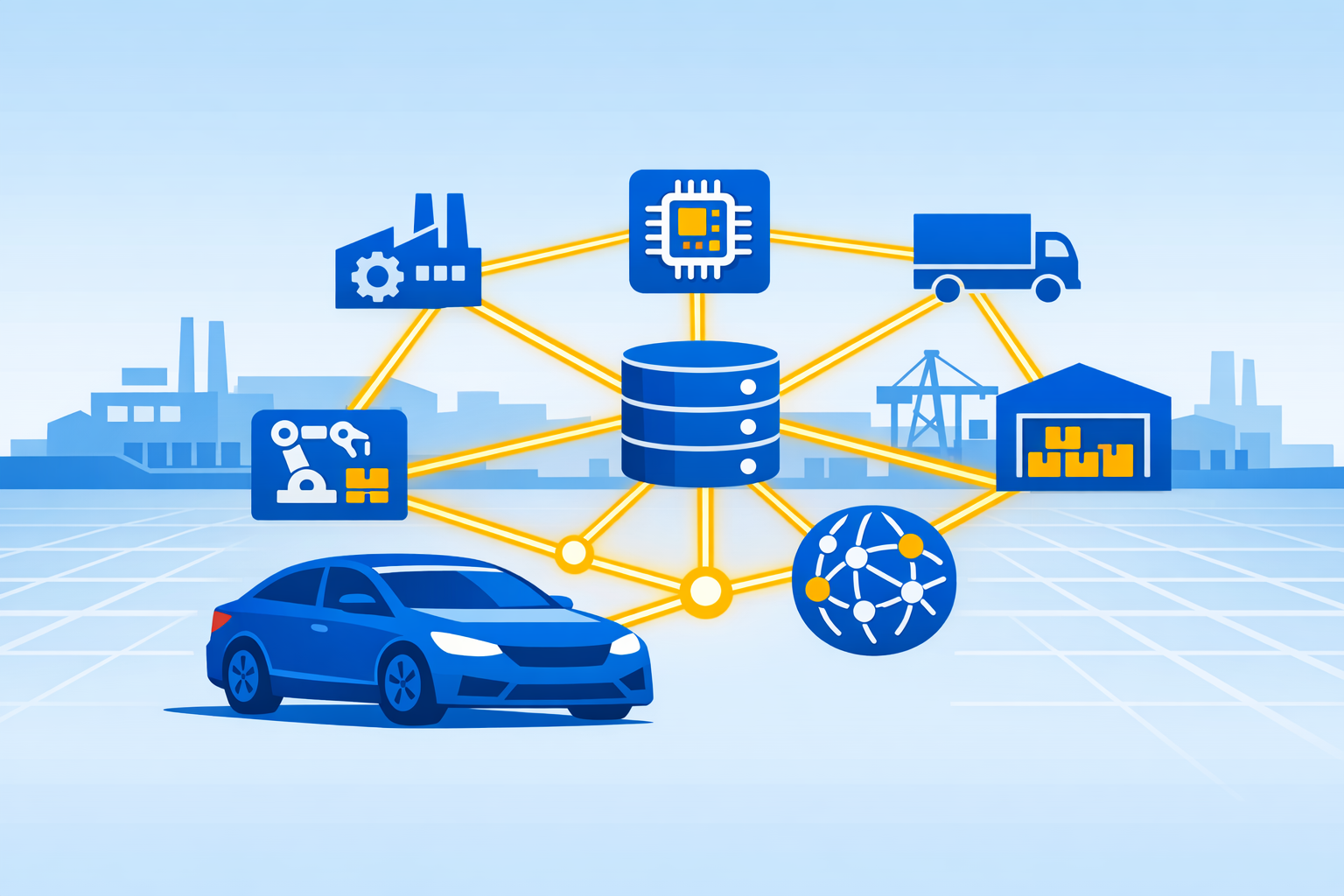
Automotive manufacturers are expanding digital twin deployments beyond individual vehicle programs into enterprise-wide supply chain infrastructure, a shift exposing unresolved questions around data ownership, interoperability, and governance that also affect aerospace, energy, and process industries.
Background
Digital twin technology-live, data-driven virtual replicas of physical assets or systems synchronized through IoT sensors-has been a fixture on automotive production floors for several years. Tesla uses digital twins to simulate crash scenarios, improving vehicle safety designs without extensive physical testing, while Toyota has created virtual replicas of its European manufacturing plants to simulate and plan production line changes without disrupting actual operations. These plant-level implementations are giving way to a more expansive architecture: the supply chain digital twin (SCDT), which models not just a single facility but the entire network of suppliers, logistics nodes, and inventory flows connected to a finished vehicle.
Persistent supply chain volatility is driving the transition. The automotive industry faces challenges including fluctuating demand, inventory imbalances, and long lead times, while traditional quality systems frequently lack the traceability and adaptability required in a disruption-prone environment, according to a peer-reviewed framework published in Advanced Engineering Informatics in 2025.
Key Developments
Ford Motor Company has emerged as a documented case study in enterprise-scale SCDT deployment. Peer-reviewed research describes Ford's approach using a three-layer framework-intracompany, Tier-1 supplier network, and deep-tier network-classified by levels of data visibility. According to the study, a properly developed SCDT can enable strategic and operational performance improvements, end-to-end visibility, agentic AI integration in decision-making, and supply chain stress testing.
Volkswagen's approach follows a similar trajectory. The MEB platform underpinning Volkswagen's electric vehicles functions as a digital twin, enabling predictive maintenance across car factories and providing instantaneous production analytics that adapt to supply shocks such as semiconductor shortages. General Motors has used virtual simulation of its Ultium battery technology design, reducing years of development to several months.
Market data reflects how rapidly the practice is expanding beyond automotive. The global digital twin market is projected to grow from approximately $21.14 billion in 2025 to $149.81 billion by 2030, at a compound annual growth rate of 47.9%, according to MarketsandMarkets. Aerospace, automotive, electronics, and energy utilities have reached the highest adoption thresholds, with over 70% of manufacturers in these verticals piloting or deploying digital twin solutions, according to PatSnap R&D intelligence data. McKinsey research indicates that supply chain digital twins can deliver up to a 20% improvement in consumer promise fulfillment, a 10% reduction in labor costs, and a 5% revenue increase through optimized operations.
Data governance has emerged as the central engineering and legal challenge as twins scale across organizational boundaries. Establishing data governance frameworks-including metadata standards, lifecycle versioning, and access control policies-is essential to maintain the integrity of digital twin systems over time, according to a September 2025 analysis in the ITEA Journal. The problem compounds at the multi-tier supply chain level: fragmented systems, inconsistent semantics, and disconnected operational views prevent AI, analytics, and digital twins from delivering meaningful outcomes, according to industry practitioners cited at the CoreShift 2025 conference.
Standardization bodies are working to close the interoperability gap. The IEC organization issued standard IEC 63278-1 in 2023, intended as the first part of a series defining the structure, security, and communication of digital twins, including an Asset Administration Shell framework. Semantic standards such as ISO 23247 provide a standardized structure for representing manufacturing systems, supporting scalable enterprise adoption across sites and vendors.
Outlook
As OEMs extend SCDT scope into deep-tier supplier networks, questions of data ownership-specifically, which party controls sensor data generated at a supplier's facility when it feeds an OEM's virtual model-are expected to generate contractual and regulatory friction. Digital twin patent filings surged 600% between 2017 and 2025, with 2,451 applications filed in 2025 alone, according to PatSnap, signaling intensifying commercial R&D investment likely to accelerate product differentiation among platform vendors. Future deployments are expected to focus on interoperability and enterprise-scale integration, with semantic standards unifying equipment data across lines and sites.