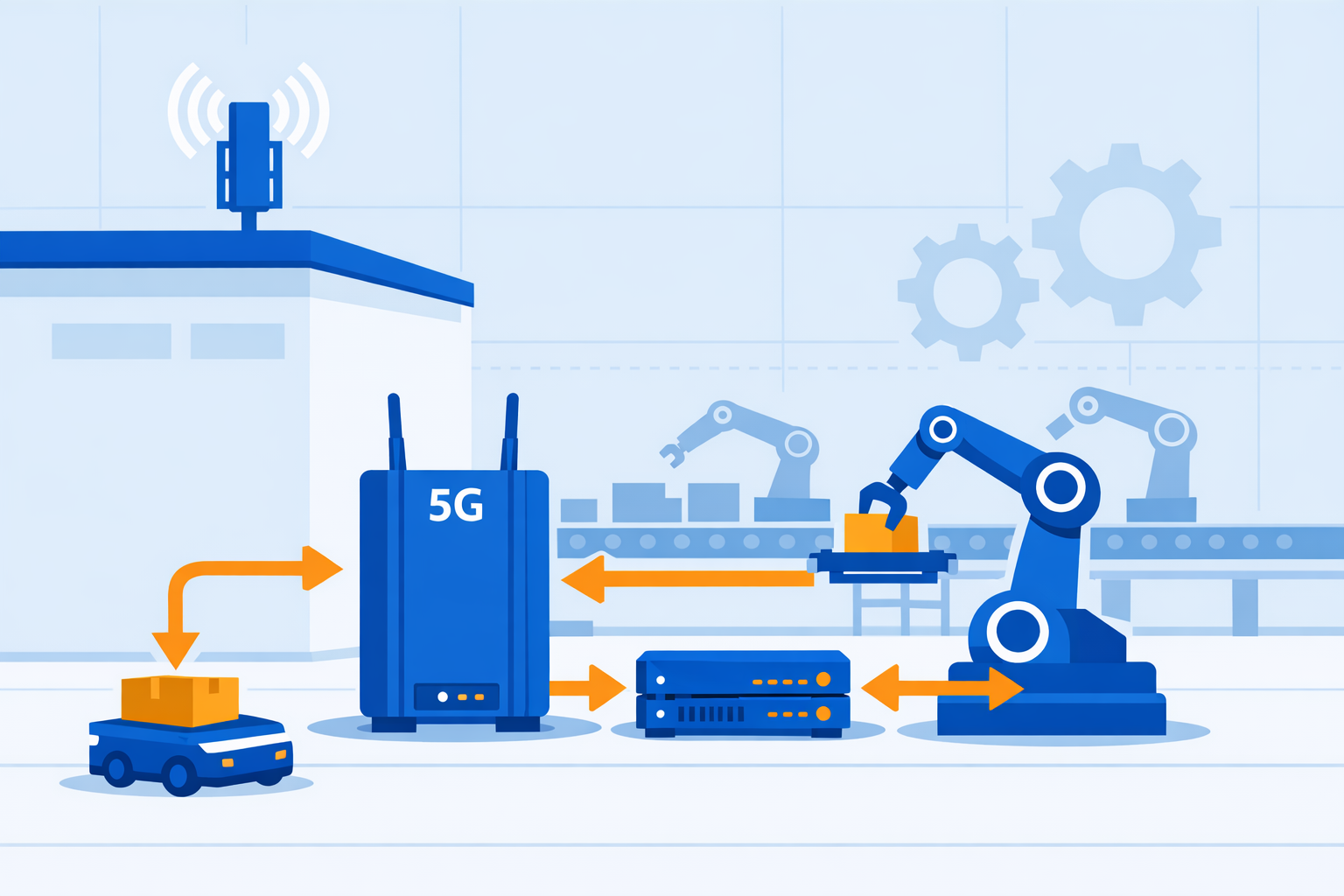
Mid-sized US manufacturers are fast-tracking private 5G and edge AI deployments as tightening federal operational technology (OT) security requirements and surging industrial cyberattacks turn legacy wireless infrastructure into a compliance liability. The convergence of regulatory pressure, maturing CBRS spectrum access, and proven return-on-investment data is driving what vendors and analysts describe as a shift from pilot programs to production-grade deployments across the factory floor.
Background
The regulatory landscape has sharpened considerably over the past twelve months. NIST released the initial public draft of IR 8183 Revision 2, the Cybersecurity Framework 2.0 Manufacturing Profile, in September 2025, providing an updated roadmap for reducing cybersecurity risk in manufacturing OT environments. The revision aligned guidance with CSF 2.0's six core functions-including the newly added Govern function-and reflects growing federal emphasis on IT/OT convergence security. Separately, NIST released a draft guidance document in 2025 addressing portable storage media risks in OT environments, with public comment closing in August 2025.
For manufacturers supplying the defense industrial base, the Cybersecurity Maturity Model Certification (CMMC) program establishes a tiered certification model building on NIST SP 800-171, and achieving compliance is required to remain eligible for Department of Defense contracts. According to industry analysis, approximately 57% of mid-to-large US manufacturers have implemented NIST CSF-aligned controls, often as part of ISO 27001-based programs or DoD supplier requirements.
The threat environment is reinforcing regulatory urgency. The US Cybersecurity and Infrastructure Security Agency (CISA) reported a 150% increase in OT-targeted cyberattacks in 2024, with breaches costing manufacturers an average of $23 million. According to Fortinet's 2025 State of Operational Technology and Cybersecurity Report, adversaries are increasingly pursuing operational disruption rather than data theft alone; ransomware and denial-of-service attacks now pose direct threats to production continuity. FortiGuard Labs reported that automated internet scanning activity rose sharply in 2024, with attackers specifically targeting OT and IoT protocols used in manufacturing environments.
Details
Private 5G adoption in US manufacturing is accelerating on the strength of the Citizens Broadband Radio Service (CBRS) shared spectrum model, which eliminates the cost and complexity of traditional licensed spectrum. According to a March 2026 study by Analysys Mason, commissioned by American-Made 5G, 75% of private 5G networks in the United States use CBRS spectrum, and manufacturing accounted for approximately a quarter of all CBRS private network deployments in 2025. Analysys Mason estimates that more than 2,500 private 5G networks will be operating in the US manufacturing sector by 2032, with over 85% relying on CBRS.
Early-adopter ROI data is reinforcing capital expenditure decisions. Nokia's 2025 Industrial Digitalization Report, drawn from 115 enterprises, found that 87% of organizations deploying private wireless and on-premises edge computing see return on investment within 12 months, with 70% already running AI-driven applications on that infrastructure. Manufacturers deploying private 5G report production downtime reductions of up to 40% and maintenance cost decreases of 25 to 30%. One automotive manufacturer documented in the Analysys Mason study cut unplanned downtime by 30% after deploying a CBRS-based private 5G network. Unplanned downtime costs US manufacturers an estimated $50 billion per year.
On the vendor side, major equipment makers are expanding US-specific offerings. Siemens announced in April 2026 that it is expanding its industrial-grade private 5G infrastructure to the United States, enabled by a new CBRS-band radio unit that allows manufacturers to deploy private 5G on-premises without relying on mobile network operators. The company simultaneously announced a verified cybersecurity solution for industrial private 5G networks developed with Palo Alto Networks. The Siemens-Palo Alto solution combines Siemens' private 5G infrastructure with Palo Alto Networks' Next-Generation Firewall (NGFW), optimized for AI, and meets IEC 62443 requirements for industrial automation and control systems security. According to Siemens, the architecture performs deep packet inspection for OT protocols while maintaining the low latency required for real-time production control-a critical distinction from generic IT security tools.
In February 2026, NTT DATA and Ericsson announced a partnership to deliver managed private 5G with edge AI, with NTT DATA Edge AI agents running on Ericsson's enterprise edge platforms to enable real-time intelligence at the point of data generation. The partnership targets manufacturing use cases including automated quality inspection, predictive maintenance, and real-time safety monitoring.
Integration with legacy OT infrastructure remains the primary operational hurdle. OT systems-including industrial control systems (ICS) and supervisory control and data acquisition (SCADA) architectures-were designed with proprietary protocols and disparate data formats often incompatible with modern IT infrastructure. According to NTT DATA, integrating legacy systems requires complex middleware development that introduces significant downtime risk. Early private 5G manufacturing deployments reveal that performance depends heavily on RF engineering, device maturity, OT integration, spectrum strategy, and organizational readiness. Factories that aligned IT, OT, automation, telecom, and safety teams from the outset reported the most consistent outcomes.
Workforce training is emerging as a parallel constraint. Factories adopting private 5G have needed to update maintenance procedures for radio units and provide training for staff operating autonomous guided vehicles (AGVs) and connected tools. The lack of personnel with specialized IT/OT convergence skills remains a recognized gap across mid-sized plant operations.
Outlook
Spectrum policy uncertainty poses a near-term risk to CBRS-dependent deployments. AT&T proposed in 2024 to relocate CBRS users from the 3.55-3.7 GHz band to the 3.1-3.3 GHz band, a move that manufacturers warn would require rebuilding the entire hardware ecosystem-chipsets, radios, and end-user devices-from the ground up, with multi-year disruption. The FCC has not resolved the matter, and the outcome will directly affect investment timing for plants currently planning CBRS-based rollouts. Meanwhile, the global 5G enterprise market is forecast to grow from $7.3 billion in 2025 to $152.7 billion by 2035. As compliance deadlines under CMMC and NIST CSF 2.0 approach, plants that have deferred OT security modernization face compounding exposure-both from regulators and from an attack surface expanding in direct proportion to IT/OT connectivity.