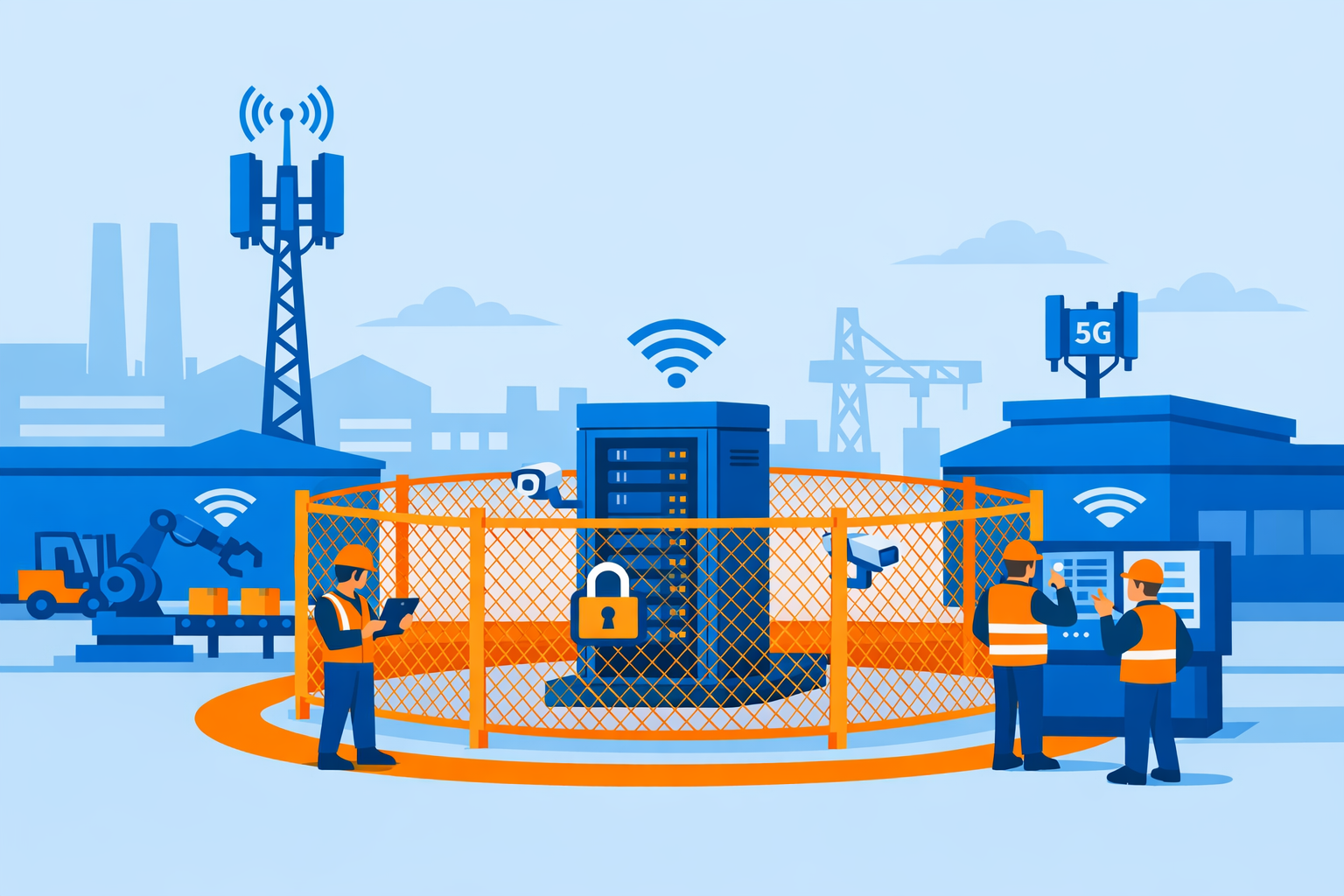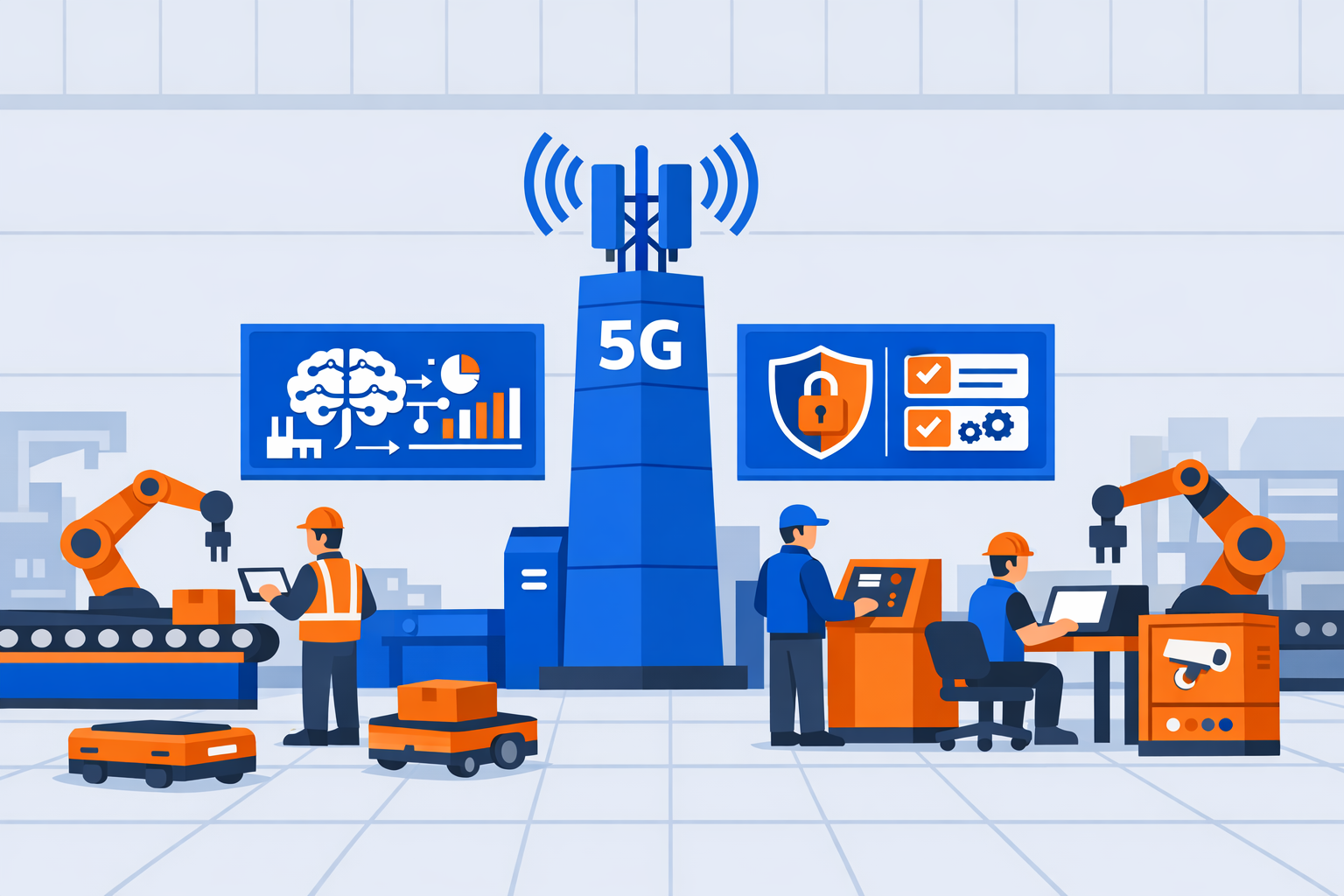
A new wave of infrastructure investment is reshaping the shop floor. Across the United States, mid-sized manufacturers are deploying private 5G networks and edge AI systems at a pace that would have seemed premature just three years ago - and two forces are driving the acceleration in tandem: tightening operational technology (OT) security requirements from federal regulators and a surge of grant funding explicitly tied to workforce training mandates.
For plant managers and operations directors weighing capital expenditure decisions, the strategic calculus has shifted. Private 5G is no longer a large-enterprise luxury. It is becoming a compliance-enabling infrastructure layer.
The Regulatory Pressure Reshaping Network Investment
The U.S. Cybersecurity and Infrastructure Security Agency (CISA) has significantly expanded its OT-focused guidance over the past 18 months. The agency's updated Cybersecurity Performance Goals (CPG 2.0)[1] provide outcome-driven, measurable actions for critical infrastructure owners and operators - including manufacturers - structured around six functions: Govern, Identify, Protect, Detect, Respond, and Recover.
In parallel, CISA published new OT asset inventory guidance[2] in partnership with the FBI, NSA, and international cybersecurity partners, specifically aimed at helping manufacturers build and maintain accurate inventories of industrial control systems (ICS), process automation equipment, and cyber-physical devices. The guidance reinforces the importance of eliminating information silos between IT and OT environments - a challenge that legacy wired networks and fragmented Wi-Fi deployments have historically made difficult to address.
OT-targeted cyberattacks surged by over 150% in 2024, with average breach costs exceeding $25 million, according to CISA data. For mid-sized plants that have historically relied on air-gapping rather than active monitoring, the exposure is compounding. A 2025 analysis[3] found a 40% rise in internet-exposed ICS devices between 2024 and 2025, with critical manufacturing consistently ranking among the most impacted sectors.
CISA's latest OT connectivity guidance, published in January 2026 alongside the UK's National Cyber Security Centre, outlines eight principles for designing, securing, and managing connectivity into OT environments. The emphasis on security-by-design - rather than security bolted on after deployment - is directly shaping how procurement teams evaluate private 5G architectures.
For deeper context on exposed ICS and OT device risks, see the Factory Tech News analysis: Systemic Cyber Risk from Exposed ICS/OT Devices.
Why Private 5G Is Gaining Ground Over Wi-Fi 6 in OT Environments
The argument for private 5G in manufacturing has historically centered on latency and bandwidth. Those factors remain relevant - particularly for autonomous mobile robots (AMRs), real-time quality inspection cameras, and predictive maintenance sensor arrays generating continuous telemetry streams. But the OT security context has introduced a new dimension: network architecture as a security control.
Private 5G networks use SIM-based authentication[4] to restrict access to authorized devices and users, with all data remaining on-premises and under operator control. This per-device identity model aligns more naturally with Zero Trust security principles than VLAN-dependent Wi-Fi segmentation, which requires additional overlay tools to achieve equivalent access granularity.
For OT environments specifically, Ericsson's analysis[5] notes that private 5G transforms "fragmented, unreliable data streams into a trusted, deterministic data plane" - enabling manufacturers to integrate long-siloed systems including manufacturing execution systems (MES), SCADA, and enterprise resource planning (ERP) without introducing the flat network structures that enable lateral movement following a breach.
Private 5G vs. Industrial Wi-Fi 6/6E: A Security-Focused Comparison
| Consideration | Private 5G | Industrial Wi-Fi 6/6E |
|---|---|---|
| Latency | Sub-5 ms deterministic | Variable (5-20 ms) |
| Device Authentication | SIM-level per-device identity | Certificate/password-based |
| Network Segmentation | Native slicing & SIM-based isolation | VLAN-dependent; less granular |
| Mobility (AMRs/Forklifts) | Seamless handoff across large facilities | Roaming gaps in large plants |
| OT/IT Convergence | Purpose-built integration | Requires additional overlay tools |
| Security-by-Design | Built-in encryption; Zero Trust ready | Requires additional configuration |
| Upfront CapEx | Higher (spectrum + RAN hardware) | Lower initial hardware cost |
| Federal Grant Eligibility | Frequently listed as qualifying infrastructure | Less commonly prioritized |
A 2025 Industrial Digitalization Report[6] covering 115 organizations found that 81% of industrial companies found their initial on-premises edge and private 5G setup was cheaper than alternatives, and 86% saw day-to-day operational costs drop after deployment.
Edge AI: From Pilot to Production
The use cases mid-sized manufacturers are prioritizing for edge AI reflect a focus on operational outcomes rather than technology novelty. Predictive maintenance, real-time quality inspection, and AI-based anomaly detection for early fault prediction are the leading deployment categories - precisely because they generate measurable reductions in unplanned downtime, scrap rates, and mean time to detect (MTTD) and respond (MTTR) to equipment faults.
Modern physical AI models can now be trained with approximately 40 hours of video[7], compared to legacy machine vision approaches that required 50,000 labeled images over nine months. This acceleration in model training timelines is closing the gap between pilot deployments and production-scale rollouts - a shift that matters significantly for mid-sized plants with limited data science resources.
Cargill, for example, has deployed private 5G networks across more than 50 manufacturing facilities[7], using them to support initiatives ranging from digitization programs to autonomous robots performing routine inspection tasks. The deployment model - modular, multi-site, vendor-agnostic - reflects the architecture most mid-sized manufacturers are now evaluating.
From an OT security standpoint, edge AI introduces a specific advantage: data filtering and action at the point of generation. Sensitive operational data need not traverse the enterprise network to a centralized cloud for inference. This reduces the attack surface and supports compliance with data residency requirements increasingly referenced in federal grant terms.
Federal Funding: De-Risking Deployment, Introducing Training Requirements
Federal grant programs are playing a material role in accelerating private 5G and edge AI adoption at mid-sized plants - not simply by offsetting capital costs, but by introducing structured compliance requirements that reinforce OT security posture.
The U.S. Department of Labor awarded more than $86 million in workforce training grants to 14 states in 2025](https://ohsonline.com/articles/2025/10/01/86-million-in-federal-grants-to-boost-workforce-training-in-high-risk-industries.aspx) to strengthen domestic industries and prepare workers for high-demand fields including manufacturing and emerging technologies. Separately, the DHS FY2025 State and Local Cybersecurity Grant Program (SLCGP) allocated $91.75 million[8] for cybersecurity risk management, with one of its four program objectives explicitly requiring organizations to ensure personnel are appropriately trained in cybersecurity commensurate with their responsibilities.
The policy linkage between infrastructure grants and mandatory OT workforce training is creating downstream demand for scalable, standardized curricula. Grant applicants are increasingly required to demonstrate measurable training progress for operators, technicians, and line managers - not just technology deployment milestones.
This structure is consequential for mid-sized manufacturers. Deploying private 5G and edge AI hardware without a parallel investment in OT security training is not only operationally risky - it may disqualify plants from the funding streams that make deployment economically viable in the first place.
Persistent Challenges: Supply Chain, Firmware, and the Skills Gap
Despite the momentum, significant operational challenges remain for mid-sized manufacturers attempting to move from evaluation to production deployment.
Supply chain integrity for edge devices is a growing concern. Industrial-grade routers, edge servers, and network slicing appliances sourced from multi-vendor stacks introduce device provenance questions that OT security frameworks increasingly require operators to address. CISA's Secure by Demand guidance[9] notes that many OT products lack secure authentication, ship with insecure default settings, and rely on legacy protocols - characteristics that compound risk in brownfield deployments.
Consistent firmware and patch management across dispersed sites remains an operational bottleneck. CISA's research[10] consistently identifies cost, complexity, and the legacy design of industrial protocols as persistent barriers to secure OT communication - even when operators understand the requirements.
The OT skills gap is arguably the most consequential challenge. Plant floor technicians and supervisors have historically operated within desktop IT paradigms that do not map onto OT-centric security practices. Recognizing this, the bipartisan Cyber Ready Workforce Act[11] - currently moving through Congress - would direct the Department of Labor to fund registered cybersecurity apprenticeships. The U.S. Bureau of Labor Statistics projects employment of information security analysts will grow 29% from 2024 to 2034 - but the pipeline is lagging demand, particularly for OT-specific roles.
Strategic Takeaways for Plant Operators and Operations Directors
The convergence of tightening OT security mandates, federal grant availability, and maturing private 5G and edge AI technology is creating a narrow but real window of competitive advantage for mid-sized manufacturers willing to act with structure rather than urgency.
Several principles are emerging from early deployments:
- Align architecture with compliance frameworks from day one. Private 5G deployments built on CISA CPG 2.0 principles and IEC 62443 alignment are better positioned for regulatory scrutiny and grant qualification than ad-hoc builds.
- Treat workforce training as infrastructure, not overhead. Federal grant terms increasingly require documented training outcomes - not just enrollment numbers. Measurable reductions in MTTD and MTTR are becoming standard grant performance metrics.
- Favor vendor-agnostic, modular builds. Multi-vendor edge stacks that emphasize interoperability reduce long-term lock-in risk and allow incremental investment as use cases and compliance requirements evolve.
- Inventory OT assets before expanding connectivity. Deploying private 5G across a facility with an incomplete asset inventory expands the attack surface. CISA's OT asset inventory guidance provides a practical starting framework.
- Secure the supply chain for edge hardware. Device provenance, firmware update protocols, and vendor security attestations should be procurement requirements - not afterthoughts.
The current funding climate - combined with regulatory momentum from CISA, DHS, and the Department of Labor - is likely to sustain this deployment wave through 2026 and beyond. For mid-sized U.S. manufacturers, the strategic question is no longer whether to invest in private 5G and edge AI. It is whether to do so with the security architecture and workforce foundation that converts the investment into durable operational and regulatory advantage.